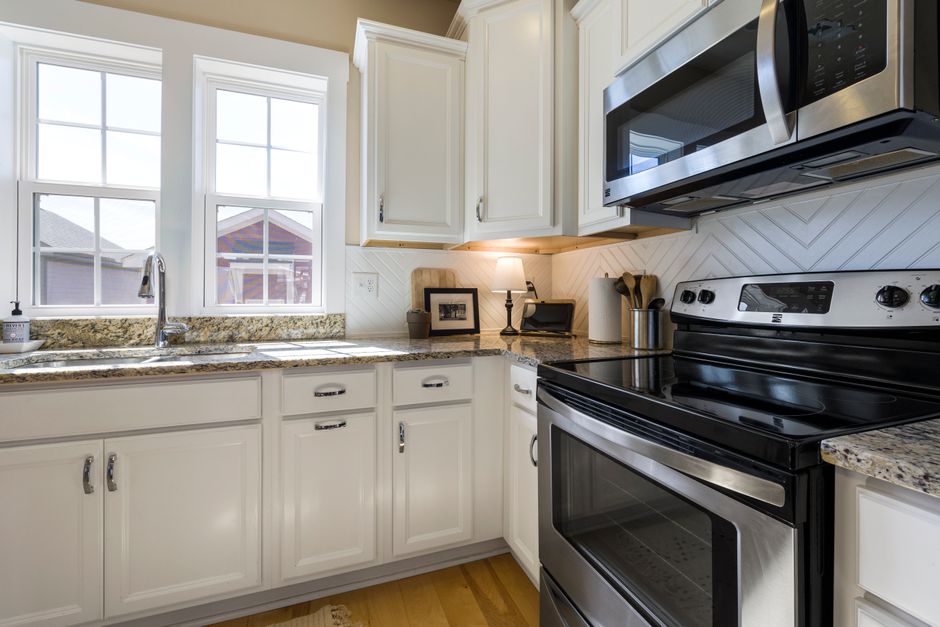

Kitchen cabinets take up more visual space than any other surface in the room, which is why they set the tone for everything around them. In a lot of south metro homes, the boxes themselves are solid and the layout works fine, but the finish has gone yellow, the hardware is dated, and the color belongs to a different decade. Replacing all of that means demolition, disposal, new boxes and new doors. Refinishing means keeping the cabinetry you already own and giving it a sprayed coating that reads like it came from a millwork shop.
We have been a family-owned cabinet painting company since 2005, with more than 20 years in the trade, and our crews are licensed, insured W-2 employees. No subcontractors, no rotating labor pool. If you are weighing cabinet painting in Denver CO against a full replacement, the sections below walk through the process, the cost math, the colors that are landing in 2026, and how to tell a cabinet specialist apart from a general house painter.
What “Factory Finish” Actually Means on Cabinets
A factory finish is not a marketing phrase. It describes how the coating is applied. Cabinets that come out of a production shop are sprayed in a controlled booth, usually with a hard, chemically cured topcoat, and they dry in a dust-free environment. Brushes and rollers cannot reproduce that. They leave stipple, lap marks, and a film thickness that varies from panel to panel.
Our version of a factory finish uses a low-VOC lacquer applied with spray equipment, not brushes or rollers. Cabinet frames get refinished on site, while doors and drawer fronts travel to our facility, where they are sprayed in a booth and cured before they come back to your kitchen. That split approach is standard for a real cabinet shop and it is one of the reasons the result holds up far better than a weekend DIY repaint.
Why Littleton, Centennial and Roxborough Cabinets Refinish So Well
Older suburban kitchens across Littleton, Centennial and Roxborough were largely built with oak and maple cabinet doors, and that is very good news for anyone considering refinishing. Oak and maple are dense, dimensionally stable hardwoods. They take primer evenly and hold a sprayed film without the bleed-through that softer or heavily grained woods can produce.
The common problem in these homes is not the wood. It is the factory finish from 1995 or 2003: an ambered clear coat, sometimes with a pickled or honey-oak stain underneath. That layer is what fails, not the door underneath it. Once the old coating is degreased, scuffed and sealed, the cabinet is essentially a fresh surface again.
Homes in Englewood and central Denver often present the opposite situation. You get 1920s to 1950s cabinetry with painted faces, multiple layers of old paint, and hardware that has been moved once or twice. Those kitchens need more prep and more repair, but the payoff is usually bigger because the cabinets are custom or semi-custom rather than builder grade. In every case, the decision to refinish should come down to whether the boxes are square, the doors are not swollen or delaminating, and the layout still works for you.
The Cabinet Painting Process, Step by Step
A finish that survives daily use in a busy kitchen is built in stages. Skipping any one of them is why so many homeowner repaints start peeling at the edges within a couple of seasons.
Degreasing and Documentation
Kitchen cabinets live under a film of cooking oil, hand oils and household cleaner residue, and none of it is visible. Every surface gets degreased before anything else happens. At the same time, we photograph the kitchen, label each door and drawer front, and note existing damage so nothing gets lost or mixed up during the days it spends off site. You get photo proof of the kitchen at each stage.
Sanding, Repairs and Surface Profile
Glossy factory finishes do not accept new coatings well, so each door and frame is sanded to create a mechanical profile the primer can grip. This is also when we handle the practical repairs: dings, split corners, failed caulk lines, loose hinges, and screw holes from hardware that is being replaced. Filling and shaping happens before primer, never after.
Priming for Adhesion
Bare wood, stained wood and previously painted surfaces all behave differently, so the primer choice matters. The goal is a sealed, uniform surface that stops tannins and old stain from bleeding through the topcoat and gives the lacquer something to bond to. A blotchy primer coat will show through even a dark color, which is why thin, even coverage matters more than speed here.
Spraying the 2K Lacquer
The topcoat is where the finish earns its durability. A 2K lacquer cures through a chemical reaction rather than simply drying, producing a hard, smooth film that resists moisture, grease and cleaning products far better than standard wall paint. Doors and drawer fronts are sprayed flat in a booth, which is the only way to get an even coat across the whole panel with no brush marks, no roller texture and no drips running down a vertical face.
Curing and Reinstallation
Lacquer needs time to cure before it is handled and loaded with hardware. Once the film has set, we reinstall doors and drawer fronts, adjust hinges so gaps are consistent, and mount new pulls if you are changing them. A typical project starts on a Monday with doors coming off and finishes by Friday, though larger kitchens or heavy repair work can run longer. Final cure continues for a period after installation, and we tell you exactly how long to keep the kitchen light on use and when to clean the surfaces.

Cabinet Painting Cost Compared With Cabinet Replacement
Refinishing costs roughly 60 to 70 percent less than replacing cabinets with comparable quality. That gap is not a gimmick. With replacement, you are paying for new boxes, doors, drawer fronts, hardware, delivery, demolition, disposal and the labor to install all of it, and you may also be paying for countertop work if the new layout does not match the old footprint.
Refinishing keeps the boxes and the countertops. Labor is concentrated in prep, spraying and reinstallation, and material cost is a fraction of new millwork. Every project is different, so the only number that means anything is a written estimate based on your actual cabinet count, condition and door style.
| Factor | Cabinet Refinishing | Full Cabinet Replacement |
|---|---|---|
| Relative cost | About 60 to 70 percent lower | Higher, plus installation and disposal |
| Disruption | Typical job runs about five days | Weeks of demolition and installation |
| Kitchen usability | Frames stay in place, contents can stay nearby | Kitchen typically unusable during work |
| Material waste | Existing boxes and doors are reused | Old cabinetry is torn out and hauled away |
| Layout changes | Not possible | Possible |
| Best suited to | Sound boxes, dated finish | Failing boxes or a full redesign |
Spray Versus Brush in Colorado’s Dry Climate
Colorado’s low humidity is hard on film coatings. Water evaporates out of paint quickly, and a brushed or rolled film can flash off unevenly, which leaves visible lap lines and a thinner film at the edges where the brush lifted off. Those thin edges are exactly where chipping and peeling begin.
A sprayed 2K lacquer cures chemically instead of relying on water to leave the film, so the dry air is far less of a problem. You also get a uniform film thickness across the entire panel rather than heavy spots in the middle and thin spots at the corners. That consistency is the difference between a finish that looks good on install day and one that still looks good after several years of wiping down grease and spills.

Cabinet Colors Trending for Denver Metro Kitchens in 2026
The cool gray era is closing out. Kitchens in Denver, Littleton and Centennial are moving warmer and more natural, and the palettes showing up in new builds and remodels reflect that shift.
- Warm whites and soft off-whites, which stay bright without the blue cast older whites can develop.
- Warm gray-greige tones that read neutral against quartz and tile instead of fighting them.
- Muted earthy greens, often paired with natural wood or brass hardware.
- Deep, saturated blues and near-blacks reserved for islands and lower cabinets.
- Natural rift sawn white oak looks, which have moved from a niche millwork spec into one of the most requested finishes for Denver kitchens.
Two-tone layouts remain popular, with a lighter perimeter and a darker island, and they photograph well for resale. If you are refinishing rather than replacing, your existing door profile shapes the result more than the color does. A raised-panel oak door in a warm white looks traditional and handsome; a flat slab door in the same color reads modern. Bring photos of your kitchen and we can talk through how a specific color will land against your floors, counters and light.
Cabinet Specialist or General House Painter?
Both can paint a wall. Cabinets are a different trade. A general painter is usually set up for large, flat, vertical surfaces using brushes, rollers and airless sprayers, and the products are formulated for drywall, not for a surface that gets opened, closed and wiped down every day.
A cabinet specialist brings different equipment and a different sequence. Doors come off and go to a booth. Frames are masked and sprayed in place. Coatings are chosen for hardness and chemical resistance rather than for how easily they touch up. Hardware holes get filled, hinges get adjusted, and the job is measured by how the doors close and how the finish looks three years later, not how it looks at the walkthrough.
Ask any painter you interview how many cabinet projects they completed last year, what product they spray, and whether they have a spray booth. If the answer involves a brush and a can of wall paint, that is a repaint, not a refinish.
How to Choose a Cabinet Painter in Denver CO
The Denver market has national franchises, local shops and one-person operations, and review counts alone will not tell you which is right for your kitchen. These questions separate the serious bids from the rest:
- Confirm licensing and insurance, and ask whether the crew is employed or subcontracted. A company that sends a different crew every day loses quality control.
- Ask exactly what product goes on the cabinets. A specific lacquer or cabinet coating is a good sign; a vague answer about “premium paint” is not.
- Ask whether doors and drawer fronts are sprayed in a booth off site. On-site-only spraying in a lived-in kitchen rarely produces a factory result.
- Get the warranty in writing, including what it covers and how long it lasts.
- Ask what prep is included: degreasing, sanding, repairs, caulk, and hardware holes.
- Request photos of finished kitchens, and confirm the estimate is fixed rather than an hourly range.

Serving Denver, Littleton, Centennial, Englewood and Roxborough
Our service area covers Denver, Littleton, Centennial, Englewood and Roxborough, CO, and every project runs with the same dustless system and a W-2 crew that shows up when scheduled. Whether your kitchen is a 1950s brick ranch in Englewood, a two-story in Centennial, a foothills-adjacent home in Roxborough or a bungalow in Denver, the process does not change: degrease, sand, prime, spray, cure, reinstall, and document each stage with photos.
Call or text for a fast free quote at cabinetpaintingdenver.net. You get a factory spray finish, photo proof on every kitchen, and a 5-year warranty in writing.
Frequently Asked Questions
How long does a cabinet painting project take?
A typical job finishes in about five days. We usually start on a Monday by picking up the doors and drawer fronts, work through prep and spraying during the week, and finish by Friday with doors reinstalled and hinges adjusted. Larger kitchens, heavy repair work or extensive trim can extend the schedule. We give you a realistic timeline with your written estimate before any work begins.
Is refinishing really cheaper than replacing cabinets?
Yes, and the gap is significant. Refinishing generally costs about 60 to 70 percent less than replacing cabinets with comparable quality, because you keep the existing boxes and doors and pay mainly for prep, spraying and reinstallation. Replacement adds new millwork, delivery, demolition, disposal and installation labor. The exact figure depends on your cabinet count, door style and condition, so a written on-site estimate is the only reliable number.
Do you paint the cabinet frames on site?
The frames stay in place and are refinished on site, which protects your countertops, tile and flooring from removal damage. Doors and drawer fronts are removed, transported to our facility and sprayed flat in a booth. That combination gives the frames a smooth in-place finish and gives the doors the even, factory-grade coating that is difficult to achieve spraying vertically in a lived-in kitchen.
What cabinet colors are popular in Denver for 2026?
Warmer and more natural tones are leading. Warm whites and soft off-whites, warm gray-greige neutrals, muted earthy greens, and deep blues or near-blacks on islands are all common requests. Natural rift sawn white oak looks have also moved from a niche spec into one of the most requested finishes for Denver kitchens. Two-tone layouts with a lighter perimeter and darker island remain strong.
What warranty comes with the work?
Our workmanship is backed by a 5-year warranty, and we are a licensed and insured company using W-2 employees rather than subcontractors. We also photograph every kitchen throughout the project so you have a record of the prep and the finished result. Full warranty terms are provided in writing with your estimate, so you know what is covered before the first door comes off.