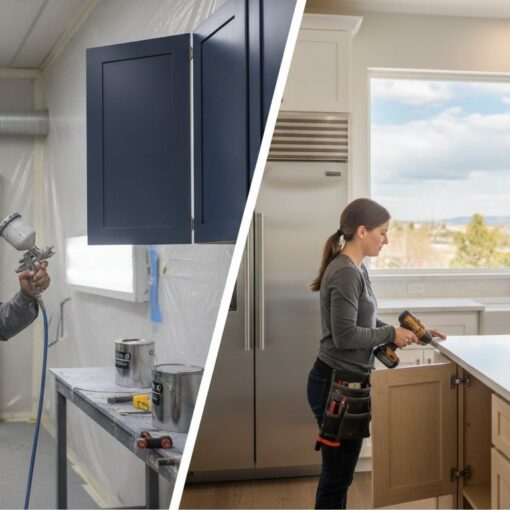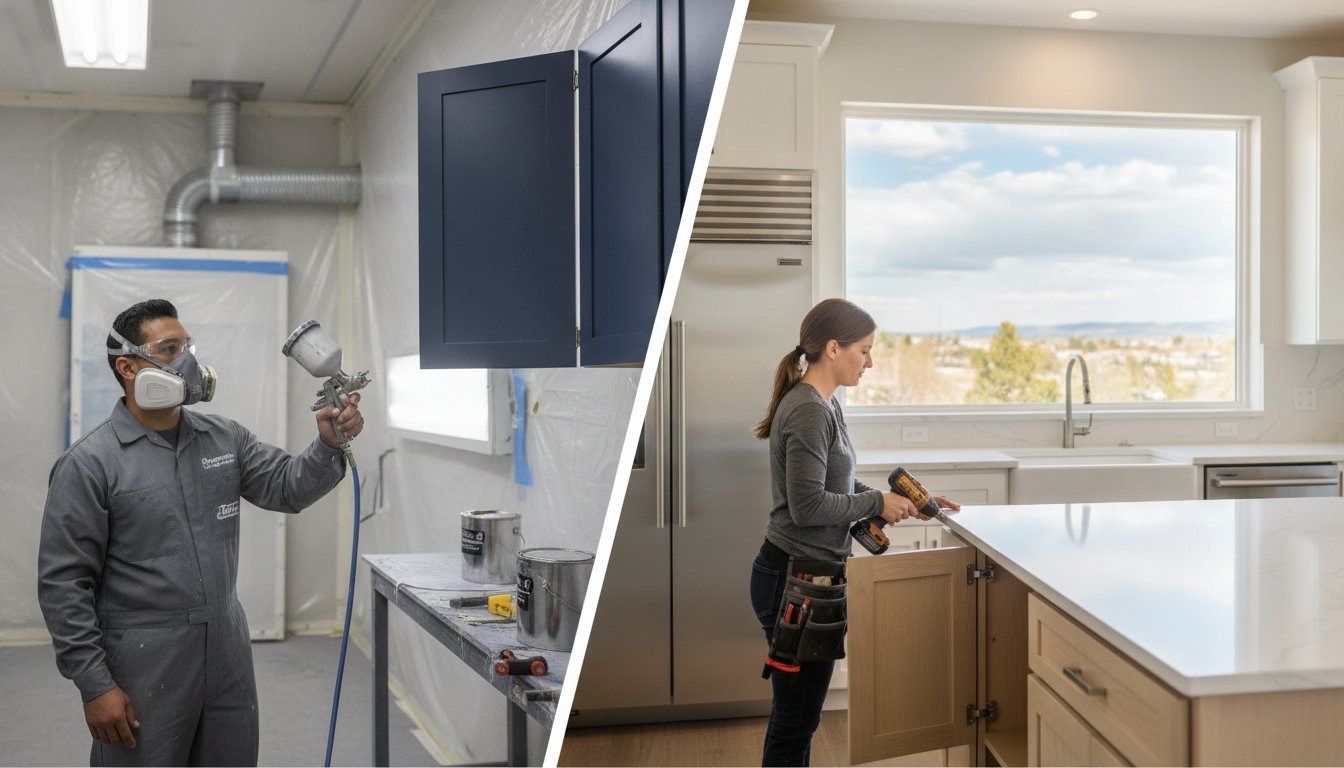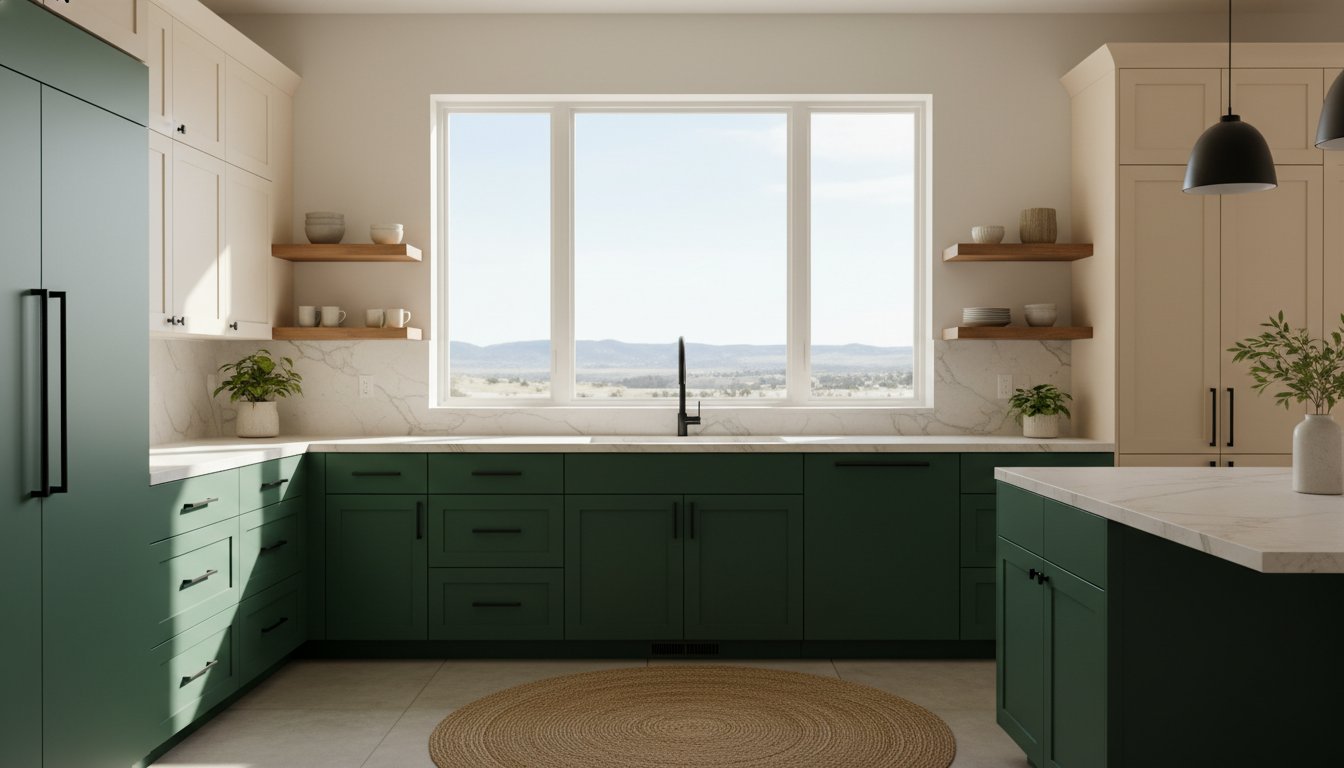

The best way to paint kitchen cabinets in Denver is a spray-applied, factory-style finish using a bonding primer and a two-component polyurethane topcoat, cured in a controlled spray booth. This method beats brush-and-roller work done in place for two Denver-specific reasons. The dry, high-altitude air changes how primers and coatings cure, and the Front Range temperature swings punish any finish that was not prepped and sprayed correctly.
Table of Contents
- Why does Denver's dry climate and altitude change how cabinets get painted?
- Is brushing and rolling cabinets as good as a professional spray finish?
- What is the step-by-step professional process for a factory finish?
- What mistakes cause cabinet paint to chip and peel in Colorado homes?
- How long does a professional cabinet finish last, and what does it cost compared to replacing?
- How does Cabinet Painting Denver deliver a factory finish for Front Range homes?
- Which Denver neighborhoods and suburbs does this service cover?
- Frequently asked questions about painting kitchen cabinets in Denver
- Key Takeaways
- References
Why does Denver’s dry climate and altitude change how cabinets get painted?
Denver's average humidity sits far below what most paint manufacturers assume, so water-based products flash off too fast to level out. That fast drying leaves brush marks, orange peel, and weak film build. A coating that looks smooth on a humid coastal test panel can look rough on a cabinet door in Cherry Creek.
At roughly 5,280 feet, lower air pressure changes solvent evaporation. Coatings that are not formulated for altitude can trap bubbles or cure unevenly. According to Denver Cabinet Coatings, local refinishing requires a solid color factory finish designed for everyday wear, not just a standard paint job.

Winter indoor heating drops humidity even further. Summer temperature swings between morning and afternoon shift cure times dramatically. A product that cures in eight hours on a mild day may still be soft the next morning after a cold night.
Prep work matters more in Denver than in humid markets. Grease, cooking residue, and old silicone must come off completely or the new finish will fail. Project Paint notes that degreasing and bonding primers are standard steps for high-traffic kitchens in the Denver metro.
The practical takeaway for Front Range homeowners is that products and dry times must be chosen for Colorado. A tutorial written for a coastal kitchen will not account for the altitude and dry air that define cabinet painting here.
Is brushing and rolling cabinets as good as a professional spray finish?
No. Brush-and-roller application leaves texture, lap marks, and visible direction changes, especially on raised-panel and shaker doors. The finish can look acceptable from across the room but shows flaws up close.
A spray booth applies an even, thin, uniform coat that mimics the factory finish on new cabinets. There is no brush texture in the corners or profiles. Project Paint describes using tough enamel or lacquer-style cabinet coatings for a reason: they level out when sprayed and harden into a smooth film.
In-place brushing means uneven coverage and visible overlap. Spraying in a booth means doors and drawers come off, get sprayed flat, and dry without runs. Denver Cabinet Coatings calls its sprayed result a solid color factory finish, not just paint.
DIY projects in Denver often fail not from bad paint but from skipping degreasing, sanding, and bonding primer. Those are the steps that make the finish stick. A homeowner can buy the same paint a pro uses and still get peeling within a year if the prep is wrong.
Homeowners in Cherry Creek, Hilltop, and Aurora Highlands typically want a finish that looks original to the house. That look comes from a sprayed finish, not a brushed one. The difference is visible on cabinet door edges and inside panel profiles.
What is the step-by-step professional process for a factory finish?
Doors, drawers, and hardware come off first. Each piece gets labeled, and the doors and drawer fronts go to a spray booth. The cabinet boxes are masked and prepped on site so the kitchen stays functional and clean.
Every surface is degreased, then sanded and scuffed. Degreasing removes cooking oils and hand oils. Sanding gives the bonding primer something to grip. Project Paint lists degreasing and bonding primers as core steps in its cabinet refinishing process.
A bonding primer goes on next. This is the step that prevents peeling on previously varnished or factory-finished cabinets. Without it, even a high-quality topcoat can lose adhesion on old lacquer or polyurethane.
The topcoats are a two-component polyurethane system. The category includes 2K polyurethane, Milesi, and Renner products, chosen for hardness and chemical resistance. These catalyzed coatings cure into a film that resists water, grease, and daily scrubbing.
Doors and drawers are sprayed flat in the booth, which lets the coating level out and dry without runs. 5280 Cabinet Coatings states that it has painted thousands of kitchens using a sprayed cabinet coating process.
Everything cures before reassembly. Hardware and doors go back on, and each door gets adjusted so it hangs straight and closes cleanly. The cure time is built into the schedule, not rushed.
What mistakes cause cabinet paint to chip and peel in Colorado homes?
Skipping degreasing leaves a film of kitchen grease that no primer can bond through. The finish lifts within a season, usually starting around the stove and sink. Project Paint identifies degreasing as a required step for durable cabinet refinishing.
Using a standard wall paint or a one-part enamel instead of a catalyzed cabinet coating means the finish never gets hard enough. Daily door slamming and drawer pulls chip the soft film. A two-component coating is the standard for a reason.
Painting over old silicone, caulk residue, or a glossy factory finish without sanding guarantees adhesion failure. The new coating sits on top of the slick surface and peels off in sheets. Sanding and scuffing break that gloss so the primer can grip.
Painting in a garage or driveway in Denver's dry air causes the coating to skin over before it levels. Solvent gets trapped under the skin, creating a soft, gummy film that never fully hardens. A controlled spray booth avoids that problem.
Reinstalling doors and drawers before the coating has fully cured leads to sticking, imprinting, and edge chipping. The finish may feel dry to the touch but still be soft underneath. Cure time in Denver's dry climate is not the same as cure time in a humid coastal market.
How long does a professional cabinet finish last, and what does it cost compared to replacing?
A properly sprayed 2K polyurethane finish on well-prepped cabinets typically holds up for a decade or more in a busy kitchen. The catalyzed topcoat resists grease, water, and daily wear far better than a one-part paint.
Cabinet painting in the Denver market generally runs a fraction of the cost of full cabinet replacement. 5280 Cabinet Coatings offers a 5 year warranty against paint peeling, which reflects confidence in the sprayed finish. Replacement involves new boxes, new doors, possible countertop and backsplash changes, and permitting or scheduling delays.
Refinishing keeps the existing layout and boxes, so the project is measured in days rather than weeks. There is no demolition, no countertop risk, and no need to move plumbing or electrical. Denver Cabinet Coatings has served the Denver to Colorado Springs corridor for over three decades with refinishing rather than replacement.
Homeowners in Lakewood, Littleton, Centennial, and Parker often choose refinishing specifically to avoid a full remodel timeline. The kitchen stays usable, and the disruption is limited to a few days of doors being off.
How does Cabinet Painting Denver deliver a factory finish for Front Range homes?
Cabinet Painting Denver is a family-run, licensed and insured shop with 20+ years painting the Denver metro. The team sprays in a booth rather than brushing on site, which is the core of a factory-style finish.
Kitchen cabinet painting and cabinet refinishing cover doors, drawers, and boxes with a bonding primer and a durable catalyzed topcoat. The process follows the same remove, degrease, sand, prime, spray, cure sequence that produces a smooth finish.
Cabinet staining is available for homeowners who want to keep a wood look rather than go solid color. Bathroom cabinet painting and refinishing handles the humidity and daily wear of bathroom vanities.
Swollen cabinet door repair fixes water-damaged doors before finishing. Color matching and consultation helps pick a shade that fits the home. Low-VOC and non-toxic coating options are available for households with kids, pets, or chemical sensitivities, and estimates and scheduling are free.
Which Denver neighborhoods and suburbs does this service cover?
Cabinet Painting Denver works throughout Denver, Aurora, Lakewood, Littleton, Centennial, and Parker. Specific Denver neighborhoods served include Cherry Creek, Hilltop, and the Denver Tech Center area, plus Aurora Highlands.
Local experience matters because the same dry-climate prep and cure rules apply whether the home is a 1920s bungalow in Hilltop or a 1990s build in Parker. A shop that understands Front Range altitude and humidity will schedule cure times correctly.
Homeowners can call 303-591-2089 for a free consultation and project scheduling.
Frequently asked questions about painting kitchen cabinets in Denver
How long does it take? Most kitchens take several days from tear-down to reinstall, with cure time built in before doors go back on. The exact schedule depends on kitchen size and the coating system used.
Can you paint oak cabinets? Yes. Oak's open grain needs filling and a bonding primer, and the sprayed topcoat seals the grain for a smooth finish. Project Paint includes oak cabinet refinishing in its Denver metro services.
What is the most durable paint for cabinets? A two-component polyurethane system such as 2K polyurethane, Milesi, or Renner, sprayed and fully cured. These catalyzed coatings are harder and more chemical-resistant than one-part paints.
Is it worth painting versus replacing in Denver? For most homeowners, yes. Refinishing costs far less than replacement and keeps the existing layout and countertops. Denver Cabinet Coatings has built a three-decade business on refinishing as the practical alternative to replacement.
Key Takeaways
- The best way to paint kitchen cabinets in Denver is a spray-applied bonding primer plus a two-component polyurethane topcoat, cured in a booth.
- Denver's low humidity and 5,280-foot altitude change how primers and coatings dry, so products and cure times must be chosen for Colorado.
- Brush-and-roller application leaves texture and lap marks; spraying doors and drawers flat in a booth produces a factory-style finish.
- The pro process is remove, degrease, sand, bonding primer, spray 2K polyurethane or Milesi or Renner, cure, then reinstall.
- The most common causes of chipping and peeling are skipped degreasing, wall paint instead of catalyzed coating, and reinstalling before full cure.
- A properly sprayed cabinet finish typically lasts a decade or more and costs far less than replacing cabinets in the Denver market.
- Cabinet Painting Denver is a family-run, licensed and insured shop with 20+ years in the Denver metro, offering free estimates at 303-591-2089.
References
- Project Paint Denver — Interior and Cabinet Painting, Project Paint Denver
- Denver Cabinet Coatings — Denver Cabinet Coatings
- 5280 Cabinet Coatings — 5280 Cabinet Coatings | Cabinet Painting | Refacing
- Painting Kitchen Cabinets Gray: The Professional Guide for Denver Homeowners — Cabinets Refinishing
- When to Paint your cabinets in Denver and not Replace them — YouTube