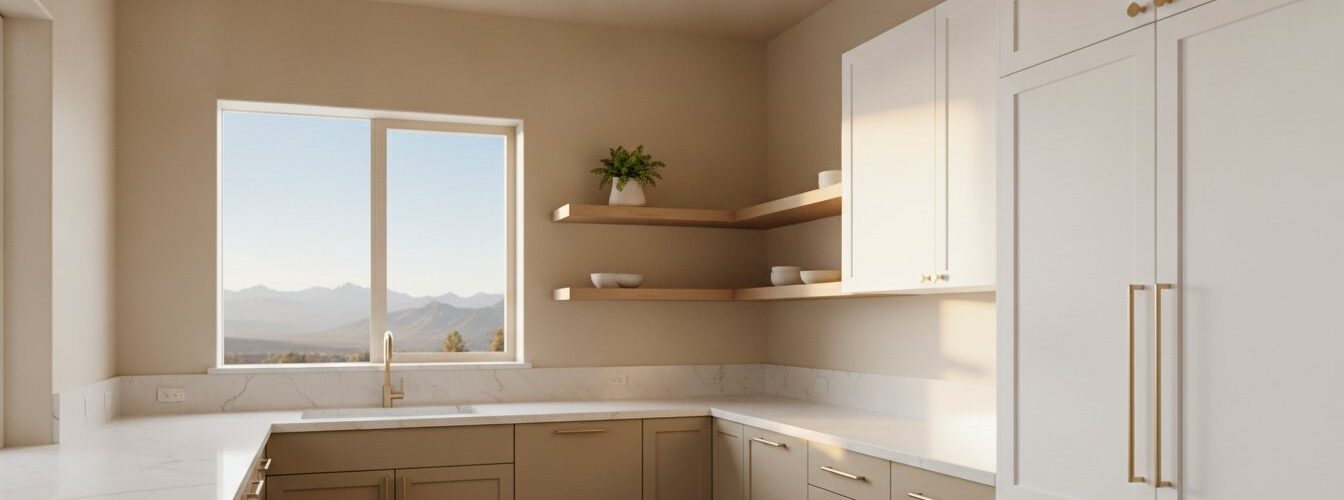
A cramped kitchen isn’t a square footage problem; it’s a light management problem. You likely feel the walls closing in when dark, heavy cabinets absorb what little natural light reaches your counters. Making a small kitchen look bigger with paint requires more than just picking a lighter shade from a swatch. It involves a systematic approach to surface reflection and color continuity that changes how your eyes perceive the room’s boundaries.
Cabinet Painting Service Areas in Denver & Surrounding Cities, Cabinet Refinishing in Denver County, Boulder CO,
Arvada, CO, Wheat Ridge, CO,
and Castle Pines CO. Englewood CO. Castle Rock CO, Centennial CO.
Cabinet Painting in Arapahoe County, CO
Including Centennial, CO, Greenwood Village, CO,
Cherry Hills Village, CO,
and Aurora, CO.
It’s frustrating to work in a space that feels cave-like, especially when budget constraints prevent a full structural renovation. This 2026 guide provides a clear plan for transforming your kitchen into a bright, open environment through professional cabinet painting. You’ll learn how specific Light Reflectance Values and factory-smooth finishes maximize every square inch of your room. We’ll cover the best color palettes for Denver homes and the technical strategies that ensure a modern, expansive result.
Key Takeaways
- Utilize Light Reflectance Value (LRV) data to select colors that scientifically expand spatial perception in rooms with limited natural light.
- Explore monochromatic color strategies for making a small kitchen look bigger with paint by eliminating visual breaks between cabinets and walls.
- Identify the optimal paint sheens that enhance light distribution and learn why professional Cabinet Refinishing provides the factory-smooth surface needed to maximize reflection.
- Implement the “5th Wall” technique and the “Continuous Line” method to visually lift ceilings and elongate cramped countertops.
- Adjust your color palette for Denver’s high-altitude sunlight to maintain a bright, airy atmosphere while avoiding clinical or sterile undertones.
The Science of Space: How LRV and Paint Colors Alter Perception
Space perception in a kitchen isn’t fixed. It’s a calculation of how surfaces reflect light. When homeowners focus on making a small kitchen look bigger with paint, they often overlook the technical data behind the color. Light doesn’t just hit a wall; it bounces or gets absorbed. Cabinet Painting Denver leverages this physics to manipulate the room’s boundaries by controlling how much light stays in the environment.
Understanding Light Reflectance Value (LRV)
LRV is a scale from 0 to 100 that measures the percentage of light a paint color reflects. A value of 0 represents absolute black, while 100 represents pure white. For compact kitchens, the target is usually a value above 75. A shift of just 10 points can be the difference between a cabinet that feels like a heavy block and one that seems to dissolve into the wall. You can find these numbers on the back of professional paint swatches or within manufacturer technical data sheets. Using high LRV coatings ensures that every bit of natural or artificial light is pushed back into the room rather than trapped by the pigment.
The "Receding Color" Effect
Colors don’t just sit on a surface; they move visually. Cool tones like soft grays, pale blues, and crisp whites are receding colors. They appear further away from the eye than they actually are. In contrast, warm tones like reds or deep yellows advance, making walls and cabinets feel closer. To maximize space, use desaturated, cool-toned colors. These shades lack heavy pigments that draw the eye, creating a sense of visual depth. High-contrast palettes, such as dark lower cabinets with white uppers, can sometimes shrink a room by creating a hard horizontal line that chops the space in half. A more unified, low-contrast approach often yields a more expansive feel.
The quality of the coating matters as much as the color itself. Retail-grade paints often contain fillers that can dull the color’s purity and reduce its reflective potential. Professional-grade coatings, as applied by Cabinet Painting Denver, provide a factory-smooth finish. This level of smoothness is critical because it allows light to reflect evenly across the surface. A DIY brush-and-roller application creates micro-textures that trap light, whereas a sprayed finish ensures the high LRV of your chosen color performs at its maximum potential. This professional approach is a primary strategy for making a small kitchen look bigger with paint without changing the physical footprint of the home.
Expert-Approved Color Palettes for Compact Kitchens
Selecting the right palette is the most direct method for making a small kitchen look bigger with paint. Visual clutter is often the result of too many color transitions. When you use a monochromatic scheme, the eye travels across surfaces without interruption. This lack of visual "stops" tricks the brain into perceiving a larger area. Matching your cabinet color to your wall color is a professional technique that creates a seamless flow, effectively blurring the boundaries of the room. This approach removes the "box" effect common in tight layouts.
The All-White Kitchen: Timeless Expansion
Professionals frequently recommend Benjamin Moore Chantilly Lace or Simply White for their high Light Reflectance Values. Chantilly Lace is a clean white with almost no visible undertone. It’s ideal for windowless kitchens that rely on artificial light. Simply White offers a slight warmth that prevents a clinical feel. To avoid a flat appearance, layer these whites by using different sheens. A satin finish on the cabinets paired with a matte finish on the walls creates depth while maintaining the spatial benefits of a white-on-white room. This layering ensures the space feels intentional rather than unfinished.
Modern Neutrals: Grays, Taupes, and "Greiges"
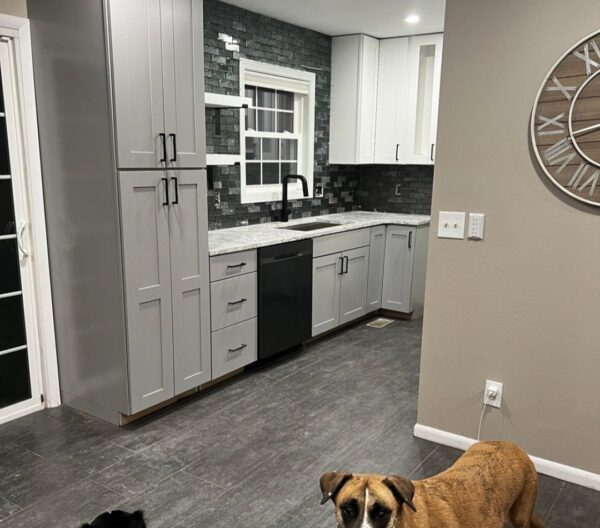
Light grays like Sherwin-Williams Repose Gray or soft "Mushroom" tones offer a sophisticated alternative to pure white. Sophisticated neutrals are a popular choice when making a small kitchen look bigger with paint while avoiding a purely sterile environment. These colors provide enough pigment to feel modern without absorbing too much light. The "Greige" family works well in small galleys because it balances cool and warm light throughout the day. If you prefer more visual weight, consider a "Tuxedo" look. Painting lower cabinets a slightly darker neutral while keeping upper cabinets and walls white helps ground the space without closing it in. This keeps the heaviest visual elements below eye level, which keeps the upper half of the room feeling airy.
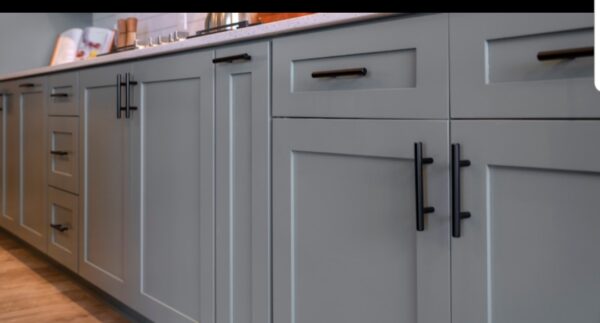
For homeowners considering these palettes, professional Cabinet Refinishing ensures these subtle tones are applied with factory-level precision. Achieving a perfect monochromatic look requires a surface free of brush marks or roller textures that can create unwanted shadows. A sprayed finish allows the light to glide over the cabinets, reinforcing the illusion of a larger kitchen. Balancing these neutral cabinets with modern, slim hardware also helps maintain a streamlined aesthetic that doesn’t overwhelm the limited square footage.
Beyond Color: The Role of Sheen and Professional Finish
Color determines the mood, but sheen determines the light’s behavior. In most compact layouts, cabinets occupy 60% to 80% of the visual field. This makes the finish level a critical component of making a small kitchen look bigger with paint. A flat finish absorbs light, which can make a room feel stagnant and enclosed. Conversely, a reflective surface acts as a secondary light source, bouncing illumination into every shadowed corner and creating an illusion of depth.
Selecting the Right Sheen Level
Satin is the professional standard for a modern, expansive glow. It offers enough reflection to brighten the room without highlighting every minor surface imperfection. Semi-gloss provides a more aggressive light bounce, which is helpful in galleys with limited window access. However, high-gloss should be used with caution. While it reflects the most light, the mirror-like effect can become visually distracting in a tight space. This can make the room feel cluttered with reflections rather than open and airy. Most homeowners find the best balance with a high-quality satin or semi-gloss finish.
The Sprayed vs. Brushed Advantage
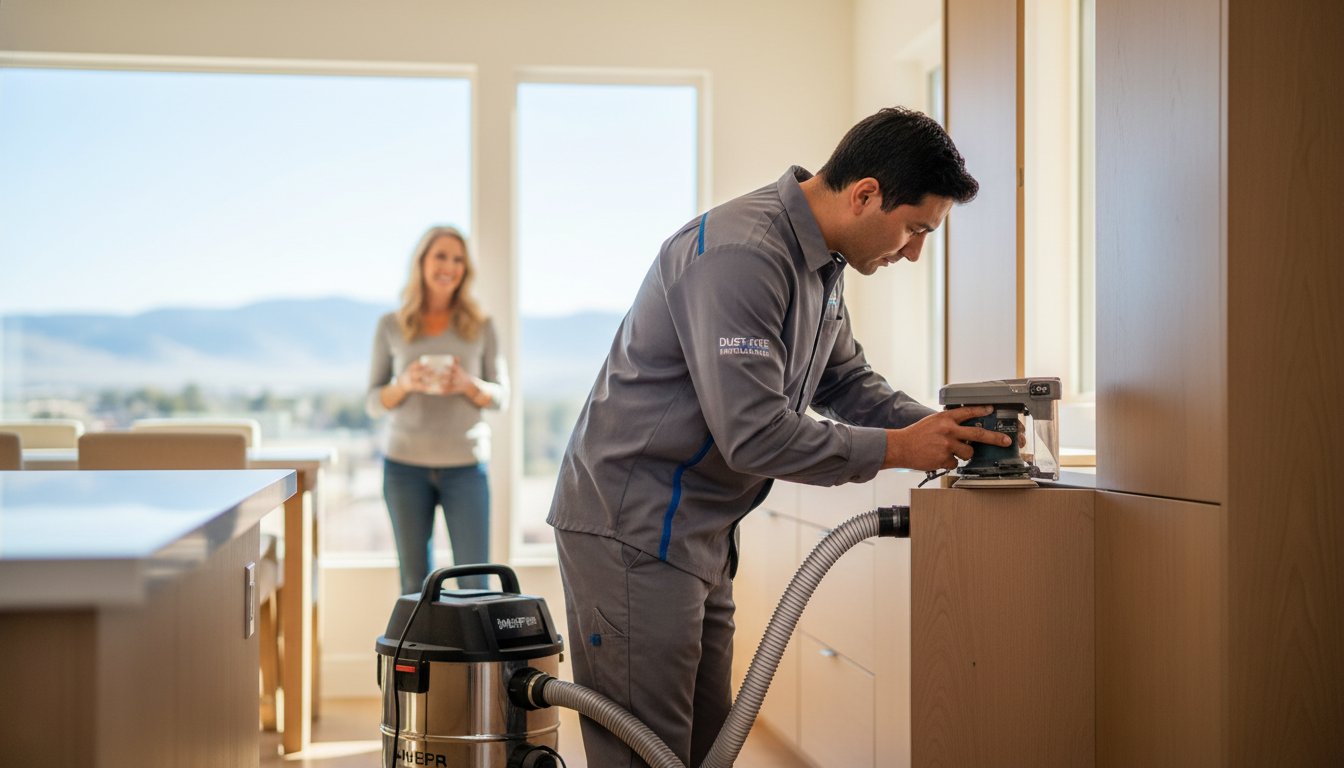
A factory-smooth finish is essential for spatial expansion. When you use a brush or roller, the resulting texture creates thousands of micro-shadows across the cabinet surface. These shadows break up the light and make the cabinets look heavy and textured. Professional Cabinet Refinishing utilizes off-site spraying to achieve a level 5 finish. This process creates a surface so smooth that light reflects with perfect uniformity. This "mirror effect" eliminates visual noise and helps the cabinetry recede into the background, which is a primary goal when making a small kitchen look bigger with paint.
Durability is also a major factor in high-reflectance finishes. Because these surfaces show more light, they also show more wear if the coating isn’t professional-grade. The specialized coatings used in Cabinet Painting are formulated for high-traffic environments. They resist the oils and moisture common in kitchens while maintaining their reflective properties over time. A smooth, durable finish ensures that the kitchen remains bright and easy to clean, preventing the space from feeling dingy or cramped as the years pass.
This focus on durability and light reflection shouldn’t stop at your cabinets; high-quality floor finishes, such as those provided by Elite Concrete Coatings, can also play a significant role in brightening a room and making it feel more expansive.

Strategic Painting Techniques to Elongate and Widen Your Space
Geometry plays a vital role in making a small kitchen look bigger with paint. Beyond the specific pigment chosen, the way that pigment is distributed across different planes determines the room’s perceived volume. By strategically placing color to guide the eye along long, uninterrupted paths, you can visually stretch a cramped floor plan. This stage of the process moves away from the science of light and into the psychology of architectural lines.
Lifting the Ceiling with Color
The ceiling is often referred to as the "5th wall," yet it is frequently ignored in small kitchen design. To create height, the ceiling should be painted one to two shades lighter than the walls. This subtle contrast makes the ceiling appear to recede upward. For an even more dramatic "Infinity Effect," continue the cabinet color through the crown molding all the way to the ceiling line. This eliminates the harsh horizontal break that usually occurs at the top of the cabinetry. If your kitchen has bulkhead gaps or soffits above the cabinets, painting them the same color as the boxes hides these architectural interruptions, making the walls look taller and more unified.
Creating a Seamless Visual Flow
Small kitchens often suffer from "visual noise," which is a collection of high-contrast breaks that stop the eye. To counter this, implement the "Continuous Line" technique. This involves blending the cabinet color with the backsplash or wall color. When the cabinets and the surrounding surfaces share a similar tone, the kitchen feels like one expansive unit rather than a collection of small parts. Professional cabinet refinishing is essential here to ensure the color on the wood perfectly complements the wall paint without the texture differences that DIY methods often produce.
- Vertical Grain: If your cabinets have a visible wood grain, refinishing them with a vertical orientation can draw the eye upward, adding to the sense of height.
- Hardware Integration: Painting hinges to match the cabinet face reduces small spots of high-contrast "noise" that can make a small surface feel cluttered.
- Island Strategy: Treat a central island as a piece of furniture by using a slightly different shade, or paint it to match the floor to make it "disappear" into the lower visual plane.
Executing these techniques requires a high level of precision to maintain the clean lines necessary for spatial expansion. If you are ready to transform your cramped layout into an open, modern space, request a professional consultation to see how these strategic painting methods can work in your home. Eliminating visual breaks is the most effective way to change the visual axis of your kitchen without moving a single wall.
Professional Cabinet Painting: The Denver Homeowner’s Secret
Denver’s unique geographic conditions present specific challenges for making a small kitchen look bigger with paint. At 5,280 feet, the atmosphere is thinner, and the sunlight is significantly more intense than at sea level. This high-altitude UV exposure doesn’t just affect skin; it alters how paint pigments appear and how they degrade over time. Local expertise is required to select coatings that maintain their color purity and reflective properties in Colorado’s notoriously dry climate. Maintaining a high Light Reflectance Value (LRV) is only possible if the coating can withstand the local environment without yellowing or dulling.
Accounting for Colorado’s Unique Light
The light in Denver often carries a cool, blue temperature, especially during the bright afternoons. If you choose a white with cool undertones for a North-facing bungalow, the room can end up feeling icy and uninviting. Homeowners in neighborhoods like Wash Park or the Highlands often prefer warm-toned whites to balance this blue light. Testing swatches in your specific kitchen is essential because the high-altitude sun can make a color look two shades lighter than it appeared in the store. This intensity can wash out subtle neutrals, so picking a color with the right saturation is critical for spatial expansion.
The Value of Professional Execution
In the competitive Denver real estate market, the quality of a kitchen’s finish directly impacts home value. While a weekend DIY project might seem cost-effective, it often results in visible brush strokes and uneven sheen that highlight a kitchen’s small footprint. Choosing cabinet painting in Denver ensures a factory-smooth finish that handles light with surgical precision. Professional spraying eliminates the texture that traps shadows, allowing the chosen color to perform its job of expanding the room’s boundaries.
A professional cabinet painter’s results are also better suited for Colorado’s low humidity. Retail paints can dry too quickly in our climate, leading to "orange peel" textures or cracking. Professional-grade coatings are formulated to cure properly in dry air, maintaining a durable, high-reflectance surface for years. This technical approach is the most efficient way of making a small kitchen look bigger with paint while modernizing older Denver homes or compact downtown condos. To begin your transformation, a professional consultation can help determine the best color and sheen for your home’s specific lighting conditions.
Transform Your Kitchen Boundaries Today
Light management and professional execution are the technical foundations of spatial expansion. You now have a clear plan to prioritize colors with high Light Reflectance Values and implement strategic techniques like the "5th Wall" method to eliminate visual clutter. These choices ensure your kitchen feels open and modern rather than boxed in by dark cabinetry or inconsistent finishes. By focusing on how light interacts with your surfaces, you can change the entire atmosphere of your home.
Achieving these results requires a level of precision that only professional Cabinet Painting can provide. Making a small kitchen look bigger with paint is a technical process that relies on a factory-smooth sprayed finish to bounce light evenly across every surface. Our team serves the entire Denver Metro area with a detailed preparation process and high-durability coatings designed specifically for Colorado’s unique climate conditions. This professional approach ensures your kitchen remains bright and durable for years to come.
You don’t need a full remodel to enjoy a kitchen that feels airy and expansive. Request a Free Professional Cabinet Painting Quote in Denver today to see how professional refinishing can transform your home. We look forward to helping you maximize your kitchen’s potential and increase your home’s value.
Frequently Asked Questions
Does white paint always make a small kitchen look bigger?
White paint is highly effective, but its success depends on the Light Reflectance Value (LRV) and the room’s specific lighting. For homeowners focused on making a small kitchen look bigger with paint, a pure white can sometimes feel sterile if it lacks the right undertones. In Denver, the intense sunlight often washes out whites, so selecting a shade with subtle warmth creates a more expansive and inviting feel than a cold, stark white.
Should I paint my upper and lower cabinets the same color in a small space?
Using the same color for upper and lower cabinets is the most effective way to eliminate visual noise in a tight layout. A monochromatic scheme allows the eye to move across the room without interruption. While tuxedo cabinets are a popular style, a single, light color for all cabinetry creates a seamless flow that makes the walls feel further apart and the ceiling appear higher.
What is the best paint finish for small kitchen cabinets?
Satin is the professional standard for compact kitchens. It provides a soft, expansive glow that reflects light without the distracting glare of a high-gloss finish. A factory-smooth sprayed surface is essential because it ensures light bounces evenly across the cabinets. This uniformity is much more effective for spatial perception than a brushed finish, which creates micro-shadows that can make a small room feel cluttered and heavy.
Can dark colors ever work in a small kitchen?
Dark colors work if they are used strategically, such as on lower cabinets or as a focused accent. However, they absorb light rather than reflecting it, which can make a small space feel more enclosed. If you choose a darker palette, it’s vital to pair it with high-LRV walls and excellent artificial lighting. For most small kitchens, lighter tones remain the safer choice for creating an airy, open atmosphere.
How much does it cost to professionally paint cabinets to save space?
The cost of Cabinet Refinishing depends on several factors, including the number of doors, the current condition of the wood, and the complexity of the layout. Professional refinishing is significantly more cost-effective than a full kitchen remodel or cabinet replacement. This investment focuses your budget on high-quality coatings and factory-smooth finishes that provide a modern look while maximizing the perceived square footage of your existing kitchen footprint.
Will painting my kitchen cabinets increase my home’s resale value?
Professional Cabinet Painting provides one of the highest returns on investment for kitchen updates. Modern, bright cabinetry is a top priority for buyers in the Denver real estate market. A factory-quality finish suggests a well-maintained home and allows potential buyers to envision themselves in a clean, open space. Choosing professional execution over a DIY project ensures the durability and aesthetic quality needed to actually boost your home’s market value.
How long does the professional cabinet painting process take?
The professional process typically takes about one working week to complete. This timeline includes detailed preparation, off-site spraying of doors and drawers for a factory finish, and on-site painting of the cabinet frames. This efficient schedule allows you to transform your kitchen’s appearance with minimal disruption to your daily routine. By using specialized drying techniques, the cabinets are ready for full use shortly after the final installation is finished.
Do I need to paint my kitchen walls if I am refinishing the cabinets?
You don’t have to paint your walls, but doing so often enhances the spatial benefits of your new cabinets. Matching your wall color to your cabinets creates a "continuous line" that blurs the boundaries of the room. This technique is a secret weapon for making a small kitchen look bigger with paint. If the walls and cabinets are different colors, the high contrast can make the room feel choppy and visually smaller.