A professional cabinet finish is not just a layer of paint; it is a factory-grade architectural coating designed to match the structural lifespan of your cabinetry. Many homeowners ask exactly how long does professionally painted cabinet finish last because they fear wasting money on a surface that might chip or peel within months. You are likely weighing the high cost of a total kitchen replacement against the anxiety of a temporary fix. It’s frustrating to feel stuck between an outdated kitchen and a massive renovation bill, especially when you require a durable surface that handles daily cleaning and heavy use.
Cabinet Painting Service Areas in Denver & Surrounding Cities, Cabinet Refinishing in Denver County, Boulder CO,
Arvada, CO, Wheat Ridge, CO,
and Castle Pines CO. Englewood CO. Castle Rock CO, Centennial CO.
Cabinet Painting in Arapahoe County, CO
Including Centennial, CO, Greenwood Village, CO,
Cherry Hills Village, CO,
and Aurora, CO.
The good news is that you don’t have to settle for a short-term solution. This guide identifies the specific technical factors that ensure your kitchen stays flawless for a decade or more. You’ll discover why professional spraying provides a durability that standard hardware store enamels cannot match. We will break down the performance differences between DIY materials and industrial 2K polyurethanes. This overview of professional standards will give you confidence that your investment provides long-term value and a finish that remains beautiful for 8 to 15 years.
Key Takeaways
- Learn exactly how long does professionally painted cabinet finish last when using industrial-grade coatings versus standard retail paints.
- Identify why professional spraying and off-site door preparation are critical for achieving a durable, factory-quality bond.
- Understand how Denver’s unique climate and humidity levels impact the long-term adhesion of your kitchen and bathroom cabinet finishes.
- Discover the maintenance habits and approved cleaning agents that can extend the life of your cabinets to 15 years or more.
- Evaluate the long-term return on investment by comparing the cost of professional painting to a full cabinet replacement.
How Long Should a Professional Cabinet Finish Last?
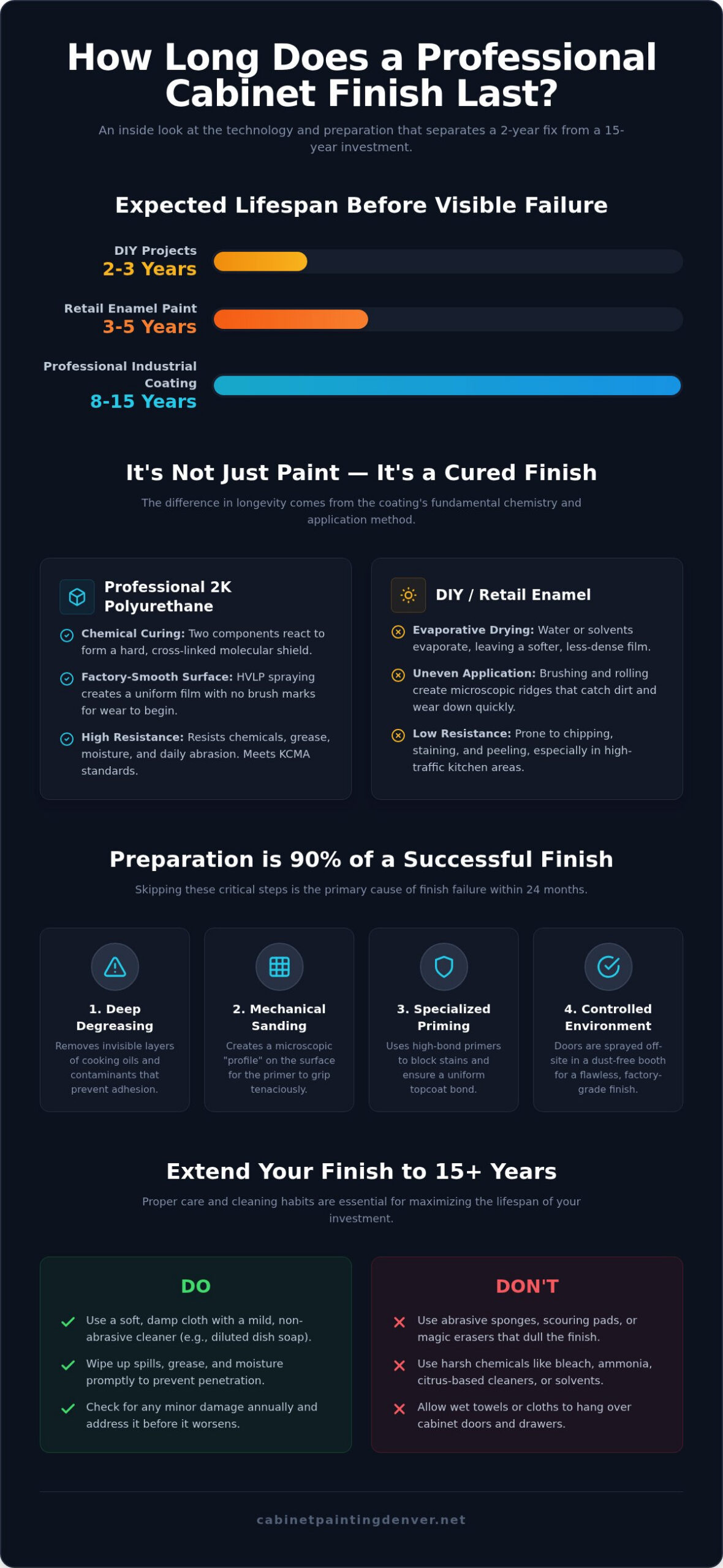
Homeowners often ask how long does professionally painted cabinet finish last before they commit to a kitchen update. A professional cabinet finish typically lasts between 8 and 12 years with proper care. This is a significant jump from DIY projects, which often show signs of failure like chipping or peeling within just 2 to 3 years. A professional finish is a factory-applied architectural coating rather than standard wall paint. It’s a specialized chemical bond designed for high-traffic surfaces. Standard lifespans for different approaches include:
- DIY Projects: 2 to 3 years before visible chipping occurs.
- Retail Enamel Paint: 3 to 5 years with moderate kitchen use.
- Professional Industrial Coatings: 8 to 12 years with standard maintenance.
The 8-to-12 Year Benchmark
Ten years is the industry standard for high-end cabinet refinishing. This lifespan depends on the quality of the original cabinet wood. Solid maple or oak provides a stable foundation for the coating, whereas lower-grade materials like MDF or particle board might expand and contract more aggressively with moisture changes. This stability prevents the finish from cracking at the joints. Professional finishes achieve a factory-smooth texture that eliminates the microscopic ridges found in brushed-on paint. These ridges are usually where wear and tear begin; a smooth surface allows objects to slide across without catching or abrading the finish. This physical smoothness is a requirement for long-term durability in high-traffic kitchens.
Why "Paint" is the Wrong Word for Longevity
The materials used by professionals are fundamentally different from hardware store latex paint. Industrial coatings utilize chemical cross-linking. This is a process where two components react to create a molecularly dense, hard surface. It’s a core part of the wood finishing process for cabinetry. Unlike retail paint that dries simply by evaporation, these coatings cure into a resilient shield that resists chemicals and grease.
Professional spraying is the key to this durability. Using high-volume, low-pressure (HVLP) equipment allows for a uniform film thickness across the entire surface. Brushing or rolling creates thick and thin spots. The thin spots wear through quickly, while the thick spots are prone to cracking. A sprayed finish ensures the coating behaves as a single, cohesive unit. This uniformity is why a professional job can withstand a decade of daily cleaning and kitchen activity. Understanding how long does professionally painted cabinet finish last helps homeowners see the value in choosing industrial-grade coatings over temporary retail solutions.
Factors That Determine Your Cabinet Finish Lifespan
Understanding how long does professionally painted cabinet finish last requires looking beneath the surface. Adhesion is the primary driver of longevity. While the topcoat provides the color, the chemistry of the coating determines if the finish stays attached for a decade or fails in a year. Industrial 2K polyurethanes are the preferred choice because they meet rigorous industry durability standards. These coatings utilize a chemical catalyst to create a cross-linked bond. This bond is significantly harder and more resistant to kitchen chemicals than 1K coatings, which dry simply through evaporation.
Usage patterns also dictate wear. Cabinets located near the stove, dishwasher, or sink encounter higher levels of heat and moisture. Trash pull-outs and silverware drawers experience the most physical contact. A professional finish is designed to withstand this localized stress, but these high-traffic zones are where the quality of the bond is tested most severely. Choosing a finish that can be wiped down easily is essential for these areas.
The Importance of Professional Preparation
Surface preparation accounts for 90% of a successful finish. Kitchen cabinets accumulate layers of invisible cooking oils and grease over time. If these contaminants aren’t removed through deep degreasing and mechanical sanding, the new coating will eventually peel. The professional process often includes:
- Deep Degreasing: Removing years of built-up oils that prevent paint adhesion.
- Mechanical Sanding: Creating a "profile" on the wood surface for the primer to grip.
- Specialized Primers: Using high-bond, stain-blocking primers to prevent tannin bleed from wood like oak.
- Off-site Spraying: Processing doors in a controlled environment to ensure a dust-free, factory finish.
Skipping these steps leads to finish failure in less than 24 months. Without proper prep, the paint sits on top of the grease rather than bonding to the wood fibers.
Environmental Impacts in Denver, Colorado
The local climate plays a significant role in how long does professionally painted cabinet finish last. Denver’s low humidity environment is beneficial for the initial curing process, allowing coatings to reach their full hardness quickly. However, the extreme temperature swings and dry air cause wood to expand and contract. This movement can put stress on the joints of cabinet doors, potentially leading to hairline cracks if the coating is too brittle. Cabinet Painting Denver accounts for local climate factors by selecting coatings that balance hardness with the flexibility needed to accommodate wood movement. Maintaining a consistent humidity level inside the home further protects the finish from environmental stress. If you want to ensure your kitchen withstands these local factors, consider the benefits of professional kitchen cabinet painting.
DIY vs. Professional Finish: The Durability Gap
The visual difference between a DIY project and a professional job is immediate, but the durability gap only becomes apparent after a few years of kitchen use. When considering how long does professionally painted cabinet finish last, the application method is a primary factor. DIY projects rely on brushes and rollers, which create an uneven surface profile. These tools leave behind microscopic peaks and valleys that are prone to wear. In contrast, professional spraying ensures a uniform film thickness across the entire cabinet. This uniformity prevents the finish from failing at thin points where friction and contact are highest.
A DIY job that requires repainting every 3 years quickly becomes more expensive than a professional application. Between the cost of premium retail materials, the time spent on labor, and the potential for surface damage during repeated sanding, the long-term ROI favors the professional route. Professional finishes are designed to survive the 8 to 12-year window without the need for frequent touch-ups or full recoating. This technical superiority is why the answer to how long does professionally painted cabinet finish last is measured in decades rather than months.
Tools of the Trade
Professional painters use high-volume, low-pressure (HVLP) sprayers to atomize the coating into a fine mist. This creates a factory-quality bond that is impossible to achieve with a brush. Brush-and-roller finishes are prone to a phenomenon called "blocking." This occurs when the paint remains slightly soft, causing doors to stick to the cabinet frames. Over time, this sticking pulls the paint away from the wood. Professionals avoid this by using off-site spraying in controlled, dust-free environments. These facilities allow the coating to cure under ideal temperature conditions, ensuring the finish reaches its maximum hardness before it returns to your home.
Chemical and Impact Resistance
The chemical resistance of a finish determines its true lifespan in a kitchen environment. Standard retail paints often soften when exposed to common household items like vinegar, lemon juice, or skin oils. Once the paint softens, it becomes susceptible to permanent scuffs and "burnishing." Industrial 2K polyurethanes are tested against these substances to ensure they remain inert. Unlike oil-based paints found at hardware stores, these professional coatings don’t yellow or become brittle over time. If you want to dive deeper into the specific products used by experts, read our guide on The Best Paint for Cabinets. Choosing the right chemistry is the only way to ensure your kitchen remains resilient against scratches and impact.
Maintenance Tips to Extend Your Finish to 15+ Years
While the quality of application determines how long does professionally painted cabinet finish last, your daily maintenance habits dictate whether that finish reaches the 15-year mark. Industrial coatings are chemically resistant, but they aren’t indestructible. Acidic food spills like tomato sauce, lemon juice, or wine can etch the protective topcoat if they remain on the surface for extended periods. Adopting a "clean as you go" rule prevents these substances from breaking down the chemical bonds of the finish. Wipe spills immediately with a damp cloth to maintain the factory-quality sheen and prevent permanent staining.
What to Avoid When Cleaning
Harsh chemicals are the primary enemy of architectural coatings. Avoid using bleach, ammonia, or heavy-duty degreasers that aren’t specifically labeled as safe for finished wood. These agents can strip the protective topcoat and leave the color layer vulnerable to grease and moisture. Instead, use a solution of mild dish soap and warm water. Apply this with a soft microfiber cloth rather than abrasive scouring pads. Abrasive pads create micro-scratches that dull the finish and trap dirt. Additionally, manage water exposure around high-moisture zones like sinks and dishwashers. Excess moisture that sits on the bottom edges of doors can lead to delamination, where the coating begins to lift from the wood substrate. Always wipe these areas dry after doing dishes or running a kitchen cycle.
Mechanical Wear and Hardware
Physical impact is a common cause of finish failure in high-traffic kitchens. Slamming cabinet doors creates localized stress at the contact points, which can lead to hairline fractures or chipping over time. Upgrading to soft-close hinges is a practical way to extend the life of your cabinet painting by eliminating these high-impact collisions. Ensure that cabinet handles and pulls remain tight. Loose hardware can wiggle and rub against the finish, causing circular abrasions that are difficult to repair. If you experience a minor accidental impact from a pot or pan, address the nick early. Professional services typically provide touch-up kits to seal these small openings. Sealing these nicks prevents moisture from penetrating the wood and causing the finish to bubble. For more details on maintaining your kitchen’s new look, consult our Cabinet Refinishing Guide. If you are ready to transform your space with a durable, long-lasting surface, contact Cabinet Painting Denver for a professional consultation.
Is It Worth It? Evaluating the Long-Term ROI
The financial benefit extends beyond the initial savings. A professionally applied coating matches the durability of factory-new cabinets. This means you aren’t sacrificing quality for price. You are simply choosing a more efficient path to a modern kitchen. When you calculate the cost per year of use, professional painting consistently outperforms both DIY attempts and full replacements. It provides the aesthetic of a high-end remodel for a fraction of the total budget.
Resale Value in Denver
The Denver real estate market remains highly competitive in 2026. Homebuyers prioritize kitchens that require zero immediate work. Modern, neutral cabinet colors like soft whites and deep charcoals are top priorities for local buyers because they create a clean, versatile aesthetic. A dated, oak-heavy kitchen can deter potential offers or lead to lower bids. By investing in a professional finish, you eliminate the psychological barrier of a "project house." Our professional cabinet painters provide a "new kitchen feel" at a fraction of the cost, ensuring your home stands out during tours.
Sustainability and the Environment
Refinishing is the most sustainable choice for a kitchen update. Many older homes in the Denver area feature high-quality solid wood cabinet boxes that are structurally superior to modern, mass-produced alternatives. Refinishing these boxes keeps bulky materials out of landfills and reduces the demand for new timber. Understanding how long does professionally painted cabinet finish last helps you appreciate the environmental value of these durable coatings. Professional coatings have evolved to meet strict environmental requirements. Modern 2K polyurethanes are now low-VOC while maintaining the extreme durability required for a 10-year lifespan. This evolution allows you to update your home without compromising indoor air quality or environmental values. You are preserving the legacy of the wood while giving it a modern, protective shield.
If you’re ready to secure a factory-quality finish that lasts, Get your free cabinet painting quote in Denver today.
Secure Your Kitchen’s Future with a Factory Finish
Investing in your cabinetry requires a balance of aesthetic appeal and long-term durability. Professional application using industrial-grade coatings ensures your surfaces withstand the rigors of daily kitchen activity for a decade or more. Understanding how long does professionally painted cabinet finish last is essential for making an informed investment in your home. Specialized preparation is the key to success. By prioritizing chemical cross-linking, you achieve a bond that resists grease, chemicals, and physical impact. Correct maintenance further protects this investment and keeps your space looking pristine.
Locally owned Denver experts provide the technical precision needed to account for Colorado’s unique climate and humidity levels. We utilize specialized industrial-grade coatings and professional spraying to provide a factory-smooth finish guaranteed to transform your kitchen or bathroom. You don’t have to endure the stress of a major remodel to get a brand-new look. Request Your Free Cabinet Painting Estimate in Denver to start your transformation today. Your kitchen is the heart of your home; it deserves a finish that stands the test of time.
Frequently Asked Questions
Does cabinet paint chip easily if done by a professional?
No, professional finishes use industrial-grade coatings that are significantly harder than standard retail paints. These coatings are chemically cross-linked to resist impact and abrasion. While no finish is indestructible, the bond created through professional spraying and proper preparation makes chipping unlikely under normal residential use. This durability is why many homeowners ask how long does professionally painted cabinet finish last before they commit to a kitchen update.
How long does it take for the cabinet finish to fully cure?
Most industrial coatings are dry to the touch within hours; however, a full chemical cure typically takes 7 to 14 days. During this period, the cross-linking process reaches its maximum density and hardness. You should treat the cabinets with extra care during these first two weeks. Avoid heavy cleaning or aggressive contact until the surface has reached its full structural integrity to ensure the finish remains flawless for its entire lifespan.
Can I clean my painted cabinets with regular kitchen degreasers?
You should avoid harsh or abrasive kitchen degreasers because they can etch the protective topcoat. Strong chemicals like ammonia or bleach break down architectural coatings over time. The best cleaning method involves using a soft microfiber cloth with a solution of mild dish soap and warm water. This gentle approach removes grease without compromising the chemical bond. Always wipe the surface dry to prevent moisture from sitting on the finish.
Is it better to paint or replace cabinets for long-term durability?
If your cabinet boxes are structurally sound, professional painting offers durability comparable to new factory-finished units. High-quality wood boxes often outlast modern, mass-produced replacements. Painting provides a factory-quality finish at a fraction of the total replacement cost. This allows you to achieve a 10-year lifespan without the waste or expense of a full demolition. It’s the most cost-effective way to update a high-traffic kitchen environment.
How does the Denver climate affect how long cabinet paint lasts?
Denver’s low humidity helps coatings cure faster, but the dry air also causes wood to contract. This movement puts stress on cabinet joints. Professionals in the Denver area select flexible industrial coatings that move with the wood rather than cracking. Maintaining a stable indoor humidity level between 30% and 50% helps protect the finish. This local expertise is a major factor in determining how long does professionally painted cabinet finish last in Colorado homes.
What happens if the paint starts to peel after a few years?
Peeling is usually a sign of failed surface preparation or the use of improper retail-grade materials. If a professional finish fails prematurely, it often indicates that oils or grease were not fully removed before the primer was applied. Professional services typically offer support to address localized issues. If you notice lifting or bubbling, contact your provider immediately. Addressing small areas early prevents moisture from penetrating the wood and causing wider delamination.
Do darker cabinet colors last longer than white or light colors?
The color itself doesn’t determine the physical durability of the coating. Both dark and light colors utilize the same industrial 2K polyurethane base, providing identical chemical resistance. However, darker colors may show dust or fingerprints more easily, while lighter colors highlight grease buildup or food stains. The longevity of the finish depends on the quality of the chemical bond and your maintenance habits rather than the specific pigment you choose for your kitchen.
Will a professional finish hide existing wood grain or damage?
A professional sprayed finish provides a smooth, uniform surface, but it won’t entirely hide deep wood grain like that found in oak. The texture of the grain remains visible under the coating unless a specific grain-filling process is performed. However, professional preparation includes filling minor nicks, scratches, and dents before the priming stage. This ensures the final architectural coating looks flawless and provides a brand-new feel regardless of the original condition of the wood.