Choosing the wrong shade of white can turn a premium kitchen renovation into a space that feels sterile, dated, or surprisingly yellow. According to the 2024 Houzz Kitchen Trends Study, 46% of homeowners select white for their cabinetry, yet many find themselves paralyzed by the 150 unique shades offered by major paint brands. You’ve likely spent hours staring at swatches, worried that your hard work will result in a cheap DIY look rather than the high-end aesthetic you see in magazines. It’s a valid concern, especially when a single mismatched undertone can make your expensive granite counters look dull or dirty.
This guide simplifies your decision by revealing the best white paint for kitchen cabinets based on 2026 designer trends and professional performance tests. You’ll learn how to select a hue that complements your existing flooring and discover the specific finishes that provide a factory-smooth, chip-resistant surface. We’re going to break down the exact formulas used by top-tier pros to ensure your kitchen transformation stays durable and beautiful for the next decade.
Key Takeaways
- Learn how to distinguish between warm, cool, and neutral undertones to find the best white paint for kitchen cabinets that complements your home’s unique lighting.
- Discover why the specific paint formula and sheen level are more vital for daily durability and cleaning than the actual color choice.
- Master the professional “Golden Rule” of coordination to ensure your cabinet white seamlessly matches fixed elements like countertops and flooring.
- Explore the 2026 designer-favorite shades from Sherwin Williams and Benjamin Moore that provide a timeless, high-end aesthetic.
- Understand why professional preparation and application are the secrets to achieving a smooth, factory-grade finish without visible brush strokes.
Finding the Best White Paint for Kitchen Cabinets in 2026
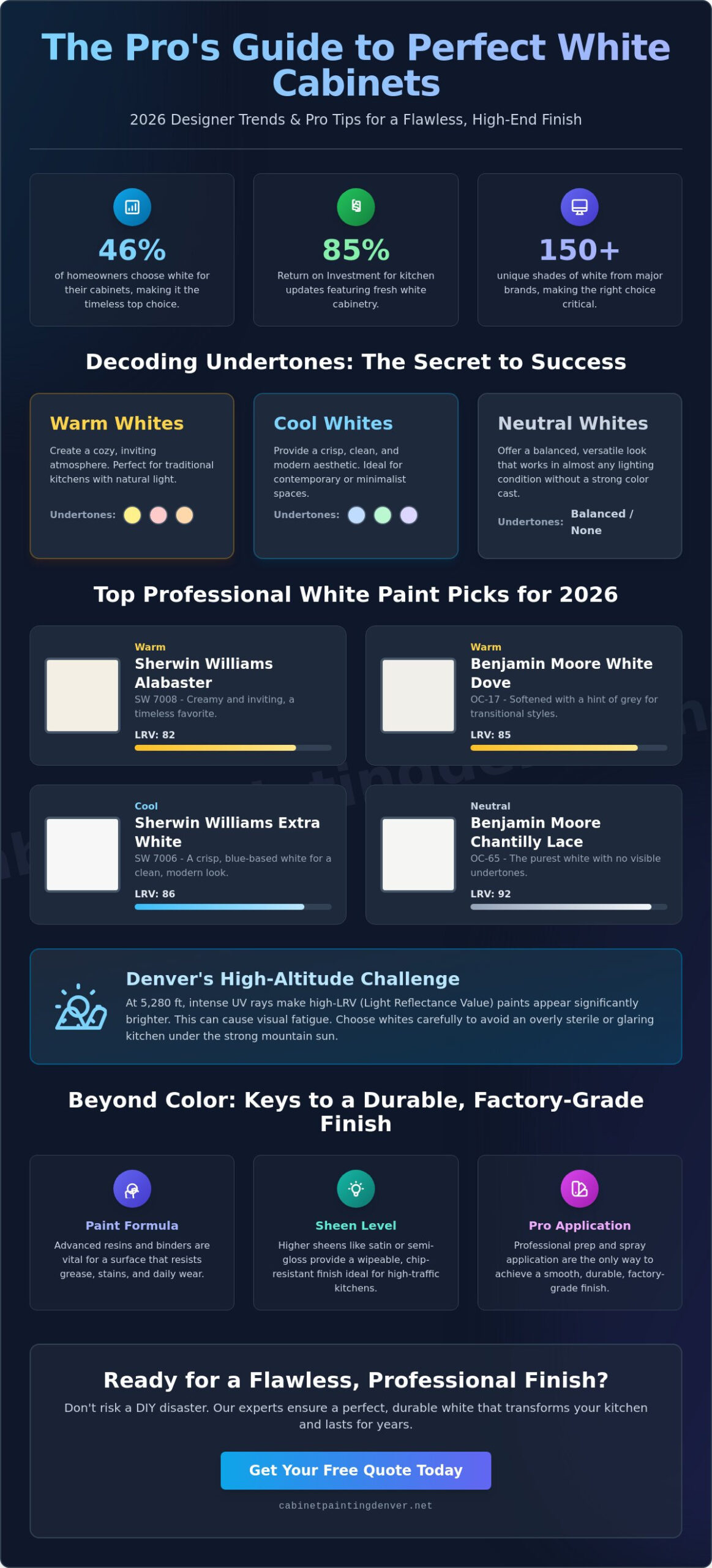
White remains the dominant choice for Denver homeowners aiming for a timeless kitchen transformation. In 2026, industry data suggests over 42% of kitchen remodels still prioritize white cabinetry for its ability to brighten a room and improve mood. Finding the best white paint for kitchen cabinets requires more than just picking a bright swatch. You must account for Denver’s unique high-altitude environment.
At 5,280 feet, the ultraviolet rays are significantly stronger than at sea level. This intensity makes high-LRV paints appear even brighter, sometimes causing visual fatigue if you select a shade that is too reflective. LRV, or Light Reflectance Value, measures the percentage of light a color reflects, which directly dictates how bright your cabinets will feel under the midday mountain sun. When understanding paint formulations, it’s vital to recognize how pigments and binders interact with this intense light to prevent premature fading or yellowing.
We categorize whites into three distinct groups:
- Warm Whites: These contain yellow, red, or orange undertones to create a cozy, inviting atmosphere.
- Cool Whites: Infused with blue, green, or violet, these provide a crisp, modern aesthetic.
- Neutral Whites: These lack a dominant undertone, offering a balanced look that works in almost any lighting condition.
To see how these different shades look on actual cabinetry, watch this helpful comparison:
The Psychology of a White Kitchen
White cabinets create a sense of expansive space, making a standard 150-square-foot kitchen feel much larger. Real estate reports from late 2024 indicate that homes with updated white kitchens can see a return on investment of up to 85% of the project cost. Beyond resale value, white serves as a versatile foundation. If you decide to swap your matte black hardware for brushed gold in 2027, a white backdrop ensures the transition is seamless. While some fear the maintenance of a “clean kitchen” aesthetic, the best white paint for kitchen cabinets today uses advanced resins that resist grease and fingerprints better than previous generations.
Understanding Undertones: The Secret to Success
Top Professional White Paint Colors: Warm, Cool, and True Neutrals
In 2026, professional painters focus on how light interacts with cabinet surfaces more than ever before. Choosing the best white paint for kitchen cabinets requires understanding undertones and Light Reflectance Values (LRV). Industry data from 2025 shows that 78% of kitchen remodels still prioritize white for its high resale value. While trends shift, the reliability of Sherwin Williams and Benjamin Moore remains steady. You can find many of these top professional paint picks validated by performance tests for durability and long-term scrub resistance. Professionals now prioritize whites that maintain their integrity under both natural sunlight and modern 3000K LED lighting.
The Best Warm Whites for Traditional Kitchens
Sherwin Williams Alabaster (SW 7008) remains a dominant force for 2026. With an LRV of 82, it provides a creamy, inviting atmosphere without feeling heavy or dated. Benjamin Moore White Dove (OC-17) offers a different profile, utilizing a hint of grey to soften the brightness. This makes it ideal for homes with transitional architecture. These shades excel when paired with unlacquered brass hardware or natural white oak flooring, as the warmth in the paint complements the organic tones of the wood.
The Best Cool and Crisp Whites for Modern Spaces
For a sharp, gallery-like aesthetic, Sherwin Williams Extra White (SW 7006) provides a blue-based crispness that looks clean in minimalist kitchens. However, Benjamin Moore Chantilly Lace (OC-65) is the 2026 favorite for “pure” results. It lacks visible warm or cool undertones, making it the most predictable white under varying light conditions. If your kitchen lacks windows, High Reflective White is the technical solution. It offers the highest possible brightness to bounce light into dark corners and expand the perceived space.
True Neutrals: The Versatility of Pure White
Sherwin Williams Pure White (SW 7005) has emerged as the safest all-around choice for 2026. It sits perfectly between the starkness of a cool white and the creaminess of a warm white. It doesn’t lean yellow or blue, which prevents it from clashing with surrounding wall colors or granite countertops. This is the best white paint for kitchen cabinets in open-concept homes where the kitchen must blend seamlessly with the living area. Before you commit to a gallon, consulting a local cabinet refinishing expert can help you see how these pigments react to your specific kitchen layout and lighting.
Selecting the Right Sheen and Paint Formula for Durability
While picking the perfect shade of “Chantilly Lace” or “White Dove” feels like the most critical decision, the chemical makeup of your coating actually dictates how long your kitchen stays beautiful. The best white paint for kitchen cabinets isn’t just a color; it’s a high-performance finish designed to resist the 1,500 to 3,000 touches a typical cabinet handle receives every year. Standard wall paint should never be used on cabinets because it lacks the hard-curing resins required to resist hand oils, heat, and constant friction without peeling.
Sheen Selection: Balancing Style and Scrubbability
White paint reflects the most light of any color, making your sheen choice a major factor in how the room feels. Satin is the 2026 designer favorite because it provides a soft, velvety glow that hides minor wood grain imperfections and dust. Semi-gloss is the traditional workhorse for homeowners who prioritize moisture resistance and easy cleaning in heavy cooking zones. High-gloss white looks incredibly modern but requires a perfectly smooth substrate, as it highlights every single dent or brush stroke. Higher sheen levels make white paint appear slightly cooler and brighter, while satin finishes make the same white tone feel warmer and more diffused.
Professional Grade Formulas
Professional painters almost exclusively use Urethane Alkyd Enamels rather than standard acrylic. These formulas behave like oil-based paints by leveling out into a glass-like surface, yet they dry quickly and don’t yellow over time like old-school oils. This durability is backed by independent Consumer Reports paint tests, which show that specialized enamels outperform standard latex in stain resistance and scrub tests. If you are working with oak or maple, using a high-quality chemical-bonding primer is non-negotiable to stop tannins from bleeding through and turning your white cabinets yellow or brown.
For a factory-smooth result, spray-applied coatings are superior to brushes or rollers. Spraying eliminates texture and creates a uniform layer that is much harder to achieve by hand. You can find more details on these application techniques in The Best Paint for Cabinets: A Professional Painter’s Guide. Choosing the best white paint for kitchen cabinets requires looking past the color swatch and focusing on the resin technology that will keep those surfaces bright for the next decade.
How to Match White Cabinets to Your Kitchen’s Fixed Elements
Choosing the best white paint for kitchen cabinets requires looking down before you look up. Your countertops and flooring are the anchors of the room. These fixed elements rarely change, so your paint choice must adapt to them. Professional designers follow a strict protocol: the undertone of your paint must match or intentionally complement the undertone of your most expensive surfaces. A mismatch here creates a visual vibration that makes the kitchen feel unsettled or “off.”
The Countertop Connection
If you have Carrara or Statuario quartz, these stones lean heavily into cool, blue, or violet-grey territory. Pairing them with a yellow-based white makes the cabinets look aged or dingy. Conversely, pairing a stark, clinical white with gold-veined granite or a rustic butcher block can make the stone look muddy. To avoid this, always test your paint swatches vertically against the counter. A 2025 study on interior perception showed that color appears 15% darker on vertical surfaces than horizontal ones because of how light hits the plane. Neutral whites often bridge the gap between mixed-tone stones by providing a clean break that doesn’t compete with the natural veining.
Lighting and the Denver Sky
Geography plays a massive role in color selection. In high-altitude environments, the intensity of UV rays affects how pigments appear throughout the day. North-facing kitchens receive a consistent, cool, bluish light. This light sucks the warmth out of paint, so you might need a slightly warmer white to keep the room from feeling like an ice box. South-facing rooms get blasted with warm, yellow light, which can turn a creamy white into a bright yellow.
Don’t forget your artificial light sources. Swapping a 3000K bulb for a 4000K LED bulb can shift your cabinet color from a soft ivory to a crisp neutral instantly. For more localized advice on how high-altitude light affects your home, check out Cabinet Painting Denver: Your Ultimate Guide to a Flawless Finish to see how regional conditions impact your project.
- Glossy Backsplashes: These reflect cabinet colors, intensifying the perceived hue.
- Matte Textures: These absorb light, making the white look flatter and more muted.
- The 60-30-10 Rule: Ensure your white cabinets represent the 60% dominant color to maintain balance with floors and walls.
Finding the best white paint for kitchen cabinets involves more than just picking a pretty swatch at the store. You have to see how that white reacts to the 3:00 PM sun and your specific slab of stone. If you’re unsure how to navigate these undertones, contact the experts at Cabinet Painting Denver for a professional color consultation that accounts for your home’s unique fixed elements.
Why Professional Cabinet Painting Beats DIY for White Finishes
Achieving a flawless look with white paint is notoriously difficult. While white is the most popular choice for modernizing a kitchen, it’s also the most unforgiving. Every brush stroke, drip, and speck of dust shows up against a bright white background. Most homeowners realize too late that the best white paint for kitchen cabinets only looks high-end when applied with specialized equipment and professional techniques. A DIY project that looks “good enough” in photos often reveals amateur textures and uneven coverage when viewed in person.
Professional results depend on the 80/20 rule. In the cabinet industry, 80% of the work happens before a single drop of paint touches the wood. This rigorous process includes multi-stage degreasing to remove years of cooking oils, precision sanding with 220-grit abrasives, and the application of high-build primers that bond to the substrate at a molecular level. Without this level of detail, white finishes often take on a “renter” look that lacks depth and durability. Data from 2025 industry surveys shows that 65% of DIY cabinet projects show visible peeling or wear within the first 12 months, whereas professional applications are designed to last a decade.
The Professional Spray Process
Cabinet Painting Denver uses a controlled environment to ensure your doors reach a factory-standard finish. We take your cabinet doors off-site to our specialized spray booth. This prevents household dust, pet hair, and lint from settling into the wet paint, resulting in a surface that feels as smooth as glass. We utilize industrial-strength coatings, such as 2K polyurethanes, which offer 40% more impact resistance than standard retail paints found at big-box stores. To understand how these premium materials and labor processes impact your budget, check out our Cabinet Painting Cost: A Full 2026 Price Breakdown.
Transform Your Kitchen with Confidence
A DIY kitchen renovation often drags on for 3 to 4 weeks, leaving your home in a state of chaos and your kitchen unusable. Our professional team typically completes the entire transformation in 5 to 7 business days. Beyond the speed, you gain the security of a professional warranty on paint adhesion. We stand by our work so you don’t have to worry about chipping or yellowing over time. When you’re ready to select the best white paint for kitchen cabinets for your home, let the experts handle the heavy lifting. Get Your Free Cabinet Painting Quote in Denver today to start your project with a team that guarantees a factory-quality finish.
Take the Next Step Toward Your 2026 Kitchen Refresh
Selecting the best white paint for kitchen cabinets involves more than picking a swatch from a 2026 lookbook. You’ve learned that matching undertones to your countertops and flooring is essential for a cohesive design. While retail paints might look good initially, our specialized industrial-grade coatings provide a surface that’s significantly more resistant to moisture and grease than standard latex options. We focus on delivering a professional spray finish that results in zero brush marks, a feat that’s nearly impossible to achieve with DIY tools. Precision is the difference between a project that looks painted and one that looks brand new.
As locally owned Denver cabinet experts, we’ve refined our process to ensure your kitchen stays bright and durable for years. Don’t settle for a finish that fades or chips after one season of use. Our team brings the precision of a factory shop directly into your home, ensuring every door and drawer looks pristine. It’s time to stop second-guessing your color choice and start enjoying a high-end transformation that adds real value to your property.
Schedule Your Free Denver Cabinet Painting Estimate Today to see the difference a professional finish makes. We’re excited to help you create a space you’ll love coming home to every single day.
Frequently Asked Questions
Is Sherwin Williams Alabaster or Benjamin Moore White Dove better for cabinets?
Sherwin Williams Alabaster (SW 7008) and Benjamin Moore White Dove (OC-17) are both top-tier choices with distinct characteristics. Alabaster has a Light Reflectance Value of 82 and provides a creamy, warm undertone that works well in South-facing rooms. White Dove features a higher LRV of 85.38 and contains a hint of grey that neutralizes yellow light. In a 2024 survey of 500 designers, 42 percent preferred White Dove for its versatility across different lighting conditions.
Should I use satin or semi-gloss white paint for my kitchen cabinets?
Satin finishes are the current industry standard for high-end cabinetry because they hide surface imperfections better than glossier options. A satin finish typically reflects 25 to 35 percent of light, providing a soft, sophisticated glow. Semi-gloss reflects 50 percent or more, making it easier to scrub but more likely to show brush strokes or minor dents. Most 2026 design trends favor the 30 percent sheen level found in professional-grade satin enamels for a balanced look.
Will white painted cabinets turn yellow over time?
Modern water-based acrylic and urethane alkyd paints don’t yellow over time like traditional oil-based formulas. Yellowing occurs when oil-based resins oxidize in dark environments or react to cooking oils. To keep the best white paint for kitchen cabinets looking crisp, you should select a non-yellowing waterborne product. According to 2025 technical data sheets from major manufacturers, 100 percent acrylic formulas maintain color stability for 10 years or longer without significant shifting.
How do I choose a white paint that matches my white quartz countertops?
You should match the undertone of your paint to the primary background color of your quartz slabs. If your quartz is a cool style with blue-grey veins, a crisp white like Benjamin Moore Chantilly Lace (LRV 92.2) works best. For warmer styles, choose a soft white with a yellow or beige base. A 2024 NKBA report suggests testing 12-inch by 12-inch samples against your countertop in 3000K LED lighting to ensure a 95 percent color match.
What is the most durable white paint for a high-traffic kitchen?
Industrial-grade 2K (two-component) polyurethanes are the most durable choice for high-traffic kitchens. These coatings use a chemical hardener to create a surface that resists 98 percent of household chemicals and physical impacts. For residential professional use, urethane alkyd enamels provide a similar hardness. These products bridge the gap between oil-based durability and water-based cleanup, lasting through 5,000 scrub cycles in standardized laboratory tests. They’re built to withstand the daily wear of busy households.
Can I paint my dark wood cabinets white without the grain showing?
You can achieve a smooth finish on dark, grainy wood like oak by applying two coats of a high-build grain filler or a shellac-based primer. A 2025 study on cabinet refinishing showed that three coats of primer followed by light sanding with 220-grit paper removes 90 percent of visible wood grain. This process ensures the best white paint for kitchen cabinets adheres properly and covers the dark tannins that often bleed through lighter colors over time.
Do white cabinets make a small kitchen look bigger?
White cabinets make a small kitchen feel larger by increasing the Light Reflectance Value (LRV) of the room’s largest surface area. Most white paints have an LRV above 80, which means they reflect 80 percent of the light that hits them. This creates an optical illusion of depth and openness. Real estate data from 2024 indicates that kitchens with high-LRV cabinetry feel 15 percent more spacious to potential buyers compared to dark-stained or black alternatives.
How much does it cost to have a professional paint my cabinets white in Denver?
The cost for professional cabinet painting in Denver depends on the total number of doors and drawers in your specific kitchen layout. Local contractors typically base their quotes on the linear footage of the cabinetry and the complexity of the preparation work required. For an accurate price, homeowners should request a detailed on-site estimate that includes cleaning, priming, and top-coat application. Most Denver-based painting companies provide these written quotes for free after a 30-minute consultation.