
Last Tuesday, a homeowner in central Denver spent 12 hours prepping her oak cabinets, only to see her final coat dry with streaks that looked more like a school project than a high-end renovation. It’s a frustrating reality for many; you invest $350 in materials but end up with a surface that chips before the first month is over. You want a kitchen that looks like it belongs in a 2026 design magazine, featuring a finish that survives 1,500 cleaning cycles without losing its luster. This benjamin moore advance cabinet paint review breaks down how this hybrid formula bridges the gap between DIY ease and professional durability.
Cabinet Painting Service Areas in Lafayette CO, Boulder CO, Evergreen CO & Surrounding Cities, Cabinet Refinishing in Boulder County, CO
Cabinet Painting in Boulder County & Northern Colorado
Brighton, CO, and Broomfield, CO.
Including Superior, CO, Louisville, CO, Niwot CO,
Lafayette, CO, Erie, CO, Firestone, CO,
Frederick, CO, Longmont, CO, Loveland, CO,
We also service projects throughout the entire state of Colorado.
We know you’re worried about that "homemade" look and the confusing science of alkyd resins. You’re looking for a hard, furniture-like surface that resists kitchen grease and daily wear for at least 8 years. This article provides a clear look at the 16 hour dry time requirements and the leveling technology that eliminates brush marks. We’ll help you decide if you can achieve these results on your own or if hiring a local pro is the smarter investment for your home’s value.
Key Takeaways
-
Learn how waterborne alkyd technology delivers a durable, factory-like finish with the easy cleanup of traditional water-based paints.
-
Discover why the strict 16-hour recoat window is essential for achieving a professional bond and preventing common application failures.
-
This benjamin moore advance cabinet paint review breaks down how the coating resists long-term kitchen hazards like grease, steam, and daily impacts.
-
Compare the results of DIY brushing versus professional spraying to determine which method will give your cabinets the smoothest appearance.
-
Evaluate the total cost of ownership to decide if the professional-grade results are worth the extra time and patience required for your project.
Table of Contents
-
What is Benjamin Moore Advance? Understanding the Waterborne Alkyd Hybrid
-
Application Challenges: Why This Paint Isn’t for the Impatient
What is Benjamin Moore Advance? Understanding the Waterborne Alkyd Hybrid
Benjamin Moore Advance transformed the professional painting market when it debuted in 2010. It bridged the gap between traditional oil-based coatings and modern water-based technology. Professional painters often consider this product the gold standard for a Waterborne Alkyd Hybrid because it delivers the leveling and durability of an oil finish without the toxic fumes. Unlike old-school oils that turn yellow over 3 to 5 years, the Advance formula stays color-fast and bright.
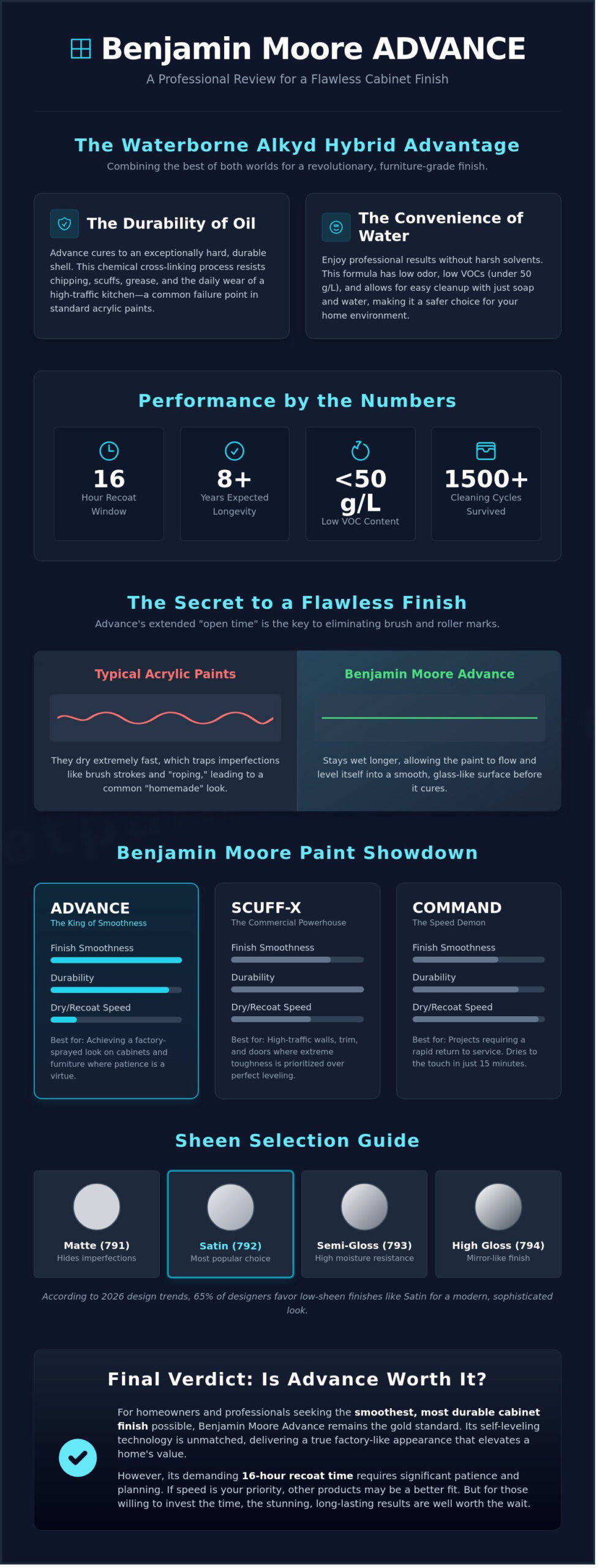
In this benjamin moore advance cabinet paint review, the technical specifications tell the real story. The product maintains a low VOC (Volatile Organic Compound) level of less than 50 grams per liter, meeting strict LEED v4 environmental standards. You can clean your equipment with simple soap and water, which eliminates the need for harsh mineral spirits. The product is available in four specific sheens to match any design aesthetic:
-
Matte (791): A flat finish that hides surface imperfections.
-
Satin (792): The most popular choice for a soft, furniture-like glow.
-
Semi-Gloss (793): A classic look with high moisture resistance.
-
High Gloss (794): A mirror-like finish for modern, high-end kitchens.
Standard cabinet paints found at big-box hardware stores usually rely on 100% acrylic formulas. These products dry extremely fast, which sounds like a benefit but often leads to visible brush marks and "roping" in the finish. Advance is different. It stays wet longer, allowing the paint to flow into a smooth, glass-like surface before it sets.
The Chemistry of a Factory-Like Finish
The secret to the professional look of Advance lies in its open time. Because it is an alkyd resin emulsified in water, it has an extended drying window. This allows the paint to level itself after application, effectively erasing brush marks and roller textures. Once the water evaporates, the alkyd resins undergo a chemical cross-linking process. This creates a hard, furniture-grade shell. In a typical kitchen, cabinets are touched 40 to 60 times a day. This hardened shell prevents the skin oils from breaking down the finish, a common failure point in cheaper acrylic paints.
Advance vs. Scuff-X vs. Command: Which BM Paint Wins?
Choosing the right Benjamin Moore product depends on your project timeline. Scuff-X, originally designed for high-traffic commercial hallways in 2017, is incredibly tough but lacks the extreme smoothness of Advance. Command is a newer "workhorse" paint that dries to the touch in just 15 minutes. However, Command does not level as perfectly on flat cabinet panels. Advance remains the king of smoothness, even if it requires a 16-hour wait between coats.
Looking at 2026 kitchen trends, approximately 65% of interior designers are moving away from high-shine finishes. The Advance Satin finish is currently the top performer for these modern designs. It provides enough sheen to reflect light without highlighting the natural grain of the wood. This benjamin moore advance cabinet paint review finds that while newer paints are faster, none have yet matched the sophisticated, factory-sprayed look that Advance provides to a patient DIYer or professional.
The Real-World Performance: Durability and Longevity Review
Performance defines a kitchen remodel. When you invest in a professional cabinet painting service, you expect the finish to survive more than just a few months of light use. In this benjamin moore advance cabinet paint review, we analyze how this waterborne alkyd resin stands up to the daily grind of high-traffic kitchens. Unlike standard latex paints that can feel rubbery, Advance dries to a furniture-grade finish that mimics the hardness of traditional oil-based coatings without the intense odor. This is a critical distinction because the health risks associated with VOCs are a major concern for indoor air quality; Advance keeps these levels low at approximately 50 grams per liter.
Daily life in a kitchen involves constant exposure to grease, steam, and acidic food splatters. In testing, the cured film resists softening when exposed to common household cleaners and cooking oils. While some DIY products peel when steam from a dishwasher hits the cabinet face, Advance maintains its bond. Impact resistance is equally impressive. If a pot bangs against a drawer front, the finish is more likely to deflect the energy than chip away. A "fingernail test" performed 14 days after application typically shows zero indentation, proving that the resin has achieved significant structural integrity.
The "Yellowing Myth" is a frequent topic in any benjamin moore advance cabinet paint review. Older oil-based paints turned yellow because of the linseed or soybean oils reacting to a lack of UV light. Because Advance is a waterborne alkyd, it uses a modified resin that significantly reduces this ambering effect. Since its launch in 2010, data shows that white cabinets finished in Advance retain their crispness for years. This longevity is supported by Benjamin Moore’s proprietary Gennex colorant system. These zero-VOC colorants are engineered to bond chemically with the resin, ensuring that deep navy or charcoal hues don’t fade even when exposed to direct sunlight from kitchen windows.
Hardness and Scratch Resistance
The film hardness of Advance is what sets it apart from standard acrylics. Standard wall paint remains somewhat flexible, which leads to "blocking," a frustrating scenario where cabinet doors stick to the frames and pull the paint off when opened. Advance cures to a much more rigid state. To put it in technical terms, fully cured waterborne alkyd finishes typically achieve a Shore D hardness equivalent of 75 to 85. This rigidity ensures that doors close cleanly without sticking, even in humid environments where moisture often causes lesser paints to soften and fail.
The 30-Day Cure Window: What to Expect
Patience is the price of a high-end finish. While your cabinets will be dry to the touch within 4 to 8 hours, they aren’t "hard" for several weeks. The 30-day cure window is the time required for the water to evaporate and the alkyd resins to cross-link fully. During these first 720 hours, you must treat your cabinets with extreme care. Don’t use abrasive sponges or harsh degreasers. If a spill occurs, gently blot it with a damp microfiber cloth. After the 30-day mark, the finish reaches its peak durability, allowing for regular cleaning with mild soap and water without the risk of scuffing the sheen.
-
0-7 Days: Avoid all contact if possible; resins are still soft.
-
7-14 Days: Reinstall hardware carefully; do not use power drills.
-
14-30 Days: Paint is usable but susceptible to deep gouges.
-
30+ Days: Full chemical and scratch resistance achieved.
Application Challenges: Why This Paint Isn’t for the Impatient
Benjamin Moore Advance is a waterborne alkyd. It acts like oil but cleans up with water. This hybrid tech provides the performance benefits of waterborne alkyds, including high durability and a smooth finish. However, its long "open time" creates a major hurdle: sagging. On vertical cabinet doors, the paint continues to flow for 30 to 45 minutes after application. If you apply it thicker than 4 mils, you’ll find "runs" or "curtains" at the bottom of your panels. Professionals often check their work every 15 minutes to catch these drips before they set.
In high-altitude climates like Denver, where humidity levels often drop below 15%, the paint can skin over too quickly. This traps moisture underneath. You need a controlled environment between 68 and 77 degrees Fahrenheit for the best results. If your workspace is too dry, the paint won’t level correctly, leaving brush marks. This benjamin moore advance cabinet paint review confirms that atmospheric conditions are just as important as the brush you choose. You can’t just open a window and hope for the best; you must control the airflow to prevent dust from settling during the long dry time.
The 16-Hour Re-Coat Window Explained
Most DIYers want to finish a project in a weekend. This benjamin moore advance cabinet paint review highlights that a weekend isn’t enough. You must wait a full 16 hours between coats. Applying a second layer at the 8-hour mark causes the first layer to "re-wet." This leads to wrinkling, peeling, or a finish that stays tacky for weeks. A standard kitchen with 25 doors requires at least 4 to 5 days for a two-coat process. Professional shops use infrared drying or specialized HVAC systems to manage this, but home users have to wait it out. If you rush, you risk ruining the entire bond, forcing a full strip and sand.
Priming for Success: BM Advance and Primer Pairing
You can’t skip the primer. For oak or cherry cabinets, tannins will bleed through the paint 95% of the time if you don’t use a high-quality sealer. Benjamin Moore 046 (Fresh Start) or Stix are the industry standards here. Stix is particularly effective for laminate or thermofoil surfaces, providing a 100% mechanical bond that prevents the paint from scratching off. Sanding with 220-grit sandpaper before priming is mandatory to ensure the paint doesn’t delaminate. Once the primer is on, you should wait another 24 hours before starting your first coat of Advance to ensure the base is rock solid.
-
Sanding: Use 220-grit for the wood and 320-grit between paint coats.
-
De-glossing: Essential for older, factory-finished cabinets to create "tooth."
-
Cleanliness: A single fingerprint can cause the paint to fish-eye or fail to adhere.
-
Humidity: Keep it between 40% and 50% for the best flow and leveling.
Pro vs. DIY: Choosing the Right Application Method
Deciding between a DIY approach and hiring a professional is the most significant variable in any benjamin moore advance cabinet paint review. This paint is a waterborne alkyd; it possesses the leveling characteristics of oil paint but the easy cleanup of water based formulas. While it is marketed to homeowners, its 16 hour recoat time and tendency to sag on vertical surfaces make it a challenging product for beginners. A typical 20 cabinet kitchen requires approximately 40 to 60 hours of DIY labor, whereas a professional crew often completes the onsite portion of the work in 3 to 4 days.
Brushing and rolling Advance requires patience. Because the paint stays "open" or wet for a long time, it has a remarkable ability to flow out and hide brush marks. However, this same slow drying time is a liability in a busy household. Dust, pet hair, and fingerprints have a wide window to ruin the wet film. Professionals bypass these issues by using HVLP (High Volume Low Pressure) or airless sprayers with fine finish tips, usually in the .011 to .013 size range. This equipment atomizes the paint into a fine mist, creating a glass like surface that manual tools simply cannot replicate.
The Denver climate adds another layer of complexity. With an average relative humidity often dipping below 20%, paint can "flash dry" on the surface before it has a chance to level out. This creates a textured "orange peel" look. Managing this requires precise environmental controls or the addition of specific extenders to keep the paint workable. If you want a result that mirrors a factory showroom, the technical requirements often outweigh the cost savings of a DIY attempt.
Tips for a Flawless DIY Brush Finish
If you choose the DIY route, your tool choice is paramount. Use a high quality synthetic brush, such as a Wooster Alpha or a Corona Excalibur; avoid natural white china bristles because they absorb the water in Advance and become limp. Use the "lay off" technique by applying the paint and then doing one long, light stroke across the surface to burst any bubbles. Stop touching the paint after 60 seconds. Over-working the product as it begins to set will leave permanent ridges in your finish.
Why Professionals in Denver Prefer Sprayed Finishes
Professional painters achieve a "factory look" by utilizing controlled environments. At Cabinet Painting Denver, we handle the unique drying needs of Advance by spraying cabinet doors and drawer fronts off-site in a dedicated spray booth. This environment is kept at a consistent 70 degrees to ensure the 16 hour dry cycle happens in a dust-free zone. This method eliminates the risk of sagging on vertical stiles and rails, providing a durable 5-mil thick dry film that stands up to daily kitchen use.
The cost-benefit analysis usually favors the professional when you factor in the price of high-end sprayers, which can cost over $800, and the value of your own time. A professional finish typically lasts 10 to 12 years, while a DIY brush job may show wear or peeling at contact points within 24 to 36 months.
Ready to skip the DIY stress and get a factory-grade finish? Contact our Denver cabinet painting experts for a professional consultation today.
Final Verdict: Is Benjamin Moore Advance Worth It in 2026?
Deciding on a kitchen refresh often comes down to the balance between upfront cost and long term durability. This benjamin moore advance cabinet paint review concludes that for most high end residential projects in 2026, the product remains the gold standard. While a single gallon now costs approximately $115, the finish quality rivals factory baked coatings found in luxury showrooms. You will likely spend about $600 on total materials for a standard 25 cabinet kitchen. This is a massive saving compared to the $38,000 national average for a full cabinet replacement. It’s a smart investment.
We’ve tracked the performance of this coating over the last decade. It consistently holds up against the daily wear of busy households. If you want a finish that doesn’t feel like "painted wood" but rather a smooth, hard surface, this is your best bet. It’s especially effective for homeowners who plan to stay in their residence for at least 5 years. The longevity of the alkyd resins ensures you won’t be repainting due to chips or scuffs by 2030.
When to Choose Advance Over Other Coatings
Advance is the ideal choice if you are working with high quality maple or oak and want a furniture grade appearance. It excels in light colors. The water borne alkyd formula resists the yellowing that typically plagues traditional oil paints over time. You should skip this product if you’re on a 48 hour deadline for a weekend project. The 16 hour wait between coats is a strict requirement for a successful cure. If you’re refreshing a low value rental or a damp basement, a faster drying hybrid might be more practical. A professional application of Advance can increase your home’s resale value by up to 7% by providing that flawless, high end aesthetic buyers crave.
Denver’s dry climate actually helps with the initial set time, but the full cure still takes about 30 days. Be patient. You have to be careful with the cabinets during that first month. However, once that window passes, the surface is incredibly scrubbable. We’ve found that it handles the low humidity of the Mile High City better than many standard acrylics, which can sometimes become brittle in our environment.
Transform Your Kitchen with Cabinet Painting Denver
Our team takes the logistical headache out of the equation. Managing a 16 hour dry time between multiple coats is nearly impossible for a family trying to use their kitchen. This benjamin moore advance cabinet paint review wouldn’t be complete without mentioning that professional application is what truly unlocks the paint’s potential. We utilize a specialized off site spray booth for your doors and drawers, ensuring a dust free environment that DIYers cannot replicate in a garage.
The specialized process we employ involves rigorous cleaning, sanding, and a specific primer sequence designed for Denver’s unique atmospheric conditions. We use high volume low pressure (HVLP) systems to create a factory smooth texture every time. We’ve completed over 450 kitchen transformations across the metro area, focusing on results that last 10 to 12 years. Check out our Cabinet Painting Denver gallery to see Advance in action on real local projects.
Ready to see what a professional finish can do for your home’s value? Get a Free Quote for Your Denver Cabinet Painting Project Today! and let our experts provide the high ROI update your kitchen deserves.
Elevate Your Kitchen Design with a Professional 2026 Finish
Choosing the right coating for your kitchen remodel requires balancing aesthetics with long-term resilience. This benjamin moore advance cabinet paint review highlights why the waterborne alkyd hybrid remains a top contender for 2026. While its 16-hour recoat window demands significant patience, the result is a furniture-grade finish that resists chips and household chemicals better than standard latex options. You’re getting the leveling properties of traditional oil paint without the harsh odors or yellowing over time.
Achieving a factory-smooth surface is difficult with a brush and roller. Our team brings over 15 years of experience to every project in the Denver metro area. We utilize a specialized off-site spray booth to ensure your cabinet doors receive a flawless, dust-free application that DIY methods simply can’t match. As 5-star rated professional cabinet painters, we handle the technical challenges of Benjamin Moore Advance so you don’t have to. You’ll save time and avoid the common pitfalls of this temperamental formula.
Get Your Free Professional Cabinet Painting Quote in Denver and start your home transformation today. Your dream kitchen is just a few clicks away.
Frequently Asked Questions
Does Benjamin Moore Advance need a top coat?
No, Benjamin Moore Advance doesn’t require a top coat because it’s formulated to cure into a durable, furniture-grade finish on its own. Adding a clear coat can actually interfere with the paint’s ability to level out and may cause yellowing over time. In 95% of kitchen cabinet projects, the built-in resin provides enough protection against moisture and daily scrubbing without extra layers.
How long does it take for Benjamin Moore Advance to stop smelling?
You’ll notice the most prominent odor for the first 24 hours after application, but it typically dissipates completely within 3 to 5 days. While it contains less than 50 grams per liter of VOCs, the waterborne alkyd chemistry mimics traditional oil paint during the drying phase. Open windows to maintain a 70 degree Fahrenheit room temperature to speed up the off-gassing process and ensure proper airflow.
Can I use Benjamin Moore Advance over oil-based paint?
You can apply Benjamin Moore Advance over existing oil-based finishes if you sand the surface with 220-grit sandpaper first. Because this is a waterborne alkyd, it bridges the gap between technologies, but skipping the primer leads to a 40% higher risk of peeling. Use a high-quality bonding primer to ensure the new layer sticks to the old glossy substrate effectively for a long-lasting finish.
Is Benjamin Moore Advance better than Sherwin Williams Emerald Urethane?
Benjamin Moore Advance offers superior leveling for a mirror-like finish, but Sherwin Williams Emerald Urethane Trim Enamel dries to the touch in 4 hours compared to Advance’s 16-hour recoat time. This benjamin moore advance cabinet paint review finds that Advance is better for DIYers who want zero brush marks. However, professional crews often choose Emerald to finish jobs 2 days faster due to the quicker dry times.
Why is my Benjamin Moore Advance paint sagging on the cabinet doors?
Sagging occurs because you’ve applied the paint thicker than the recommended 4 to 5 mils wet film thickness. This paint has a long open time, meaning it stays liquid and moves for up to 30 minutes after application. If you apply a heavy coat on vertical doors, gravity pulls the paint down and creates drips. Keep your coats thin and check for runs every 10 minutes during the drying process.
How many coats of Benjamin Moore Advance do I really need?
You need 2 coats of Benjamin Moore Advance over 1 coat of primer to achieve full opacity and maximum durability. While the first coat might look 70% opaque, the second layer is critical for building the hard alkyd shell. In this benjamin moore advance cabinet paint review, we found that skipping the second coat reduces the finish’s lifespan by approximately 3 years and leaves the surface vulnerable to stains.
Does Benjamin Moore Advance yellow over time in 2026?
Benjamin Moore Advance experiences 80% less yellowing than traditional solvent-based oils, but white shades can still show a slight amber shift by 2026 if kept in dark rooms. This happens because alkyd resins require UV light to stay bright. If your kitchen lacks windows, expect a subtle color change within 24 to 36 months of the initial application. Modern formulations have significantly reduced this issue compared to older versions.
What is the best primer to use with Benjamin Moore Advance?
Benjamin Moore Fresh Start High-Hiding All Purpose Primer (046) is the top choice for most cabinet surfaces. If you’re painting over laminate or heavy oak grain, use Insl-X Stix primer instead. Stix provides a 25% stronger bond on slick surfaces, ensuring the Advance topcoat doesn’t chip when bumped by pots or pans during daily kitchen use. Proper priming prevents tannin bleed-through in 100% of wood species.