
In Denver’s thin air and intense UV light, standard house paint isn’t a finish; it’s a liability for your built-in cabinetry. Many homeowners find that painting built in bookshelves denver homes often results in sticky "blocking" or visible brush marks that ruin the architectural appeal. You likely want the look of custom cabinetry without the high price tag of a full carpentry replacement. It’s frustrating when a DIY project leads to yellowing finishes or shelves that bond to your books because the coating never fully cured in our arid climate.
Cabinet Painting Service Areas in Denver & Surrounding Cities, Cabinet Refinishing in Denver County, Boulder CO,
Arvada, CO, Wheat Ridge, CO,
and Castle Pines CO. Englewood CO. Castle Rock CO, Centennial CO.
Cabinet Painting in Arapahoe County, CO
Including Centennial, CO, Greenwood Village, CO,
Cherry Hills Village, CO,
and Aurora, CO.
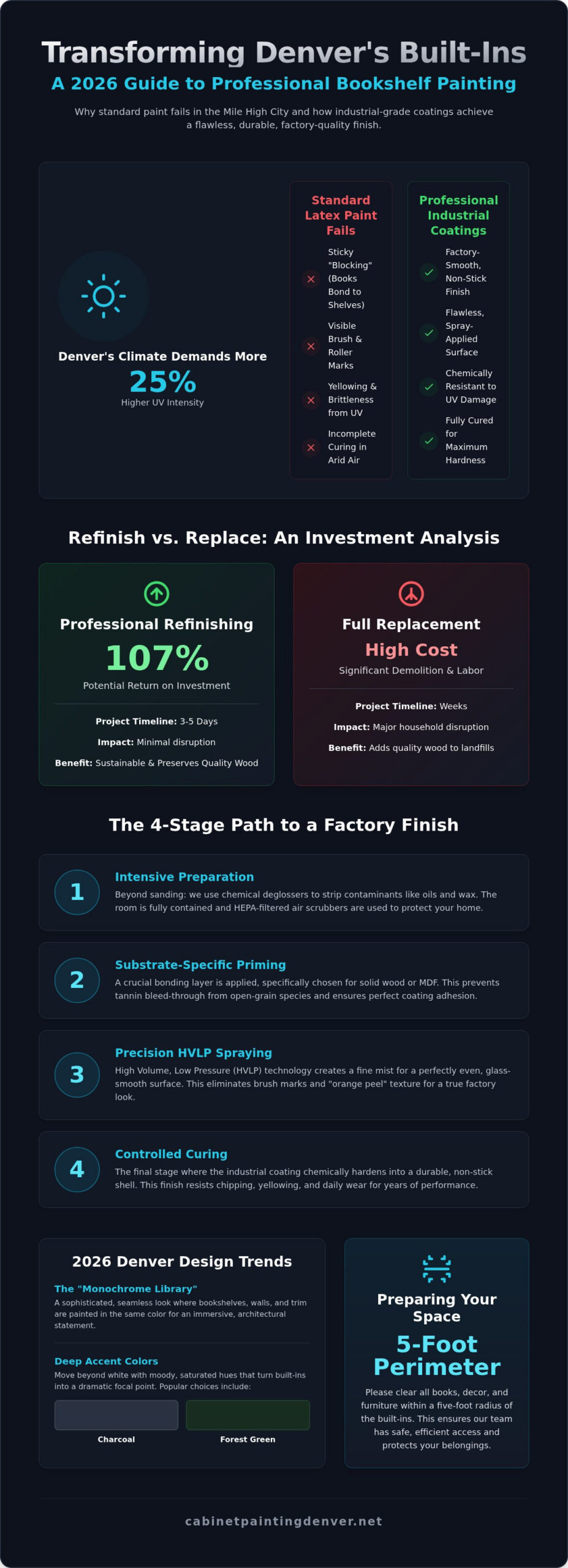
This 2026 guide explains how professional industrial-grade spraying transforms dated units into high-end features that look like they came straight from a factory. You’ll discover why Denver’s 25% increase in UV intensity requires specific chemical coatings rather than standard latex. We’ll preview the latest 2026 color trends, explain the specialized spraying process for a flawless texture, and show how a professional update increases your home’s resale value. Achieving a durable finish in the Mile High City requires a technical approach to both chemistry and application.
Key Takeaways
- Learn how professional industrial spraying eliminates common issues like brush marks and shelf sticking to provide a factory-quality finish.
- Discover why painting built in bookshelves denver homeowners choose is a cost-effective alternative to expensive custom carpentry replacement.
- Understand the technical differences between refinishing solid wood and MDF, including how to prevent tannin bleed-through in open-grain species.
- Explore 2026 design trends such as the “Monochrome Library” look and the use of deep accent colors like charcoal and forest green.
- Identify the essential preparation steps for your home, including clearing a five-foot workspace perimeter to ensure a clean and efficient application.
Why Professional Painting is the Best Update for Denver Built-ins
Built-in bookshelves define the character of Denver’s diverse housing stock. From the ornate, dark-stained oak found in historic Capitol Hill mansions to the clean-lined millwork in modern RiNo lofts, these features are permanent architectural assets. When homeowners consider painting built in bookshelves denver projects, they often face a choice between preserving these sound structures or incurring the high cost of custom carpentry. Professional refinishing allows you to update the aesthetic while maintaining the structural integrity of high-quality original wood that is often superior to modern MDF alternatives.
To visualize the impact of a professional transformation, watch this detailed step-by-step process:
Refinishing vs. Replacing: An Investment Analysis
Choosing to refinish rather than replace built-ins is a strategic financial decision. Industry data indicates that professional interior painting in Denver can yield a return on investment as high as 107%. Full custom cabinetry replacement involves significant labor costs and often requires weeks of demolition and construction. In contrast, professional spraying typically takes only three to five days. Refinishing is also the more sustainable choice. It prevents high-quality wood from entering local landfills and reduces the environmental impact associated with manufacturing and transporting new materials.
The Functional Demands of Bookshelf Surfaces
Bookshelves face unique physical stressors that standard walls do not. Horizontal surfaces must support the weight of heavy collections without the finish softening or failing under pressure. Standard residential latex paints often lead to "blocking," a condition where the paint remains slightly tacky. This causes books to bond to the shelves, eventually tearing the paper or peeling the paint away when you move them.
Success in Denver’s climate requires a deep understanding of The Professional Refinishing Process. We utilize industrial-grade coatings that are chemically engineered to cure harder than consumer-grade paint. In the Mile High City, where UV intensity is 25% higher than at sea level, these coatings are essential. They resist the yellowing and brittleness caused by high-altitude sun exposure. These professional-grade finishes provide a smooth, factory-quality surface that handles daily wear while matching your home’s modern aesthetic.
The Professional Refinishing Process: Achieving a Factory Finish
Achieving a factory-grade result requires a technical sequence that goes beyond standard interior painting. When homeowners start painting built in bookshelves denver projects, the quality of the finish depends entirely on the transition from raw or previously finished wood to a new industrial coating. This process involves four critical stages: intensive preparation, substrate-specific priming, precision spraying, and controlled curing.
Surface Preparation and Contaminant Removal
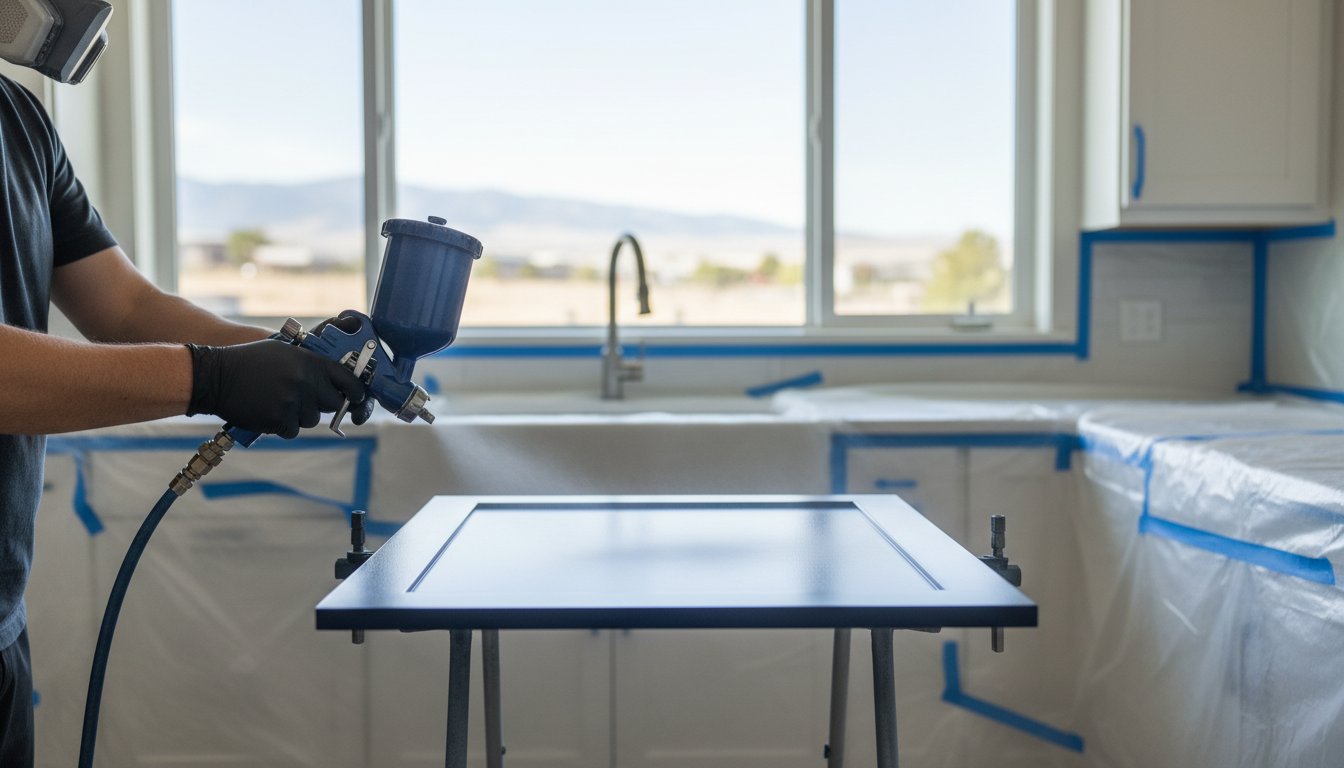
Proper preparation is the foundation of achieving a factory finish that lasts for decades. Sanding alone is insufficient for older built-ins. Over time, bookshelves accumulate household oils, furniture wax, and skin oils that prevent paint adhesion. We use chemical deglossers and specialized cleaners to strip these contaminants without damaging the wood fibers. During this phase, we also implement strict containment measures. This includes masking the surrounding room with plastic sheeting and using HEPA-filtered air scrubbers to protect your Denver home from dust and overspray.
The Science of Spraying vs. Brushing
The most visible difference between a DIY attempt and professional work is the application method. Brushing or rolling leaves "orange peel" textures or visible brush marks. We utilize High Volume Low Pressure (HVLP) spraying technology to deliver a consistent mil-thickness across every surface. This precision ensures the coating is thick enough for durability but thin enough to avoid drips and sags. To maintain the highest quality, we spray removable parts like adjustable shelves off-site in a controlled environment. This leaves your home cleaner and ensures every edge of the shelf receives an even, professional application. If you want to learn more about our specific approach, you can review our bookshelves cabinet painting options for your next project.
Priming isn’t a one-size-fits-all step. We select primers based on the specific substrate, whether it’s open-grain oak or smooth MDF. These primers create a chemical bond with the industrial topcoat. Once sprayed, the units require a controlled curing period. Unlike standard paints that stay soft for weeks, our industrial coatings reach a hard-cure state quickly. This allows for final reassembly and immediate use of your library. This technical approach ensures that your bookshelves don’t just look new, but perform like high-end architectural features.
Comparing Materials: Painting Solid Wood vs. MDF Shelving
The first technical requirement for painting built in bookshelves denver projects is the precise identification of the substrate. Denver’s housing stock ranges from historic bungalows with solid oak millwork to modern suburban homes featuring engineered MDF. Each material dictates a different chemical approach to priming and coating. Solid woods like Maple and Pine are closed-grain and relatively easy to seal, whereas Oak and Ash require more intensive labor to manage their deep, open pores.
Painting Open-Grain Woods (Oak and Ash)
Oak is a staple in older Denver neighborhoods like Park Hill or Washington Park. Its prominent grain pattern remains visible even after multiple coats of paint unless a grain filler is applied. We often discuss the ‘Grain Fill’ debate with clients. Some prefer the natural wood texture to remain visible under the new color, while others want a completely flat, mirror-smooth finish. Regardless of the texture choice, Red Oak presents a chemical risk. The wood’s natural tannins can bleed through standard latex paint, causing permanent yellow or brown discoloration. To prevent this, we use high-solids, oil-based or specialized shellac primers. For older homes, safety is the priority. We strictly follow EPA lead-safe work practices during the preparation of any built-in installed before 1978. This prevents lead-contaminated dust from entering your living space during the deglossing and sanding phases.
Refinishing Engineered Materials (MDF and Laminate)
MDF is arguably the best material for a modern, solid-color spray finish. It lacks the knots and grain patterns of solid wood, providing a perfectly flat canvas. In Denver’s arid climate, MDF is also less prone to the seasonal expansion and contraction that causes wood joints to crack. However, MDF is essentially a compressed sponge. If it’s not sealed correctly, the material absorbs moisture from the paint, leading to swelling and structural failure. We apply specialized bonding primers that seal the porous edges of the MDF. This creates a hard, non-absorbent shell that allows the industrial topcoat to sit on the surface rather than soaking in. For laminate or ‘IKEA-style’ built-ins, the challenge is adhesion. These surfaces are designed to be stain-resistant and slick. We use high-performance bonding primers that create a permanent mechanical link between the laminate and the new finish. This technical precision ensures your updated bookshelves look like a factory-new architectural feature rather than a DIY project.
Navigating Denver Design Trends: Colors and Finishes for 2026
Design trends for 2026 emphasize architectural continuity. When planning for painting built in bookshelves denver homeowners are increasingly choosing the ‘Monochrome Library’ look. This involves matching the bookshelf color exactly to the surrounding walls and trim. This technique creates a seamless, built-in appearance that expands the visual scale of a room. Alternatively, Denver lofts in areas like RiNo and LoDo often utilize deep accent tones. Deeper, moodier colors like ‘Mopboard Black’ and ‘Evergreen Fog’ provide a sophisticated contrast against industrial elements like exposed brick or steel. Sheen selection is a functional requirement. Satin and semi-gloss finishes are the standard for bookshelves because they provide the necessary durability and ease of cleaning. Flat finishes are avoided as they lack the scrub-resistance needed for surfaces that handle frequent friction from books and decor. Integrating hardware updates, such as modern brass or matte black pulls, completes the 2026 transformation.
Matching Denver’s Architectural Styles
Matching Denver’s Architectural Styles requires neighborhood-specific palettes. In Capitol Hill’s Victorian homes, muted historical tones like sage, dusty rose, or earthy clay preserve the vintage character. Conversely, modern minimalist finishes in RiNo favor high-contrast blacks or crisp whites that complement biophilic design elements. For traditional suburban homes in Highlands Ranch, warm neutrals like beige and soft terracottas remain popular choices. These colors align with the 2026 trend toward ‘warm minimalism,’ which prioritizes spaces that feel lived-in yet functional. Choosing the right palette ensures the built-ins serve as a cohesive element of the interior design. Request a quote for bookshelves cabinet painting to align your home with these 2026 design standards.
The Impact of Denver’s High-Intensity UV Light
The Impact of Denver’s High-Intensity UV Light requires technical consideration. Choosing UV-stable pigments is essential to prevent color fading over time. Standard resins often yellow when exposed to the ‘Mile High’ sun, so we utilize non-yellowing topcoats to ensure long-term aesthetic stability. Denver’s altitude results in a 25% increase in UV intensity compared to sea level, making professional-grade coatings a necessity for longevity. The dry climate can cause pigments to cure harder and faster, leading to more saturated colors that may shift unexpectedly if not professionally applied. Denver’s high altitude and intense UV exposure accelerate the breakdown of chemical bonds in standard paint, significantly reducing the longevity of the finish compared to sea-level applications.
Preparing Your Home for a Professional Bookshelf Painting Project
Successful painting built in bookshelves denver projects require a clear logistical plan before the crew arrives. You must remove all items from the shelves at least 24 hours before the scheduled start time. Use sturdy plastic bins for temporary book storage to prevent dust accumulation. We require a clear five-foot perimeter around the entire built-in unit. This space is necessary for our HVLP equipment and allows technicians to maintain the precise spray angles required for a factory finish. Accessibility is key for a smooth workflow. Move any furniture, rugs, or floor lamps that obstruct the work zone to a different part of the home.
During the in-home spray phase, we manage airflow using professional-grade air scrubbers and exhaust fans. You’ll need to keep the room isolated from high-traffic areas to prevent dust settlement on the wet coating. Once the final topcoat is applied, the 24-hour curing window begins. During this time, the finish is dry to the touch but remains susceptible to physical damage. Don’t touch the surfaces or attempt to move the shelves until the cure is complete. Denver’s dry climate helps the initial flash-off of solvents, but the chemical bonding process still requires a stable, undisturbed environment.
Pre-Project Checklist for Homeowners
Preparation starts with clearing the area. You should move all electronics, including televisions, speakers, and gaming consoles, at least 10 feet away from the work zone. Fragile items like glass vases or framed photos must be stored in a different room. If your built-ins have integrated lighting, ensure the power is accessible for disconnection. You must also identify any structural repairs, such as loose shelving pins or cracked trim, before the painters arrive. We can’t achieve a factory finish over compromised wood structures. Finally, ensure all pets and children are restricted from the work area to prevent accidental contact with wet coatings.
Post-Project Care and Maintenance
The longevity of your finish depends on initial care. Don’t place heavy book collections or decorative objects on the shelves for at least 72 hours. Although the surface feels dry within hours, the chemical bond is still strengthening. When you eventually restock the shelves, place items gently rather than sliding them across the finish. For routine cleaning, use a damp microfiber cloth. Avoid using furniture polish or wax, as these products can create a film that interferes with the industrial coating’s performance. For comprehensive maintenance strategies, refer to Cabinet Painting Denver’s ultimate guide to maintaining high-end finishes.
Elevate Your Interior Architecture with Professional Refinishing
Updating your home’s millwork is a technical investment that yields immediate aesthetic and financial returns. You now understand how industrial-grade coatings prevent common issues like blocking and yellowing while providing a surface that handles the weight of extensive collections. Executing a professional painting built in bookshelves denver project requires specialized equipment and chemical knowledge to navigate our unique Mile High climate. Our locally owned and operated expert crew uses climate-tested coatings to ensure your finish remains stable despite Denver’s 25% increase in UV intensity. By choosing professional spraying over replacement, you preserve high-quality structural elements while achieving a factory-smooth spray finish that matches 2026 design standards. It’s the most efficient way to modernize your space without the disruption of a full construction project.
Ready to transform your study or living room? Get Your Free Built-in Bookshelf Painting Quote in Denver today to secure your project on our 2026 calendar. Our team is ready to help you achieve the durable, high-end look your home deserves.
Frequently Asked Questions
How long does it take to paint built-in bookshelves professionally?
Professional refinishing for painting built in bookshelves denver projects typically takes three to five days to complete from start to finish. This timeline includes the initial preparation and masking of your home, specialized priming, and the application of industrial-grade coatings. We spray removable shelves off-site to ensure a factory-smooth result while the frames are finished in your home. This structured process allows for proper curing times, which is essential for a durable finish.
Will my books stick to the shelves after they are painted?
Books won’t stick to the surfaces if you use professional industrial-grade coatings. Standard residential latex paints often remain slightly tacky, leading to a condition called "blocking" where items bond to the shelf. Our process involves using hard-curing coatings specifically engineered for horizontal surfaces. These materials reach a full chemical cure quickly, ensuring that your book collection remains safe and the finish stays intact without any adhesive behavior or peeling over time.
Is it better to spray or brush-paint built-in bookshelves?
Professional spraying is the superior method for achieving a factory-quality finish on built-in cabinetry. Brushing or rolling often leaves visible textures, such as brush marks or "orange peel" patterns, which detract from the high-end look of your home. We utilize High Volume Low Pressure (HVLP) spraying technology to apply a consistent, thin layer of coating across the entire unit. This technique ensures a smooth, durable surface that matches the quality of custom-ordered furniture.
Do I need to empty my bookshelves before the painters arrive?
You must completely empty your bookshelves at least 24 hours before our crew arrives. This includes removing all books, electronics, and decorative items to prevent dust contamination during the preparation phase. Clearing the workspace allows our technicians to perform the necessary cleaning, deglossing, and masking procedures efficiently. We also require a five-foot perimeter around the built-ins to accommodate our professional spraying equipment and ensure a clean, unobstructed application environment for every project.
How much does it cost to paint built-in bookshelves in Denver?
The total investment for painting built in bookshelves denver homes depends on several technical factors. These include the overall square footage of the unit, the current material of the substrate, and the complexity of the architectural details. For example, open-grain woods like oak require more intensive priming and grain-filling than smooth MDF. We provide customized quotes based on the specific requirements of your project to ensure procedural clarity and transparent pricing for every homeowner.
Can you paint bookshelves that are already finished or stained?
We can professionally refinish bookshelves that are currently stained, lacquered, or previously painted. The process requires intensive surface preparation, including chemical deglossing and mechanical sanding to ensure proper adhesion. We then apply specialized bonding primers that create a permanent link between the old finish and the new industrial topcoat. This technical approach allows us to transform dated wood tones into modern, high-end architectural features without the need for full carpentry replacement.
What kind of paint is most durable for bookshelves?
Industrial-grade coatings are the most durable option for bookshelves because they’re engineered for high-friction surfaces. Unlike standard interior house paint, these professional materials cure to a much harder state, resisting scratches and heavy wear from books. In the Denver area, we specifically use non-yellowing, UV-stable coatings to handle the 25% increase in UV intensity found at higher altitudes. This ensures the finish remains stable and maintains its color integrity over years of daily use.
How do I choose between a matte or glossy finish for my built-ins?
Satin and semi-gloss finishes are the industry standard for built-in cabinetry due to their superior durability and ease of maintenance. While matte finishes are trendy, they often lack the scrub-resistance needed for horizontal shelves that experience frequent contact. A satin finish provides a soft, modern look that hides minor surface imperfections, whereas semi-gloss offers a higher sheen that reflects more light and provides maximum protection against moisture and physical wear-and-tear throughout the year.