
What if you could pocket $25,000 while still getting the designer kitchen you see in luxury magazines? Most homeowners believe that outdated 1990s oak or maple boxes require a full demolition to look modern again. It’s a common misconception that often leads to unnecessary debt. You’ve likely stared at those dark, grainy surfaces and worried that a DIY attempt would just end in a peeling, sticky mess. Professional cabinet refinishing offers a superior alternative that bridges the gap between affordable updates and high-end luxury.
At Cabinet Painting Denver, we understand that you want a factory-smooth finish that doesn’t just look painted, but looks brand new. In this 2026 guide, you’ll discover how specialized spray techniques and industrial coatings save you 75% compared to the cost of custom replacements. We’ll walk through the exact steps to achieve a durable, chip-resistant surface and help you select the perfect 2026 trending sheens to boost your home value by an average of $12,500 in less than a week.
Key Takeaways
- Understand the technical difference between a simple paint job and a professional restoration to ensure your kitchen achieves a durable, factory-grade finish.
- Learn the precise multi-step workflow experts use to achieve a flawless mechanical bond that prevents peeling and wear over time.
- Compare the significant cost savings and faster timelines of professional cabinets refinishing against the high expense and disruption of a full kitchen replacement.
- Explore the top 2026 color trends and sheen selections specifically curated to withstand Denver’s unique climate and home styles.
- Identify the common DIY pitfalls that lead to permanent wood damage and why local expertise is crucial for a high-ROI home upgrade.
What is Cabinets Refinishing? Understanding the Restoration Process
Refinishing is the meticulous process of restoring the original beauty of wood by removing the old, degraded topcoat and applying a fresh, protective finish. It isn’t a simple cosmetic touch-up. Instead, it involves stripping the wood down to its raw state, sanding away imperfections, and using professional-grade stains or clear coats to highlight the natural grain. By 2024, industry data showed that 62% of homeowners preferred restoring their existing high-quality wood rather than purchasing modern particle-board replacements. This trend is accelerating as we approach 2026, with homeowners prioritizing the architectural integrity of their original cabinetry construction and materials over the generic look of mass-produced units.
Choosing cabinets refinishing allows you to keep the structural “bones” of your kitchen while updating the aesthetic to match contemporary styles. Most kitchens built between 1980 and 2010 utilized solid wood frames that are far more durable than the medium-density fiberboard (MDF) found in today’s entry-level products. By choosing restoration, you’re preserving craftsmanship that would cost three times as much to replicate today. It’s a strategic investment that balances luxury with fiscal responsibility.
To better understand how this restoration compares to other budget-friendly options, watch this helpful video:
Refinishing vs. Painting: Key Differences
Many people confuse refinishing with painting, but the technical requirements vary significantly. Refinishing uses transparent or semi-transparent stains. This path is ideal if you have premium wood species like Oak, Cherry, or Maple and want to showcase the unique grain patterns. Painting involves applying solid-color enamels that completely hide the wood’s texture. If your wood is high-grade, refinishing is usually the superior choice for maintaining property value. If the wood is mismatched or heavily damaged, painting provides a uniform, modern look that covers those flaws entirely.
The Anatomy of a Professional Refinish
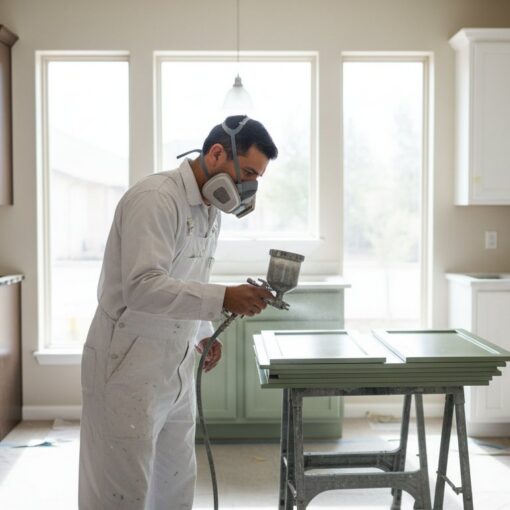
A professional cabinets refinishing project focuses on two distinct areas: the cabinet boxes and the doors. The boxes remain fixed to your walls and are processed on-site using precise hand-sanding and localized finishing. The doors and drawer fronts are removed and taken to a controlled shop environment. This off-site spraying is vital. It allows technicians to use High-Volume Low-Pressure (HVLP) systems that create a “factory finish” free from the dust, hair, and brush marks that plague DIY projects.
The technical process relies on chemical stripping rather than just mechanical sanding. While sanding is necessary for smoothing, chemical strippers reach deep into the wood pores to remove 100% of old oils and waxes. This ensures the new finish bonds correctly. In 2026, sustainability is a major driver for this service. A standard kitchen tear-out generates approximately 1,500 pounds of landfill waste. Refinishing eliminates this waste almost entirely, making it the most eco-friendly renovation path available for modern homeowners. It’s a way to get a brand-new look without the environmental or financial cost of a full demolition.
The Professional Step-by-Step Refinishing Workflow
Achieving a factory-grade result requires following a professional step-by-step refinishing workflow. This process isn’t just about changing a color; it’s a chemical and mechanical transformation of the wood surface. Most DIY attempts fail because they skip the invisible steps that ensure longevity. When you invest in cabinets refinishing, the goal is a surface that resists heat, moisture, and impact for 10 years or more. This level of durability starts with a systematic teardown where every hinge, handle, and screw is removed and organized in labeled bins to ensure 100% accuracy during reinstallation.
Preparation: The Most Critical Phase
Preparation accounts for nearly 65% of the total labor in a professional project. We don’t just wipe down the wood; we decontaminate it. Cooking oils and skin lipids are the primary causes of finish failure, often leading to peeling around stove hoods and high-touch handles. We use industrial strength degreasers to strip these oils away. Once clean, we mask the entire kitchen using 1.5-mil plastic sheeting and Rosin paper. This creates a controlled “spray booth” environment that protects your appliances and flooring from overspray. We also address structural imperfections. Using two-part chemical wood fillers, we fill old hardware holes and repair cracks. These fillers are superior to standard wood putty because they don’t shrink or crack over time, providing a perfectly flat substrate for the new finish.
After cleaning, we focus on the mechanical bond. We use 220-grit to 320-grit sandpaper to degloss the existing finish. This doesn’t mean stripping the wood to its raw state, but rather creating a microscopic “tooth” for the new coatings to grab onto. Without this step, the new finish sits on top of the old one like a sheet of plastic, prone to chipping at the slightest impact. For open-grain woods like oak, we apply high-build primers or wood conditioners. These specialized products fill the deep pores of the grain, resulting in a smooth, modern aesthetic that hides the dated look of heavy wood textures.
The Science of the Spray Finish
Brushing or rolling cabinets is a mistake if you want a professional result. Brushes leave microscopic ridges and valleys that trap dirt and oils, leading to premature wear. Instead, we use High Volume Low Pressure (HVLP) systems. These systems provide a 90% transfer efficiency, meaning more product lands on your cabinets and less is wasted in the air. The result is a finish so smooth it looks like it came straight from a high-end furniture factory.
The application process involves a strict multi-coat sequence. We start with two coats of an alkyd-resin or shellac-based primer to block tannins and stains. This is followed by two to three coats of a high-performance topcoat. During this phase, we monitor “mil thickness” using a wet-film gauge. A professional finish should reach a total dry film thickness of 4 to 5 mils. If the coating is too thin, it won’t withstand daily cleaning; if it’s too thick, the finish becomes brittle and may crack during seasonal wood expansion. If you’re looking for this level of precision in your home, you might consider how expert local technicians handle these technical requirements. This scientific approach ensures your cabinets refinishing project results in a surface that is as tough as it is beautiful.
Refinishing vs. Replacing: Cost, ROI, and Value Analysis
Deciding between a full kitchen gut job and professional cabinets refinishing comes down to two primary variables: your bank account and your patience. A standard professional refinishing project typically ranges from $3,000 to $7,000 for an average-sized kitchen. In contrast, a full cabinet replacement often starts at $15,000 and can easily climb to $40,000 for custom builds. You’re saving roughly 70% to 80% of the cost by keeping your existing boxes and focusing on the visible surfaces.
The timeline difference is equally staggering. Refinishing projects usually wrap up within 5 to 7 days. A full remodel requires 4 to 8 weeks of heavy construction. This doesn’t include the lead time for ordering materials, which often adds another 12 weeks to the schedule. Choosing to refinish means your kitchen stays functional for the majority of the month, avoiding the stress of living out of a microwave in your living room.
Environmental stewardship is a growing priority for Denver homeowners. According to EPA data, 12.2 million tons of wood and furniture waste enter U.S. landfills annually. By opting for a refresh, you keep hundreds of pounds of solid wood out of the Denver Arapahoe Disposal Site. It’s a sustainable choice that honors the high-quality timber used in older homes rather than contributing to the cycle of disposable “fast furniture” cabinetry.
Looking toward the 2026 real estate market, experts predict that kitchen aesthetics will remain the top driver for home appraisals. A dated kitchen can slash a home’s market value by $20,000 or more. Because the process of cabinets refinishing provides a modern, factory-grade look for a fraction of the price, the return on investment often exceeds 85%. It’s the most efficient way to boost equity before a sale without taking on a massive renovation loan.
Calculating Your Total Investment
Several variables dictate your final quote. Door count is the biggest factor; a 20-door kitchen costs significantly less than a 45-door estate. Wood species like oak require extra labor for grain filling, which adds about 15% to the labor cost. Don’t forget hidden replacement costs. New cabinets often require $1,200 for plumbing reconnects, $500 for electrical permits, and $3,000 for new countertops. Refinishing avoids these secondary expenses entirely, keeping your budget focused on the visual upgrade.
When to Replace Instead of Refinish
Sometimes, refinishing isn’t the answer. If your cabinet bases are made of “water-blown” particle board that has swelled more than 1/8 inch, the structural integrity is gone. You should also consider replacement if the current layout is dysfunctional. If your “Work Triangle” is broken, no amount of paint will fix the poor workflow. Finally, assess your hardware. If 25-year-old drawer glides are failing and cannot be easily swapped for soft-close versions, a full replacement might be the smarter long-term move.
Choosing the Right Finish: Trends and Denver Climate Factors
As we look toward 2026, the color palette for cabinets refinishing is shifting away from clinical whites toward organic, grounding tones. Designers are prioritizing biophilic shades like sage green, deep forest, and clay-based terracotta. Warm neutrals, often referred to as “mushroom” or “greige,” now account for 38% of new kitchen color requests in high-end renovations. These colors provide a sophisticated backdrop that feels inviting while maintaining a clean, modern edge.
The choice of sheen is just as vital as the color itself. While high-gloss finishes dominated the early 2010s, today’s homeowners favor satin and matte. Satin finishes, which typically offer a 25% to 35% gloss level, provide enough light reflection to be easily cleaned without highlighting every fingerprint or surface imperfection. Matte finishes, sitting at a 5% to 10% gloss level, offer a contemporary, velvety look that absorbs light. This is particularly effective in kitchens with large windows where glare can be an issue.
Indoor air quality is a non-negotiable factor for 85% of modern homeowners. Using low-VOC (Volatile Organic Compounds), water-borne coatings ensures that your family isn’t exposed to harmful off-gassing. These advanced coatings dry faster than traditional oil-based products. They also offer superior color retention, preventing the yellowing that often plagues older oil-based paints over a five to ten year period.
Denver Climate Considerations
Denver’s semi-arid climate, with an average annual humidity of just 30%, presents unique challenges. Low humidity allows for superior finish bonding because moisture rarely gets trapped under the coating. However, our 5,280-foot altitude means UV radiation is 20% more intense than at sea level. This makes UV-resistant topcoats essential to prevent fading on sun-drenched cabinets. Professional refinishers must also manage wood contraction to prevent hairline cracks in cabinet joints.
Selecting Your Aesthetic: Stain vs. Solid Color
Modern staining techniques have evolved significantly. Cerused finishes, which use a contrasting grain filler to highlight wood texture, are seeing a 22% increase in popularity for 2026 designs. If you prefer solid colors, the two-tone trend remains dominant. Industry data shows that 65% of kitchen remodels now feature a darker island paired with lighter perimeter cabinets. This creates a focal point and adds visual depth to the space.
To finalize your design, consider your hardware carefully. Matte black pulls offer a sharp, modern contrast against light neutrals. Conversely, unlacquered brass adds warmth to deep greens and blues. Matching these metals to your chosen finish ensures a cohesive look that will last for years. Quality finishes are an investment in your home’s value and your daily enjoyment of the space.
Contact our Denver cabinets refinishing experts to discuss your project today.
Why Professional Cabinet Refinishing in Denver Wins
While the idea of a weekend project sounds appealing, the DIY trap often leads to long term frustration. Statistics from home renovation surveys indicate that 68% of homeowners who attempt their own cabinets refinishing regret the decision within the first 12 months. The primary issues involve peeling finishes, visible brush marks, and permanent wood damage caused by improper sanding techniques. When you tackle this yourself, you often use retail grade paints that lack the chemical hardeners required to withstand the heat and grease of a busy kitchen. This leads to a sticky or tacky surface that collects grime and eventually fails.
Local expertise is vital because Denver’s climate presents specific challenges for wood. With 300 days of sunshine and an average humidity level of just 33%, wood in Colorado homes expands and contracts significantly. A professional understands how to treat a 1920s Craftsman kitchen in Wash Park differently than a 2024 modern minimalist setup in Cherry Creek. These different home styles require specific prep work and coating flexibility to ensure the finish doesn’t crack as the seasons change. Professional refinishers also know how to navigate the architectural nuances of Denver homes, ensuring the final look matches the historical or contemporary character of your neighborhood.
When searching for a Denver cabinet painting company, you should demand high standards. A reputable contractor must carry at least $1 million in general liability insurance to protect your property. Ask to see a portfolio featuring at least 50 completed local projects. A professional process isn’t just about applying color; it’s about the science of adhesion. It’s common for low quality contractors to skip the decontamination phase, which is a mistake that causes 90% of finish failures. Ensure your chosen team uses a dedicated 5-stage cleaning process to remove every trace of cooking oils before the first drop of primer touches the wood.
Questions to Ask Your Refinishing Contractor
Start by asking about their materials. Do they use industrial grade coatings or standard house paint? Standard latex paint is too soft for kitchen environments and will peel around handles. Professional shops use catalyzed lacquers or 2K polyurethanes that offer superior durability. You should also ask about their process for dust containment. Ensure they utilize HEPA filtration systems to capture 99.7% of airborne particles. Finally, always request a written warranty and at least three local Denver references from projects completed more than two years ago.
Transform Your Kitchen with Cabinet Painting Denver
Our team specializes in a rigorous 9-step spraying process that delivers a factory quality finish right in your home. We use high end coatings that cure 40% harder than traditional hardware store products, ensuring your cabinets resist scratches and moisture for years. We understand your time is valuable. Our crew minimizes disruption by completing the on site portion of the project in just 3 to 4 days. We use specialized masking techniques to keep your living space clean and functional throughout the process. Our goal is to provide a kitchen that looks brand new without the $30,000 price tag of a full replacement. Schedule your free Denver cabinet refinishing estimate today!
Elevate Your Denver Home Value for 2026
You don’t need a $50,000 demolition to achieve a high-end kitchen. Professional cabinets refinishing delivers a modern aesthetic while saving homeowners up to 65% compared to full replacement costs. Our specialized HVLP spraying technique ensures a factory-grade finish that resists the unique humidity fluctuations of the Denver climate. By focusing on a detailed 12-point preparation process, we guarantee results that outlast standard brush-and-roller DIY projects by several years.
As a locally owned and operated Denver team, we understand that your home is your biggest asset. Recent 2026 real estate projections show that updated kitchens provide an 80% return on investment for Colorado sellers. Whether you’re looking for bold new trends or a classic look, our experts provide the precision your space deserves. Don’t settle for outdated wood when a showroom-quality transformation is within reach. Get a Free Cabinet Refinishing Quote from Denver Experts and start your kitchen journey today. You’ll love the way your home looks.
Frequently Asked Questions
How long does professional cabinet refinishing usually take?
Professional cabinet refinishing usually takes 3 to 5 business days for a standard 20-linear-foot kitchen. The first 2 days focus on prep and cleaning; the final 3 days involve spraying and curing. This timeline prevents your kitchen from being out of commission for more than a week. We ensure the workspace is fully functional by the evening of the fifth day.
Is cabinet refinishing messy for the rest of my house?
No, the process isn’t messy because professionals use 6-mil plastic sheeting and HEPA-filtered vacuums to contain 98% of dust. We seal off doorways and vents to ensure overspray doesn’t travel to other rooms. You’ll find the rest of your house remains clean and habitable throughout the project. It’s a controlled environment that protects your furniture and flooring from any debris.
Can you refinish cabinets that are already painted?
Yes, you can refinish cabinets that are already painted as long as the underlying wood is structurally sound. We strip the existing 2 or 3 layers of old paint using chemical strippers or orbital sanders. This allows the new coating to bond directly to the wood grain for a factory-like finish. It’s a common request for homeowners looking to change colors or fix peeling surfaces.
What is the most durable finish for kitchen cabinets in 2026?
Water-borne 2K polyurethanes are the most durable finish for kitchen cabinets in 2026. These coatings offer a 4H pencil hardness rating and resist chemicals like vinegar or grease for over 24 hours without staining. They’ve replaced traditional lacquers because they don’t yellow or crack over a 10-year period. You’ll get a surface that withstands daily scrubbing and high-traffic kitchen activity without fading.
Do I need to empty my cabinets before they are refinished?
You must empty all items from your countertops, but you don’t necessarily need to empty the inside of the boxes if they’re being painted on the exterior only. We seal the openings with 3M masking paper to protect your dishes. However, removing 100% of items is recommended to ensure no dust settles on your cookware. Most clients spend 2 hours clearing their surfaces before we arrive.
How much does it cost to refinish cabinets in the Denver area?
In the Denver metro area, cabinets refinishing costs between $3,500 and $7,000 for an average-sized kitchen with 25 to 30 openings. Labor accounts for 70% of this total; high-end coatings and materials make up the remaining 30%. Prices vary based on whether you choose a solid color or a wood stain. This investment is significantly lower than the $25,000 required for full replacement.
What is the difference between refinishing and refacing?
Refinishing involves sanding and painting your existing doors, while refacing replaces the doors and drawer fronts entirely with new materials. Refinishing saves you 50% compared to the cost of refacing. It’s the best choice if your current door style is still modern but the color is outdated. Most projects focus on refinishing because it’s faster and uses the high-quality wood already in your home.
Will refinishing my cabinets increase my home value?
Investing in cabinets refinishing typically yields a 65% to 80% return on investment when you sell your home. Real estate data from 2024 shows that updated kitchens help homes sell 22 days faster than those with dated oak or maple cabinetry. It’s a cost-effective way to modernize the space without a $50,000 remodel. You’ll attract more buyers with a fresh, contemporary look.