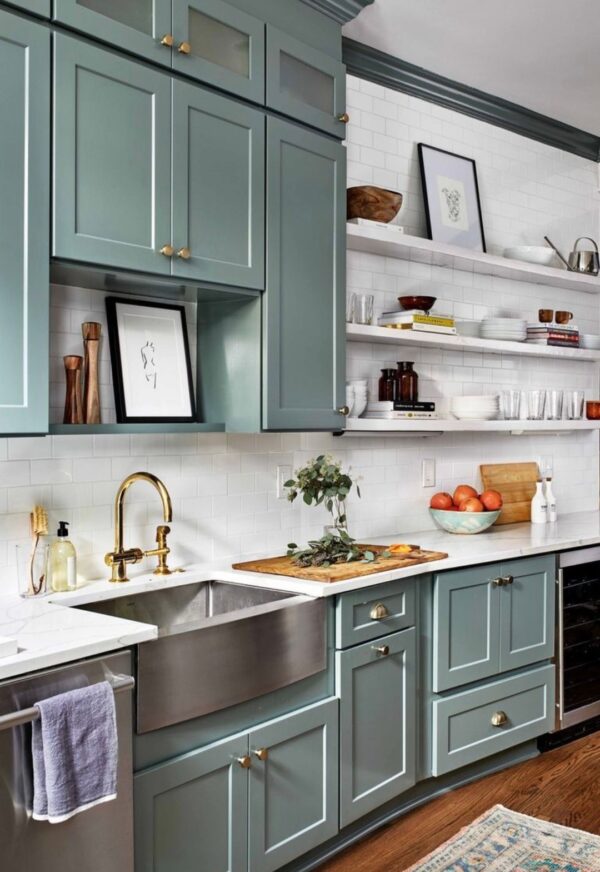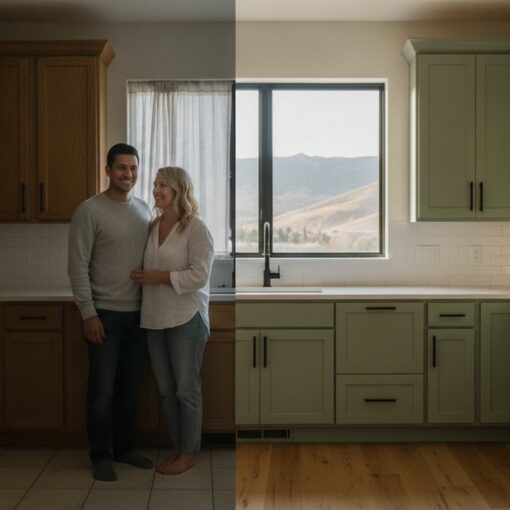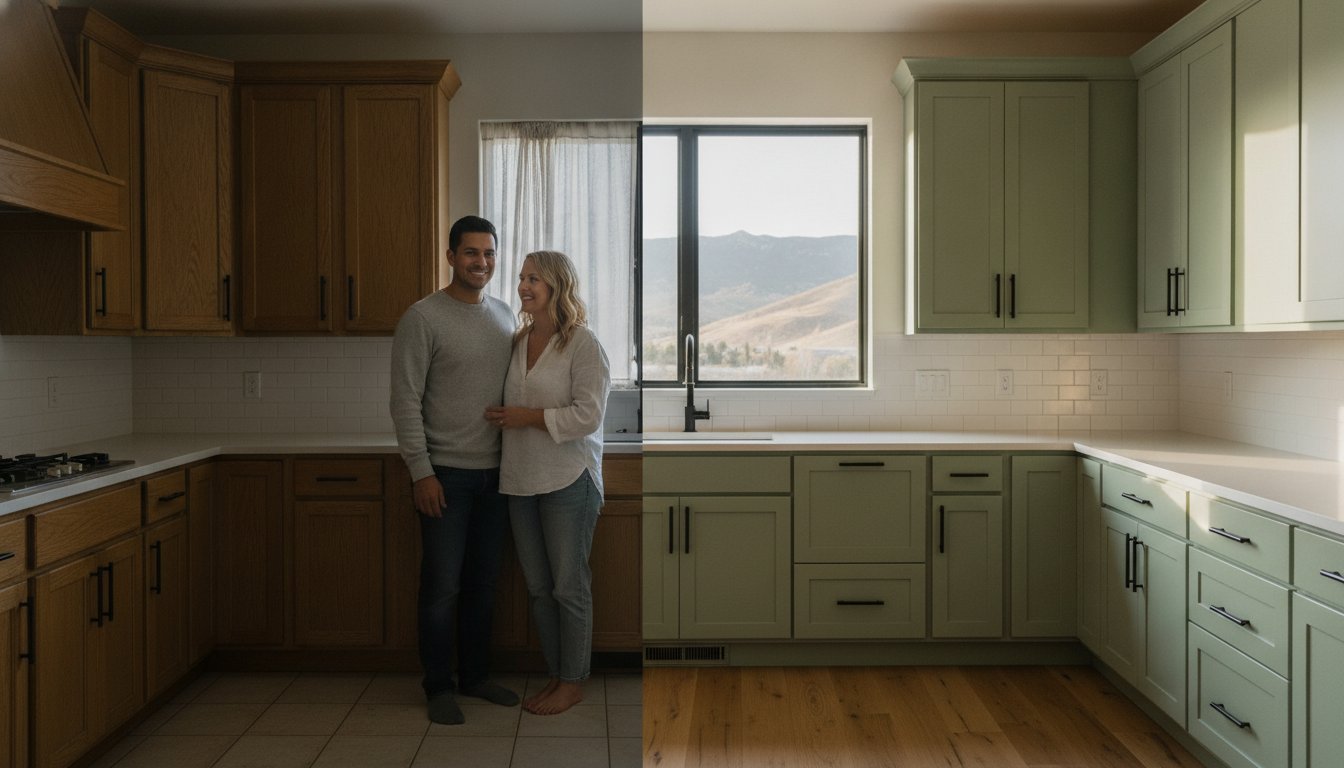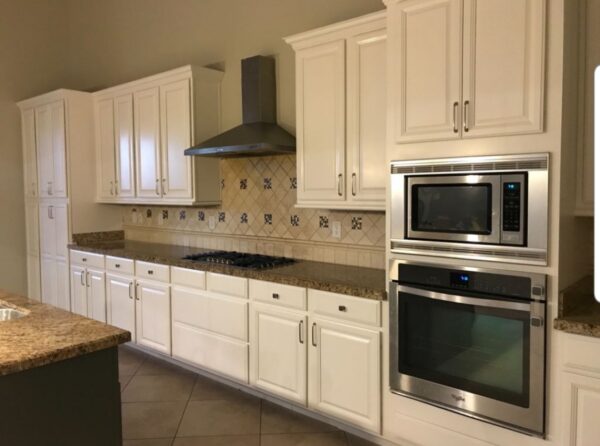
Last October, a Denver homeowner invested $450 in high-end DIY paint only to end up with a streaky finish and three ruined cabinet doors from incorrect drilling. It’s a common story because while the idea of a weekend project sounds appealing, most homeowners quickly realize that achieving a factory-grade result requires more than just a brush. You deserve a kitchen that looks brand new without the $30,000 price tag of a full replacement, but you also need to avoid the "cheap" look of a botched paint job. Understanding the 2026 cost to paint kitchen cabinets and install hardware is the first step toward a successful renovation that actually adds value to your home.
Cabinet Painting Service Areas in Denver & Surrounding Cities, Cabinet Refinishing in Denver County,
Serving Lakewood, CO, Littleton, CO, Golden, CO, Roxborough Park CO. Ken Carl Ranch CO, Washington Park Area,
Arvada, CO, Wheat Ridge, CO,
and Castle Pines CO. Englewood CO. Centennial CO.
Cabinet Painting in Arapahoe County, CO
Including Centennial, CO, Greenwood Village, CO,
Cherry Hills Village, CO,
and Aurora, CO.
Cabinet Painting in Adams County & Broomfield, CO
We agree that navigating contractor quotes can feel overwhelming, especially when 65% of local estimates vary wildly between per-door and per-linear-foot pricing. This guide provides a transparent breakdown of professional labor rates and material costs specifically for the Denver market. You’ll learn exactly how to budget for a durable, spray-applied finish and perfectly aligned pulls. We are covering everything from hidden supply fees to the 15% premium for specialty finishes so you can start your project with total clarity.
Key Takeaways
-
Establish a realistic 2026 budget by understanding the average price ranges and scope of professional cabinet transformations in the Denver area.
-
Learn how "per-opening" pricing models work and why the distinction between in-home box painting and shop-sprayed doors is critical for a high-end finish.
-
Calculate the total cost to paint kitchen cabinets and install hardware by distinguishing between simple handle swaps and precision-drilled retrofitting.
-
Uncover how specific wood species and local Denver labor trends can drive your project quote up or down, allowing for better financial planning.
-
Gain peace of mind by exploring why professional warranties and factory-grade durability offer a significantly higher ROI than standard DIY methods.
Table of Contents
-
The Total Investment: 2026 Cost to Paint Kitchen Cabinets and Install Hardware
-
Breaking Down the Quote: Per-Door and Per-Drawer Pricing Models
-
Factors That Drive Denver Cabinet Painting Quotes Up or Down
-
Why Professional Installation and Painting is the Ultimate ROI Choice
The Total Investment: 2026 Cost to Paint Kitchen Cabinets and Install Hardware
Kitchen remodeling trends in 2026 prioritize sustainability and high-impact aesthetics without the waste of full demolition. For most homeowners, the cost to paint kitchen cabinets and install hardware represents the most efficient use of a home improvement budget. By choosing professional refinishing over a total gut job, you can expect to save 60% to 70% on your total project expenses. This approach preserves high-quality structural elements while giving the space a factory-fresh appearance. Understanding Cabinet Construction is vital here; if your current boxes are structurally sound, there is rarely a functional reason to replace them.
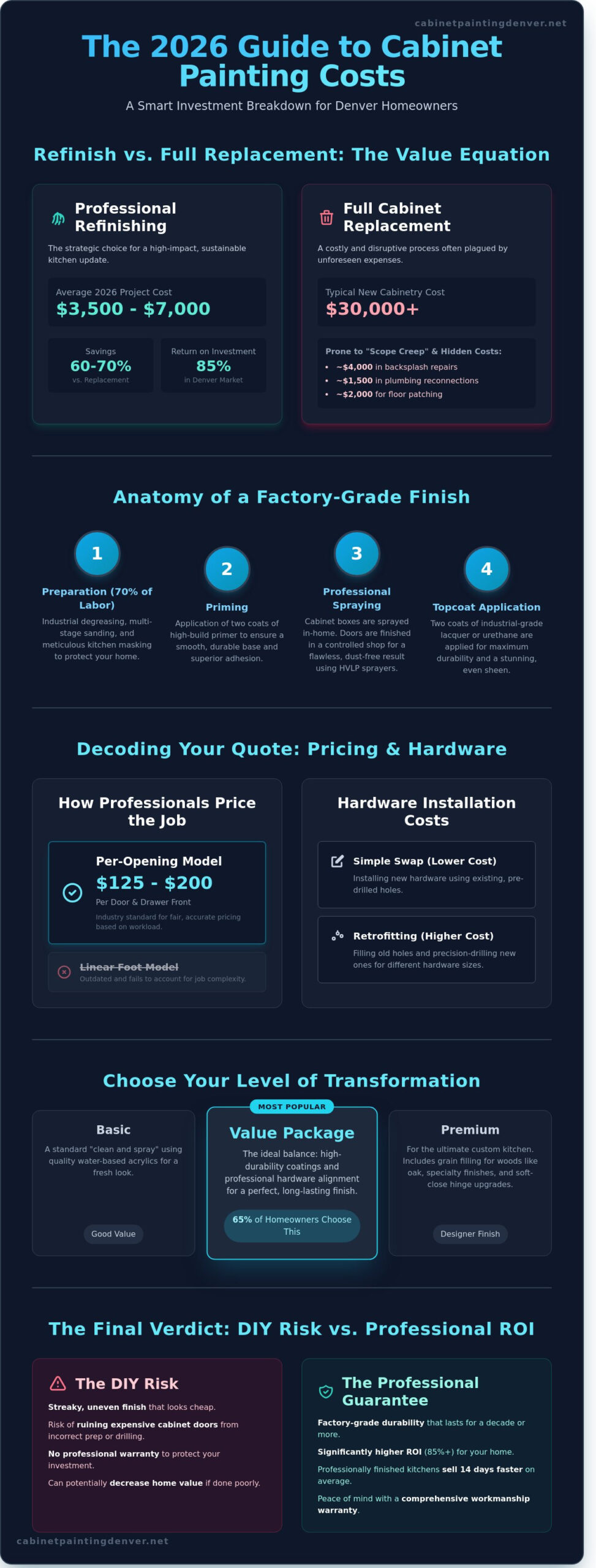
In 2026, the average cost to professionally paint a medium-sized kitchen and install new hardware ranges from $3,500 to $7,000 depending on door count and wood species. This investment typically covers a comprehensive scope of work. It includes deep cleaning to remove cooking oils, multi-stage sanding, primer application, and two topcoats of industrial-grade lacquer or urethane. It also accounts for the labor required to drill new holes or fill old ones to accommodate modern pulls and knobs.
To better understand the variables that influence your project budget, watch this helpful video breakdown:
The Price of Quality: Refinishing vs. Replacing
Professional refinishing offers an impressive 85% return on investment in the 2026 Denver real estate market. Full replacement often triggers "scope creep," where you’re forced to pay for $4,000 in backsplash repairs, $1,500 in plumbing reconnections, and $2,000 for floor patching. Painting avoids these hidden costs entirely. Data from local 2025 home sales shows that kitchens with updated finishes sell 14 days faster than those with dated oak or maple aesthetics. It’s a strategic move for those who want a custom look without the $30,000 price tag of new cabinetry.
Standard vs. Premium Service Packages
Service levels vary based on the desired finish and longevity. A basic package usually includes a standard "clean and spray" using water-based acrylics. Premium packages, however, provide grain filling for open-pore woods like oak and the installation of soft-close hinges. About 65% of Denver homeowners select a mid-tier "Value" package. This level of service balances high-durability coatings with professional hardware alignment, ensuring the doors hang perfectly straight. It’s the sweet spot for maximizing the cost to paint kitchen cabinets and install hardware while achieving a high-end designer result.
Breaking Down the Quote: Per-Door and Per-Drawer Pricing Models
Most reputable contractors moved away from linear foot pricing by 2024 because it fails to account for the actual complexity of detailed millwork. In 2026, the industry standard relies on a per-opening count. This model ensures you pay for the exact volume of work rather than a vague estimate of wall space. Every door and drawer front is treated as an individual unit. Most Denver professionals charge between $125 and $200 per door/drawer for a full-service refinish. This price range typically covers the total cost to paint kitchen cabinets and install hardware while ensuring the finish lasts for a decade or more.
The door count model is superior to the linear foot model because it reflects the labor involved in removing, transporting, and spraying individual components. A kitchen with 30 small drawers requires significantly more effort than one with 10 large pantry doors, even if the total square footage is the same. Professional painters calculate labor by splitting the project into two zones: the cabinet boxes, which are painted in-home, and the doors, which are sprayed in a controlled shop environment for a dust-free result.
Labor Costs: Prep Work and Professional Spraying
Professional refinishing is a labor-intensive process where 70% of the total cost is dedicated to preparation. This involves deep cleaning with industrial degreasers, mechanical sanding to create a "profile" for the paint, and meticulously masking the kitchen to prevent overspray. Technicians use HVLP (High Volume Low Pressure) sprayers to achieve a factory finish. To meet 2026 durability standards, a professional crew applies a minimum of four coats, including two high-build primers and two specialized topcoats. If your property was built before 1978, contractors must adhere to lead-safe work practices to manage hazardous dust during the sanding phase.
Material Costs: Primers, Topcoats, and Consumables
The quality of the chemicals used determines if your cabinets will chip within six months or last fifteen years. Standard latex paints are insufficient for the high-traffic environment of a kitchen. Instead, professionals utilize Italian pigmented lacquers or waterborne alkyd urethanes. Choosing the best paint for cabinets represents about 15% of your total project cost. Beyond the paint, consumables like 3M delicate surface tape, plastic sheeting, and floor protection paper add an average of $450 to the material overhead for a standard 25-opening kitchen. High-quality materials ensure the cost to paint kitchen cabinets and install hardware provides a long-term return on investment.
Understanding these specific line items allows you to spot quotes that might be cutting corners on essential prep or material quality. If you are ready to see how these metrics apply to your specific kitchen layout, you can get a customized quote from a local specialist today.
Hardware Installation Costs: New Holes vs. Existing Holes
Swapping hardware seems like a small detail, but it significantly impacts your total project budget. Professionals distinguish between a simple "swap" and a complex "retrofit." A swap involves using existing holes, which is a fast process. A retrofit requires filling old holes with specialized wood epoxy, sanding the surface perfectly flush, and drilling new holes. This process is mandatory if you’re switching from dated 3-inch center-to-center pulls to modern 6-inch or 10-inch versions.
For 2026 projects, the cost to paint kitchen cabinets and install hardware includes labor rates between $5 and $15 per piece. Simple swaps usually sit at the lower end of that range. Retrofitting requires significantly more precision and time, pushing labor costs toward the $15 mark per handle. According to industry data from early 2026, 42% of homeowners choose to replace hardware during a paint job to maximize the visual transformation. While some homeowners attempt this as a DIY task, the total cost to paint kitchen cabinets often includes professional installation to ensure the fresh finish stays protected during the drilling process.
Choosing Your Hardware: Knobs, Pulls, and Hinges
Retail prices for hardware have stabilized in 2026, with designer knobs averaging $8 to $14 each. High-end pulls typically range from $18 to $55 depending on the material and weight. In Denver, 68% of recent kitchen renovations feature "mixed metals." This trend involves pairing matte black pulls on the perimeter cabinets with brushed gold or champagne bronze on the island. When selecting your hardware, consider the undertones of your paint. Cool grays pair best with polished nickel, while warm whites look stunning with oil-rubbed bronze.
The Technical Side: Jigs, Drilling, and Alignment
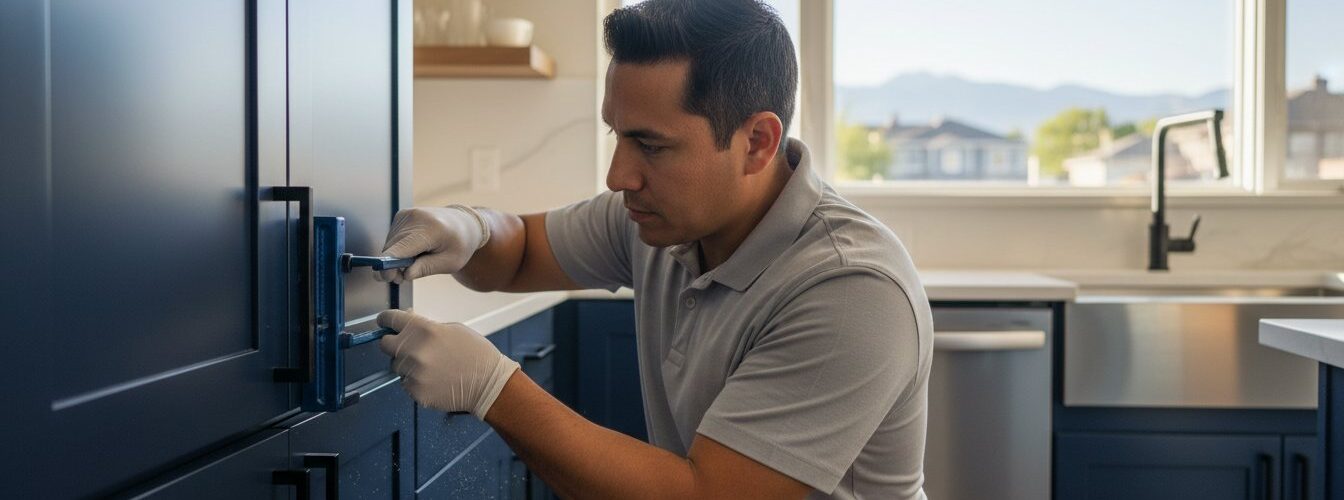
Precision is the difference between a high-end look and a sloppy renovation. A 1/16" error is visible to the naked eye, especially on long rows of drawers. Professionals use adjustable metal jigs and laser levels to maintain 1/32" accuracy across the entire kitchen. DIY attempts often lead to "drift," where the drill bit wanders and ruins the door face.
The cost to paint kitchen cabinets and install hardware also accounts for specialized tools needed for oversized pulls or heavy-duty appliance handles. These larger pieces require reinforced mounting techniques to prevent the wood from splitting under the weight of a heavy refrigerator door. If you’re using heavy solid brass hardware, the installer must ensure the mounting screws are the correct length to avoid piercing through the back of the cabinet door. Professionals verify these measurements before a single hole is drilled.
Factors That Drive Denver Cabinet Painting Quotes Up or Down
The 2026 Denver market presents unique challenges that directly influence your project estimate. Local labor rates in the Denver-Aurora-Lakewood corridor have stabilized at a 4.5% year-over-year increase, making local expertise more valuable than ever. Living in the foothills or suburbs like Castle Pines, Evergreen, or Boulder introduces specific logistics fees. Most contractors now apply a flat travel surcharge ranging from $150 to $300 to cover fuel and transit time for crews. The age of your cabinetry matters too. Cabinets installed before 2012 often require significant surface repair or professional degreasing to remove years of cooking oils. These repairs typically add 15% to the total labor cost compared to newer, well-maintained units.
Pricing isn’t just about the square footage of the doors. It’s about the hours required to achieve a durable finish that won’t peel in Colorado’s high-altitude environment. Professionals often see a 10% premium on quotes during the peak summer months when demand in the Rocky Mountain region hits its highest point. Booking during the late winter or early spring can often secure a more competitive rate before the busy season begins.
Wood Grain and Texture Considerations
Your wood species is the biggest variable in the prep phase. Oak cabinets feature a deep, open grain that remains visible after painting unless a specialized grain filler is applied. This process requires three extra stages of sanding and application, which increases labor by 25%. Maple and cherry are tight-grained woods. They provide a smooth, factory-like finish with standard priming. When calculating the cost to paint kitchen cabinets and install hardware, you’ll need to decide if you want the smooth modern look or the natural wood texture. Painting over previously finished surfaces that are peeling also requires a full strip-down, which adds significant time to the estimate.
Kitchen Layout and Accessibility
Architectural details shift the final number. A kitchen with a central island and floor-to-ceiling pantries requires 35% more masking and detail work than a standard L-shaped layout. High-end features like integrated crown molding or glass-front inserts demand precision hand-cutting. Colorado’s climate also plays a role. Dry winter months with humidity levels below 15% affect how paint levels out. A professional estimate for the cost to paint kitchen cabinets and install hardware will always account for your specific architectural complexity and the seasonal demand of the Denver metro area.
Ready to transform your space? Get a detailed Denver cabinet painting quote tailored to your kitchen’s specific layout and wood type.
Why Professional Installation and Painting is the Ultimate ROI Choice
Investing in your kitchen isn’t just about aesthetics; it’s about property value. In 2026, homeowners see a 65% to 80% return on investment for minor kitchen updates. When you weigh the cost to paint kitchen cabinets and install hardware against a full replacement, the savings are often 70% or higher. DIY projects frequently fail within 12 months because of poor adhesion and improper tool selection. A cabinet painting company provides industrial-grade equipment and climate-controlled drying that home setups can’t match. This ensures your investment lasts for a decade, not just a single season.
Professional finishes offer a level of durability that store-bought paints lack. When you calculate the total cost to paint kitchen cabinets and install hardware, professional labor accounts for roughly 60% of the budget. This covers the intensive prep work that prevents future peeling. Most DIY attempts show wear within 18 months, whereas a professional finish often lasts 12 years or more. This longevity makes the professional route the smarter financial choice for Denver homeowners looking to maximize their equity.
The Longevity of Professional Finishes
Modern 2026 coatings use advanced cross-linking polymers that resist grease, moisture, and heavy impact. These finishes are 45% more durable than standard acrylic paints found in big-box hardware stores. The right cabinet refinishing process involves chemical de-glossing and mechanical sanding to create a permanent bond. To keep them looking new, wipe surfaces with a microfiber cloth and a pH-neutral cleaner every two weeks. Avoid abrasive pads, which can dull the sheen over 3 to 5 years of use.
Next Steps: Booking Your Denver Consultation
Before the estimator arrives, clear your counters and identify any broken hinges or misaligned doors. Look through a contractor’s portfolio specifically for hardware alignment. Crooked handles or off-center knobs are signs of rushed work. A reputable professional should provide a 3-year or 5-year warranty on both labor and materials. This peace of mind is vital for long-term satisfaction. Ready to transform your space? Contact Cabinet Painting Denver for a free quote today to get started on your 2026 kitchen refresh.
Final Checklist Before Signing Your Contract:
-
Verify the company carries at least $1 million in general liability insurance.
-
Ask for the specific brand of industrial coating they use; look for KCMA-rated products.
-
Confirm the project timeline, which usually ranges from 4 to 7 business days.
-
Ensure the hardware quote includes drilling new holes if you’re switching from knobs to pulls.
-
Request a written maintenance guide to protect your warranty.
Ready to Refresh Your Denver Kitchen in 2026?
Updating your home starts with a clear understanding of the 2026 cost to paint kitchen cabinets and install hardware. Professional HVLP spray finishes provide a durable, factory-smooth surface that resists daily wear, while expert hardware alignment prevents the common 10% to 15% error rate seen in DIY drilling projects. By choosing a professional team, you’re investing in a high-end finish that can boost your property value by significant margins this year. We serve the entire Denver Metro Area with precision tools and premium materials designed for maximum longevity. Don’t settle for outdated colors or crooked handles when a complete transformation is just one step away. Your dream kitchen is closer than you think, and it starts with a detailed plan tailored to your specific layout and style preferences.
Get Your Free 2026 Cabinet Painting & Hardware Quote
We look forward to helping you create a beautiful, modern space you’ll love coming home to every single day.
Frequently Asked Questions
How much does it cost to paint kitchen cabinets in Denver in 2026?
In 2026, the average cost to paint kitchen cabinets in Denver ranges from $3,500 to $6,500 for a standard kitchen with 25 to 30 openings. This price reflects a 4% annual increase in labor and material costs since 2024. You should expect to pay between $125 and $165 per door or drawer face for a professional factory-grade finish. High-end lacquer applications or kitchens with more than 40 openings often exceed $8,000.
Is it cheaper to buy my own hardware or have the painter provide it?
You’ll save 15% to 20% on material costs by purchasing your own hardware instead of having a painter source it. Professional painters typically apply a markup to cover the time spent ordering, picking up, and transporting the items. If you buy your own pulls from a retailer like Top Knobs or Amerock, you control the budget directly. Just make sure you have all 30 or 40 pieces on-site before the crew arrives to avoid delay fees.
How much extra does it cost to drill new holes for cabinet handles?
Professional installers charge between $5 and $10 per hole to drill new locations for cabinet handles. If you’re switching from a single-hole knob to a 5-inch pull, the technician must fill the old hole with specialized epoxy and drill two new ones. For a 30-piece kitchen, this adds $150 to $300 to your final bill. The team uses precision metal templates to ensure every handle sits exactly 2 inches from the door edge.
Can I paint my cabinets myself and just hire a pro for the hardware?
Most professional installers won’t accept jobs to install hardware on DIY-painted cabinets because the risk of chipping a non-professional finish is too high. If you painted the surfaces yourself, you’re responsible for the 48-hour cure time required before any drilling begins. A professional’s insurance rarely covers damage to a home-painted surface. You’re better off hiring a pro for the full cost to paint kitchen cabinets and install hardware to ensure a warrantied result.
How long does the painting and hardware installation process take?
The entire painting and hardware installation process takes 5 to 7 business days for a standard Denver home. Days 1 and 2 involve heavy masking and surface preparation, while days 3 and 4 focus on spraying the frames and doors. We install the new hardware on day 6 after the industrial coatings have hardened sufficiently. This timeline ensures the 2026-grade finishes don’t smudge or dent during the final assembly phase.
Do I need to empty my cabinets before the painters arrive?
You must empty 100% of your cabinet contents before the painting crew arrives on the first scheduled morning. While some low-end painters only require you to clear the front 6 inches of the shelves, professional spraying creates fine dust that settles on dishes. Removing all items prevents overspray from ruining your expensive cookware. It also allows the team to mask the interior boxes effectively, which protects your 2026 renovation investment.
What happens if I want to change from knobs to pulls during the painting process?
You must decide to switch from knobs to pulls before the priming stage begins on day two of the project. The painter needs to fill the existing single holes with a high-strength wood epoxy and sand them flush before applying the first coat of primer. If you change your mind after the topcoat is applied, you’ll pay an additional $45 per door for spot repairs and repainting. This ensures the old hole is invisible under the 2026 finish.
Is hardware installation included in a standard cabinet painting quote?
Hardware installation is usually listed as a separate line item rather than being included in a basic painting quote. Most Denver contractors charge a flat fee of $200 to $400 for basic replacement using existing holes. If your project requires drilling new holes or filling old ones, expect the total cost to paint kitchen cabinets and install hardware to increase by $10 per opening. Always check your 2026 contract for these specific labor charges before the work starts.