What if the most vulnerable moment for your Kitchen Cabinet Painting project is the exact second you think it’s finished? While a surface might feel dry to the touch within hours, the professional cabinet paint curing process is a complex chemical transformation that takes much longer than simple moisture evaporation. It’s natural to want your kitchen back in working order quickly; however, rushing the process can lead to permanent damage and visible chipping on your new surfaces.
Serving Lakewood, CO, Littleton, CO, Golden, CO, Roxborough Park CO. Ken Carl Ranch CO, Washington Park Area,
Cabinet Painting Service Areas in Denver & Surrounding Cities, Cabinet Refinishing in Denver County,
Arvada, CO, Wheat Ridge, CO,
and Castle Pines CO. Englewood CO. Centennial CO.
Cabinet Painting in Arapahoe County, CO
Including Centennial, CO, Greenwood Village, CO,
Cherry Hills Village, CO,
and Aurora, CO.
Cabinet Painting in Adams County & Broomfield, CO
We understand that you want a scratch-resistant finish that meets ANSI/KCMA A161.1-2022 durability standards to protect your home investment. This guide explains the critical difference between drying and curing so you can ensure a factory-hard result that lasts for years. You’ll learn the specific 30 day timeline required for the coating to reach its maximum hardness, how to navigate the challenges of Denver’s dry climate, and the correct methods for cleaning your new cabinets safely during the hardening phase.
Key Takeaways
- Distinguish between surface drying and chemical bonding to prevent premature damage to your kitchen or bathroom cabinet painting project.
- Learn how the professional cabinet paint curing process utilizes industrial catalysts to meet ANSI/KCMA A161.1-2022 durability standards.
- Understand how Denver’s low humidity affects coating stability and the specific steps taken to prevent “skinning” during the initial hardening phase.
- Follow a clear 30-day timeline for safe cabinet usage to ensure your finish remains scratch-resistant and factory-hard.
- Discover the advantages of off-site spraying in a controlled environment for achieving a durable, industrial-grade result.
Table of Contents
Dry vs. Cured: Understanding the Professional Cabinet Paint Curing Process
Achieving a high-quality result for your Kitchen Cabinet Painting project requires an understanding of the timeline beyond the initial application phase. Many homeowners assume that once the surface feels dry, the project is complete. Drying and curing are distinct. These phases represent the professional cabinet paint curing process. Drying occurs when the liquid solvents or water evaporate from the surface, leaving behind a solid film. While this makes the cabinets appear finished, the coating hasn’t reached its final density or strength.
This essential chemical process allows paint molecules to cross-link and form a dense, resilient barrier. This transformation represents a permanent chemical change that provides the necessary impact resistance for daily kitchen use. You can learn more about The Science of Curing to see how these molecular bonds create structural integrity. Until this chemical reaction finishes, touch-dry cabinets remain highly vulnerable. Simple actions like a stray fingernail mark or heat from a nearby steamer can permanently indent or delaminate the soft coating.
To better understand the chemistry behind professional coatings, watch this helpful video:
The Three Stages of the Finishing Timeline
Managing expectations for your cabinet surfaces involves tracking three specific phases. During Stage 1, the finish is dry to the touch within 1 to 4 hours. At this point, the surface is no longer tacky, which prevents airborne dust from settling into the wet finish. Stage 2 occurs between 24 and 48 hours when the coating becomes handleable. The material is stable enough for professional installers to re-attach hardware and hang doors back on the frames without causing immediate damage. Finally, Stage 3 is the fully cured phase, which takes 21 to 30 days. This is the only point where the finish achieves maximum chemical and scratch resistance.
Why Proper Curing Matters for Longevity
Following the professional cabinet paint curing process to its conclusion is the only way to prevent blocking, which is a common issue where cabinet doors stick to the frames and peel away when opened. Without this hardening period, the finish cannot effectively withstand the grease exposure and frequent cleaning inherent to a functional kitchen. Proper curing ensures the coating meets ANSI/KCMA A161.1-2022 standards for household chemical resistance. This standard guarantees that your Bathroom Cabinet Painting or bookshelves project remains durable against spills, moisture, and household cleaners for years to come.
The Science of High-Performance Coatings and KCMA Standards
Professional grade coatings differ fundamentally from the standard wall paint found at local hardware stores. While consumer latex paint relies almost entirely on the evaporation of water to dry, high-performance industrial coatings utilize chemical catalysts. These catalysts trigger a reaction during the professional cabinet paint curing process that transforms the liquid coating into a rigid, non-porous solid. This chemical transformation is what allows the finish to achieve a factory-hard surface that resists daily wear and tear.
The benchmark for this durability is established by the Kitchen Cabinet Manufacturers Association (KCMA) through the ANSI/KCMA A161.1-2022 standard. This rigorous testing protocol ensures that cabinet finishes can withstand extreme conditions. To meet these requirements, coatings are subjected to high humidity, temperature swings, and prolonged exposure to common household chemicals like vinegar, lemon juice, and detergents. Professional industrial coatings are engineered specifically to pass these tests, providing a level of protection that retail products cannot match. If you want a finish that survives the demands of a busy home, our professional cabinet painting services utilize these high-specification materials.
Chemical Cross-Linking Explained
Cross-linking is the specific molecular behavior that occurs as a professional coating cures. Instead of the paint molecules simply sitting on top of the wood grain, they weave together to form a dense, interconnected web. This creates a "plastic-like" shield that is significantly more durable than a standard dried paint film. Environmental factors play a major role here. Controlled shop temperatures and consistent airflow accelerate the speed of this chemical bonding. Additionally, professional spraying equipment applies the coating at a high velocity. This results in a tighter molecular bond and a smoother surface than manual brushing or rolling can ever achieve.
Professional Grade vs. DIY Paints
Many DIY "cabinet paints" lack the specialized chemical binders found in industrial lacquers or 2K polyurethanes. These consumer products often remain soft for weeks, leaving them susceptible to damage during the critical hardening phase. While some homeowners research cabinet refinishing as a way to update their space, painting requires a precise chemical compatibility between the primer and the topcoat. If these layers don’t bond correctly at a molecular level, the finish will eventually delaminate or peel. Professional systems ensure that every layer works together to facilitate the professional cabinet paint curing process, resulting in a finish that adheres permanently to the substrate.
Environmental Factors: How Denver’s Climate Affects Curing
Denver’s specific environment presents unique challenges for the professional cabinet paint curing process. While many regions struggle with high humidity, Colorado’s air is often extremely dry, with humidity levels frequently dropping below 20%. This lack of moisture can cause coatings to dry too quickly on the surface. When the top layer "skins over" before the underlying layers have a chance to release their solvents, it creates a structural weakness. This trapped moisture or gas can lead to bubbling or a finish that remains soft underneath a hard exterior shell.
Managing these conditions requires more than just waiting. In winter months, temperature fluctuations in Colorado kitchens can be significant. If the room drops below 50°F overnight, the chemical reaction required for curing may stall or stop entirely. Consistent airflow is often more critical than high heat for modern waterborne alkyds. Moving air helps carry away evaporated solvents without forcing the surface to dry prematurely. This balance is necessary for both Kitchen Cabinet Painting and Bathroom Cabinet Painting projects to ensure long-term durability.
Managing Arid Conditions in Colorado
In a high-altitude, low-humidity environment, cabinet painting Denver professionals often use humidifiers to maintain a relative humidity of 40% to 50%. This controlled moisture allows the paint to self-level properly before the skin forms. Without this intervention, the coating may show "orange peel" textures or brush marks because it didn’t have enough time to flow out. Altitude also affects the evaporation rate of solvents, requiring specific adjustments to the thinning and application techniques used during the professional cabinet paint curing process.
Optimal Temperature and Humidity Ranges
The ideal environment for curing cabinets stays between 65°F and 75°F. Maintaining these temperatures consistently for the first 72 hours is vital for the molecular bonds to set. Homeowners should avoid the common mistake of opening windows for ventilation during high-pollen or dusty seasons. While fresh air seems helpful, it introduces contaminants and causes unpredictable temperature swings that can ruin a factory-grade finish. Keeping the kitchen at a stable, moderate temperature ensures the coating achieves its intended hardness and chemical resistance.
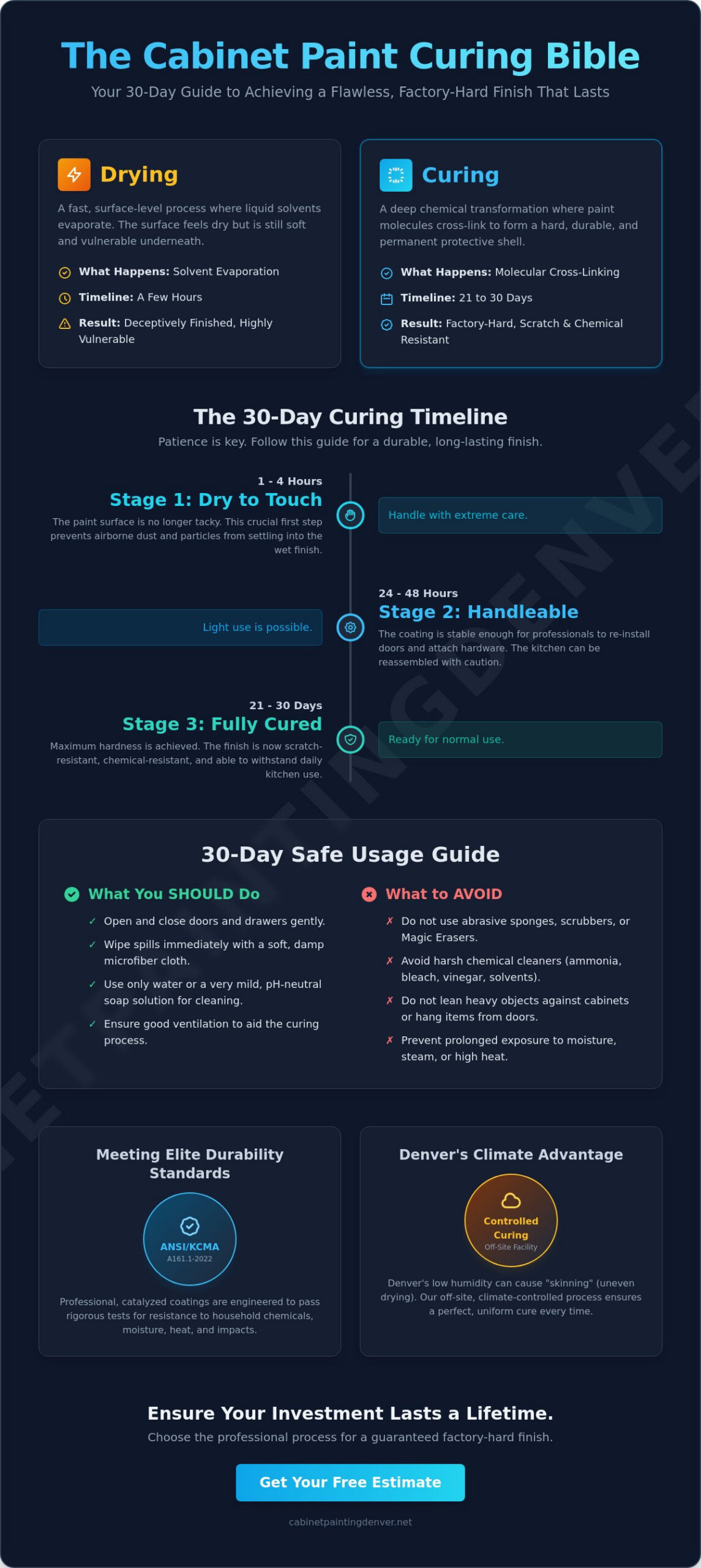
The 30-Day Survival Guide: Living with Curing Cabinets
The final installation of your Kitchen Cabinet Painting project marks the beginning of the most critical phase: the 30-day "hard cure." While your kitchen is technically functional, the professional cabinet paint curing process is still active beneath the surface. Treating the coating with extreme care during this month ensures the finish reaches its maximum industrial hardness without accidental damage. If you’ve invested in Bathroom Cabinet Painting or bookshelves, the same rules apply to those surfaces to prevent premature wear.
-
Days 1-3: Maintain a strict "no contact" policy. Keep pets, children, and vacuum cleaners away from all surfaces. Even a light touch can leave a permanent fingerprint in the soft film while it’s in its initial drying stage.
-
Days 4-14: Transition to light use. You can begin loading items back into the cabinets, but you must use the handles exclusively. Don’t touch the painted edges or faces with your fingers, as skin oils can interfere with the final hardening of the resins.
-
Days 15-30: The finish is gaining significant strength but remains sensitive to chemicals and high heat. Continue to avoid abrasive scrubbing or heavy-duty cleaning agents. The molecular bonds are still tightening during this period.
-
Post-30 Days: The chemical cross-linking is complete. You can resume standard cleaning protocols and full usage of your space. The finish is now factory-hard and ready for the rigors of daily life.
If you’re ready to start a project that stands the test of time, contact the experts at Cabinet Painting Denver to schedule your service.
Safe Cleaning Practices During Curing
Dust is the only thing you should remove during the first month. Use a dry, soft microfiber cloth to gently wipe away particles. You must avoid all citrus-based, ammonia-heavy, or abrasive cleaners for the full 30 days. These chemicals can dissolve the top layer of a fresh cure, leading to a hazy or sticky finish that’s difficult to repair. If a spill occurs, blot the area immediately with a damp cloth. Never rub the surface. Friction can create a permanent "burnish" mark on a semi-cured coating, ruining the consistent satin or matte look of your professional finish.
Appliances and Heat Management
Heat and moisture are the primary enemies of a fresh finish. Move coffee makers, toasters, and air fryers away from the underside of upper cabinets during the first two weeks. The concentrated steam and heat can cause "blushing," a condition where moisture gets trapped in the coating and creates a white, cloudy appearance. Be mindful of your dishwasher’s steam cycle as well. If possible, don’t use the high-heat drying setting. You can also crack a kitchen window to prevent steam from lingering on the surrounding cabinet frames during the professional cabinet paint curing process.
Ensuring a Factory Finish with Cabinet Painting Denver
Achieving a durable result for your Kitchen Cabinet Painting or Bathroom Cabinet Painting project isn’t just about the initial application. It’s about controlling the environment where the critical chemical bonding occurs. Our off-site spraying facility is designed to optimize the professional cabinet paint curing process by maintaining strict temperature and humidity levels. This controlled setting prevents the common issues of "skinning" or solvent entrapment that can occur in the variable climate of a residential home. By removing the doors and drawers to a dedicated shop, we ensure the coating hardens in a dust-free space with consistent airflow.
We utilize industrial-grade coatings that far exceed the durability and performance of standard paint for cabinets. These materials are specifically formulated to meet ANSI/KCMA A161.1-2022 standards, providing a finish that resists household chemicals and physical impacts. Every project follows the professional cabinet painters standard of excellence. This commitment to procedural clarity means we don’t skip steps in the cleaning, priming, or curing phases. The result is a factory-hard surface that looks new and stays resilient for years.
Why Our Process Reduces Your Downtime
Our operational system is built for efficiency without compromising the integrity of the finish. We use specialized drying racks and advanced airflow systems that accelerate Stage 2 of the curing timeline. This allows us to return your doors and drawers in a handleable state more quickly than traditional on-site methods. Our team uses expert re-installation techniques to protect the finish while it’s still in its vulnerable 30-day hardening phase. We conduct quality control checks at every stage of the professional cabinet paint curing process to verify that the chemical bond is forming correctly before the pieces ever leave our shop.
Request Your Professional Consultation
A professionally cured finish provides significant long-term value. Homeowners can save 60-70% by painting cabinets instead of replacing them, and these updates typically yield a 70-80% return on investment in the Colorado market. By choosing a specialized service for your bookshelves cabinet painting or kitchen update, you avoid the risks of premature chipping and peeling. We provide every Denver homeowner with detailed post-project care instructions to guide you through the 30-day curing window safely. Contact Cabinet Painting Denver today to request a professional consultation and receive an estimate for your project.
Achieve a Lasting Factory Finish for Your Home
Understanding the professional cabinet paint curing process is the critical difference between a finish that chips within months and one that lasts for decades. By respecting the 30 day hardening phase and managing Denver’s unique arid climate, you protect your significant home investment. Our team utilizes KCMA rated industrial coatings and a specialized off-site spray booth to ensure every project achieves factory quality curing. We’ve provided local Denver expertise since 2010 for homeowners seeking reliable bathroom cabinet painting, bookshelves painting, or kitchen updates.
Following these science based care protocols ensures your surfaces remain scratch resistant and easy to maintain. If you’re ready for a durable transformation that meets the highest performance standards, Get Your Free Cabinet Painting Quote in Denver. Your kitchen is the heart of your home; it deserves a professional finish built to withstand the rigorous demands of daily life. We look forward to helping you create a space that stays beautiful for years to come.
Frequently Asked Questions
How long does it take for cabinet paint to fully cure?
Full curing takes approximately 30 days to reach maximum industrial hardness. While the surface is handleable within 48 hours, the internal chemical bonds require a full month to finish cross-linking. During this time, the finish is susceptible to impressions from heavy objects or fingernails. This 30 day window is the standard for the professional cabinet paint curing process to ensure the coating meets industrial durability benchmarks.
Can I use my kitchen while the cabinets are curing?
You can return to light kitchen use after the first 72 hours of drying. However, you must exclusively use the hardware handles and avoid touching the painted surfaces with your fingers. Skin oils and heat can interfere with the chemical hardening process. Keep appliances that produce steam, such as coffee makers and kettles, away from the upper cabinets until the full 30 day period has passed.
Why does my cabinet paint feel sticky after a few days?
Stickiness, often called blocking, occurs when the paint hasn’t yet reached the second stage of the curing timeline. This is usually caused by excessive humidity or applying the coating too thickly, which traps solvents underneath the top layer. In Denver’s climate, this is less common but can happen if the workspace isn’t properly ventilated. If the surface remains tacky after 72 hours, it requires additional airflow to facilitate solvent release.
What is the difference between water-based and oil-based curing times?
Water-based industrial coatings typically dry to the touch within one hour, whereas oil-based products often require six to eight hours. Despite the faster drying time, both materials generally require a full 30 days to achieve a complete chemical cure. Modern waterborne alkyds used in Kitchen Cabinet Painting offer the advantage of lower odors and faster re-installation times without sacrificing the final hardness of traditional oil-based finishes.
How do I clean my cabinets during the first 30 days?
Clean your cabinets using only a dry, soft microfiber cloth during the first 30 days. Do not use water, detergents, or any abrasive cleaning pads, as these will damage the semi-soft finish. If a spill occurs, blot it immediately with a slightly damp cloth and dry the area right away. Avoid all citrus-based or ammonia-heavy cleaners until the professional cabinet paint curing process has reached its conclusion.
Does Denver’s altitude affect how my cabinet paint cures?
Denver’s high altitude and low humidity significantly accelerate the initial drying phase. The lower atmospheric pressure allows solvents to evaporate more quickly than at sea level. While this sounds beneficial, it increases the risk of the paint "skinning over" too fast. Professionals must adjust their application techniques and maintain a controlled environment to ensure the finish levels out properly before the surface hardens.
What happens if I chip the paint before it is fully cured?
Chipping the paint before it cures requires a professional touch-up to ensure the new layer bonds correctly. Because the surrounding finish is still soft, attempting a DIY repair often results in a visible patch or further delamination. It’s vital to keep pets and children away from the area during the first week. If damage occurs, leave the area alone and contact your technician to schedule a proper repair.
Is there a way to speed up the curing process at home?
You can support the curing process by maintaining a stable indoor temperature between 65°F and 75°F. Using floor fans to keep air circulating throughout the kitchen helps move evaporated solvents away from the cabinets. Don’t use space heaters or heat guns, as excessive direct heat can cause the paint to crack or bubble. Consistent, moderate airflow is the most effective way to help the coating harden naturally.