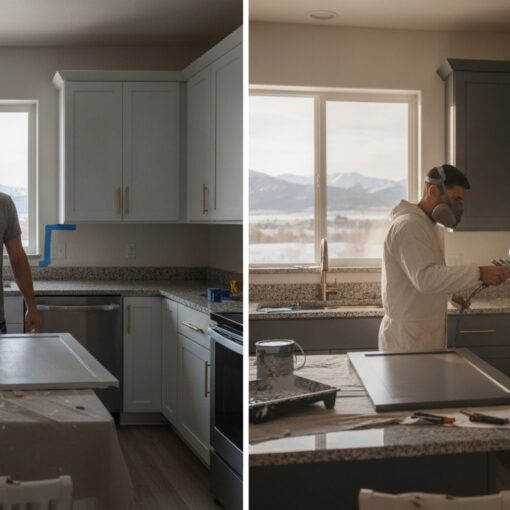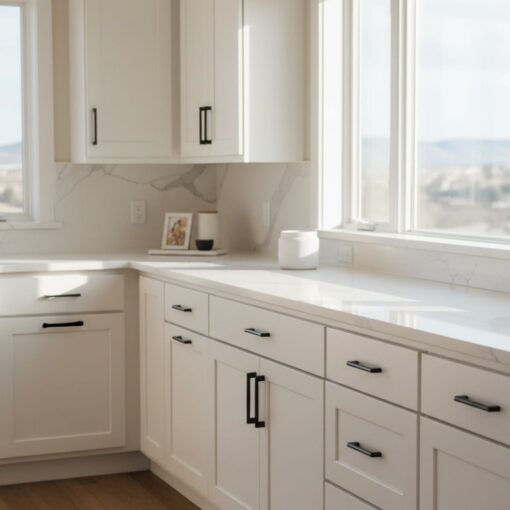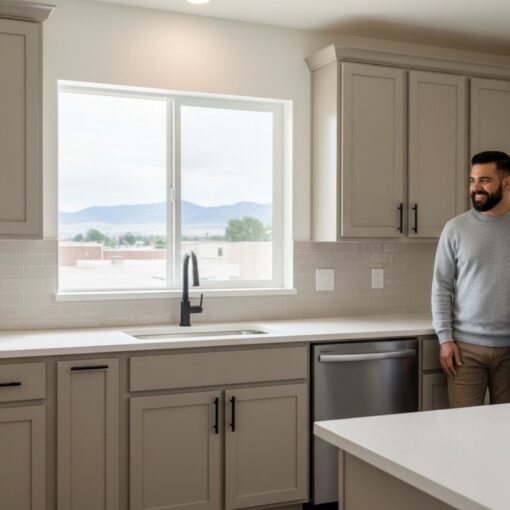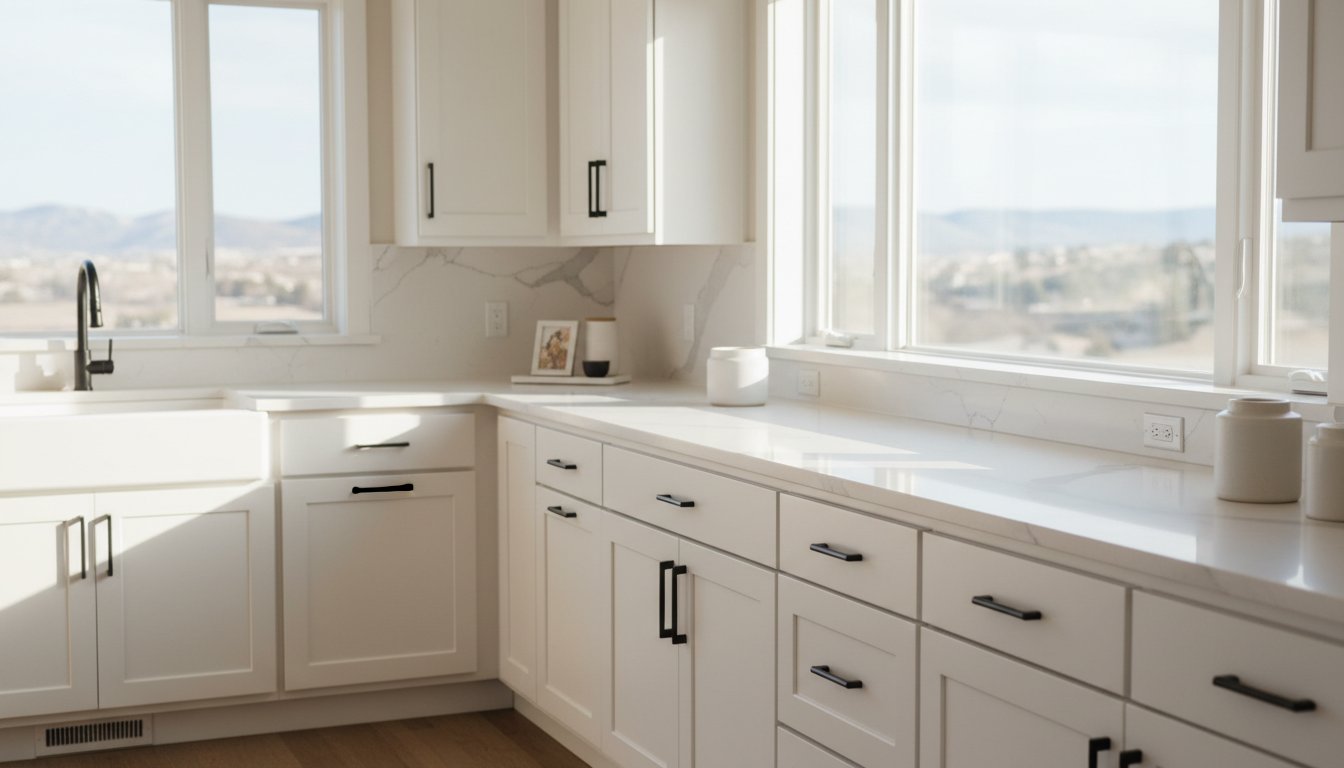
An estimated 60% of DIY cabinet painting projects show signs of failure, such as chipping or peeling, within 18 months. This usually happens because the process of painting oak cabinets without grain showing requires more than just a brush and a bucket of paint. Most homeowners find that standard coatings fail to hide the deep, porous pits inherent in oak, leading to a finish that looks homemade rather than professional.
It’s frustrating to spend your weekend working only to see the wood’s heavy texture still visible through the final coat. You deserve a glass-smooth surface that mimics the quality of a factory-new installation. This guide provides the exact professional-grade techniques and high-solids materials required to transform heavy oak textures into a sleek, grain-free finish. We’ll examine the three-stage mechanical leveling process, compare the costs of DIY versus professional Kitchen Cabinet Painting, and detail the specific high-build primers and fillers that ensure a long-lasting result.
Key Takeaways
- Understand why oak’s open-grain structure requires specialized filling techniques rather than just standard paint application.
- Master the professional double-fill protocol using water-based grain fillers to create a perfectly level surface on textured wood.
- Identify the critical differences between bonding primers and high-build surfacing primers for sealing oak tannins effectively.
- Learn the five-step professional sequence for painting oak cabinets without grain showing, starting with chemical deglossing and mechanical sanding.
- Evaluate the technical requirements of a grain-free finish, including the use of HVLP spray booths and industrial dust extraction.
The Challenge of Oak: Why Grain Shows Through Paint
Oak is a ring-porous hardwood. This anatomical structure means the wood contains large, deep vascular pores that function as open channels on the surface. When homeowners attempt painting oak cabinets without grain showing, they often find that standard coatings fail to bridge these physical pits. Instead of creating a flat surface, the paint follows the internal contour of the wood fibers and settles into the valleys.
This results in the “telegraphing” effect. As paint cures, it loses volume through evaporation. The remaining solids shrink and pull tight against the wood, which highlights the grain even more than before the paint was applied. The process of painting oak cabinets without grain showing is essentially a resurfacing project rather than a simple paint job. Achieving a 2026 factory-smooth standard requires a mechanical intervention to fill these voids before the final topcoat is ever touched.
To better understand this concept, watch this helpful video:
Open-Grain vs. Closed-Grain Woods
Woods like maple and cherry are closed-grain species with small, uniform pores that accept paint without significant texture issues. Oak is the opposite. The “honey oak” cabinets installed in previous decades are particularly difficult because they feature deep, erratic graining. Over time, original stains and lacquers can dry out and recede further into these pores. This creates an uneven substrate that resists simple over-coating and requires aggressive preparation to level.
The Limitations of Standard Cabinet Paint
Many believe that applying extra coats of the best paint for cabinets will eventually fill the grain. This is a technical misconception. Paint has surface tension that causes it to “bead” or flow into gaps rather than spanning across them. Standard kitchen cabinet painting protocols are designed for color change, not surface reconstruction. Higher sheen levels, such as semi-gloss or gloss, reflect light into the grain’s depths, making the texture even more prominent to the eye.
Professional Grain Filling: The Key to a Level Surface
The foundation of successful painting oak cabinets without grain showing relies on the “Double-Fill” protocol. Most standard DIY guides suggest a single application of filler, but professionals recognize this as a recipe for failure. Because fillers contain liquids that evaporate during the curing process, they naturally lose volume and shrink. A single layer will recede into the deep pores of the oak, leaving visible dimples once the paint dries. Two thin applications create a stable, level base that resists this volume loss and ensures the surface remains flat.
Selecting the right medium is the first step in this mechanical leveling process. Water-based grain fillers are preferred over traditional wood putties because they are designed to be spread across large surfaces and sand to a fine powder. Wood putties are often too thick and oily, which can lead to adhesion failure with modern cabinet paints. The “Zero-Pore” state is reached when the second application of filler remains perfectly flush with the wood surface after fully curing and sanding. Achieving this state is what separates a DIY attempt from a professional finish.
Your choice of application tools also dictates the quality of the bond. Plastic spreaders offer the necessary flexibility for contoured door profiles and beveled edges. In contrast, stainless steel putty knives provide the rigid edge required to scrape flat panels clean. Using these tools correctly ensures the filler is forced into the wood fibers rather than simply resting on the surface. If the technical nature of these stages feels overwhelming, seeking professional Kitchen Cabinet Painting can guarantee the smooth results you desire.
Types of Professional Grain Fillers
High-solids acrylic fillers are the industry standard for 2026 cabinet projects. They offer fast dry times and sand easily without clogging sandpaper or industrial equipment. For high-impact areas like drawer fronts or trash pull-outs, epoxy-based fillers provide superior durability and a stronger bond. Professionals often tint the filler to match the intended primer color. This strategic step improves coverage and reduces the total number of primer coats needed to achieve full opacity on dark oak.
The Art of the Mechanical Bond
A filler is only as effective as its adhesion to the substrate. Professionals perform a thorough scuff sand before filling to remove old topcoats and open the wood fibers. The “cross-hatch” application method is then used, where the filler is applied at a 45-degree angle to the grain and then repeated from the opposite direction. This technique forces material into the deepest vascular pores of the oak. Removing excess filler while it’s still wet is a critical efficiency step. It minimizes the labor-intensive sanding required to bring the surface back to a level plane.
High-Build Primers: The Second Line of Defense
Grain filling alone rarely achieves a factory-smooth surface. The next critical phase in painting oak cabinets without grain showing involves the application of high-build surfacing primers. While a standard bonding primer is designed to help paint stick to a surface, a high-build primer contains a significantly higher volume of solids. These solids act as a liquid filler, settling into any remaining microscopic pores or sanding scratches left behind from the grain-filling stage. This creates a uniform, non-porous substrate that prevents the final paint from “sinking” into the wood fibers over time.
Regional environmental factors play a major role in how these materials perform. In Denver’s semi-arid climate, the low average humidity can cause primers to dry too quickly. If the solvent evaporates before the primer has a chance to level out, it creates a bumpy “orange peel” texture. Professionals often adjust their application methods or use specific retarders to ensure the primer stays wet long enough to lay flat. This environmental management is essential for the “Sand-Back” technique, where the primer is sanded until it is perfectly smooth, leaving behind a base that feels like polished stone.
Solvent-Based vs. Waterborne Primers for Oak
Shellac-based primers remain the gold standard for oak projects. Oak is a high-tannin wood; waterborne primers often cause these natural oils to bleed through the finish as yellow or brown stains. Shellac creates an impermeable barrier that locks tannins in place while providing an incredibly fast dry time. For those seeking lower-VOC options in 2026, high-solids waterborne alkyds have improved significantly. However, you must avoid standard “all-purpose” latex primers. These lack the build and tannin-blocking properties required for professional kitchen cabinet painting on oak.
Sanding Grits and Sequence
- Initial Leveling: Use 120-grit sandpaper to remove the bulk of the high-build primer and flatten the surface.
- Refining the Plane: Transition to 220-grit for a final pass to remove any scratches from the previous stage.
- Guide Coating: Professionals often spray a light mist of a contrasting color over the primer. When sanded, this “guide coat” remains only in the low spots, clearly identifying any pits that still need attention.
Effective dust extraction is mandatory during this stage. Because high-build primers produce a fine, chalky dust, any particles left on the surface will contaminate the final topcoat. Using HEPA-filtered vacuums attached directly to sanders ensures the environment remains clean for the final stages of painting oak cabinets without grain showing.
The 5-Step Professional Process for a Smooth Finish
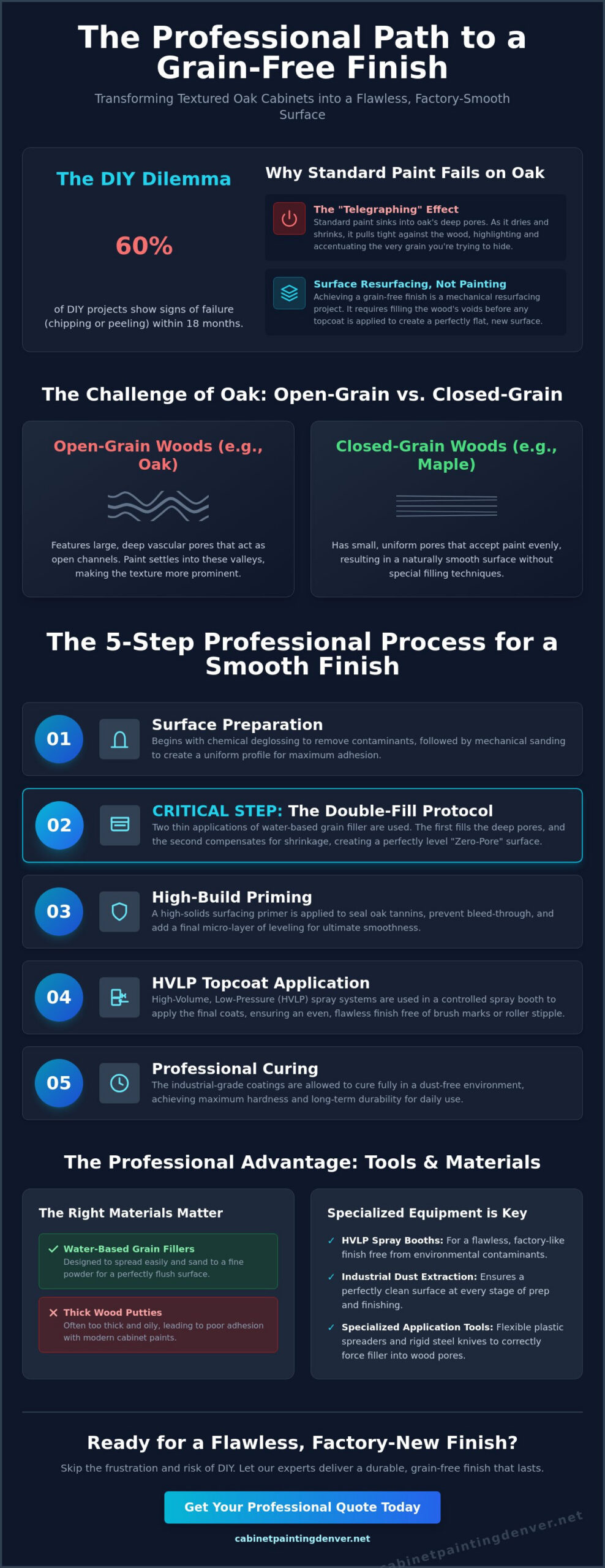
Achieving a factory-smooth finish involves a sequenced workflow where each layer depends on the precision of the one before it. The process of painting oak cabinets without grain showing is not a one-day task; it requires a disciplined multi-day schedule to allow for proper chemical bonding and material shrinkage. Skipping a single step or rushing the cure times will inevitably lead to the wood texture reappearing weeks later.
- Step 1: Preparation. We begin with chemical deglossing to remove accumulated kitchen grease and oils, followed by mechanical sanding to create a profile for the new coatings.
- Step 2: Leveling. This involves the dual-stage grain filling protocol discussed previously, ensuring all vascular pores are physically blocked and leveled with the wood surface.
- Step 3: Surfacing. We apply two coats of high-build primer. A 24-hour cure window is mandatory between these coats to ensure the primer has fully settled before the next stage.
- Step 4: Polishing. A final sand with 320-grit sandpaper removes any microscopic imperfections or “nibs,” leaving the surface feeling like polished stone.
- Step 5: Finishing. We apply the final topcoat using HVLP technology, which is the gold standard for cabinet refinishing in modern kitchens.
Spray Application vs. Hand Brushing
Brushes and rollers are designed to move paint, but they cannot hide grain. The physical action of a brush actually pulls paint out of the pores, while a roller creates a stippled texture that mimics the wood’s original irregularities. HVLP (High Volume Low Pressure) systems atomize the paint into a fine mist, allowing it to settle evenly across the surface. This creates the correct “wet film thickness” (WFT) necessary to maintain a flat appearance. If you want a result that looks like it came from a showroom, professional Kitchen Cabinet Painting using industrial spray equipment is the only viable path.
Environmental Controls in the Denver Metro Area
Denver’s arid climate presents unique challenges for paint leveling. Low humidity causes the water or solvent in the paint to evaporate rapidly, which can lead to “dry spray” or a rough, sandpaper-like finish. At high altitudes, “flash-off” times-the time it takes for the initial solvents to leave the film-are significantly shorter than at sea level. Professionals use specific retarders to slow down this drying process, giving the paint enough time to flow and level before it sets. This technical adjustment is vital for painting oak cabinets without grain showing in the Colorado heat.
Professional Implementation: Why Denver Homeowners Choose Experts
Homeowners often underestimate the time required for a high-quality result. While a standard project might take a few days, the process of painting oak cabinets without grain showing takes approximately three times longer. This is due to the mandatory cure windows between filling and priming stages. Rushing these windows leads to material failure because the products haven’t stabilized. In Denver’s specific climate, the low humidity can accelerate surface drying while leaving the deeper layers of filler soft. Professionals manage these variables with precision to ensure a durable Cabinet Painting Denver result that adds significant value to the property.
Achieving a smooth finish requires specialized industrial equipment that most homeowners don’t own. Industrial sanders equipped with HEPA dust extraction are vital for maintaining a clean environment. These tools prevent airborne particles from settling in the wet finish and protect the home’s air quality. HVLP spray booths provide the controlled environment needed to lay paint flat without the interference of wind or household dust. Without this level of equipment, the risk of surface contamination increases significantly.
The cost of a “redo” project is a significant consideration. Research indicates that an estimated 60% of DIY cabinet painting projects show signs of failure, such as chipping or peeling, within 18 months. Fixing a failed grain-fill attempt is more expensive than a first-time application because the incorrect materials must be chemically stripped or mechanically removed. This labor-intensive recovery often doubles the project’s complexity and timeline.
The Value of a Factory-Quality Finish
A smooth finish impacts home resale value in the Denver market. The 2026 design trend has moved away from “rustic” oak toward modern-minimalist smooth surfaces. A professional grain-free finish provides the durability needed for high-traffic kitchens. Professional preparation prevents chipping in the grain valleys, which is where most DIY failures begin. This level of detail ensures the finish remains intact even as the wood expands and contracts with Colorado’s temperature fluctuations.
Getting a Professional Assessment
When selecting a contractor, you should examine their oak portfolio specifically. Look for close-up photos of finished doors to verify the absence of grain texture. Ask detailed questions about their grain-filling process and the specific high-build primers they utilize. A transparent professional will be able to explain their multi-stage leveling protocol in detail. If you are ready to upgrade your kitchen, Contact Cabinet Painting Denver for a professional grain-free transformation to ensure the highest standard of quality.
Achieving a Factory-Smooth Aesthetic in Your Kitchen
The transition from heavy oak texture to a modern, glass-smooth surface is a technical achievement. It relies on a meticulous five-step sequence that prioritizes mechanical leveling over simple color application. By utilizing high-solids grain fillers and high-build primers, you can effectively bridge the vascular pores that standard painting techniques leave behind. This ensures your kitchen meets the 2026 factory-finish standard while resisting the shrinkage and telegraphing that often plague DIY attempts.
Professional execution is the most reliable way to ensure the longevity of your investment. Successful painting oak cabinets without grain showing requires the precise application of materials and industrial-grade equipment. We have served Denver and the Front Range for over a decade, providing homeowners with factory-quality HVLP spray finishes and a specialized high-build filling process designed specifically for oak. You don’t have to settle for the dated look of heavy wood grain.
If you are ready to modernize your space, Request Your Free Professional Oak Cabinet Assessment today. You can transform your existing cabinetry into a durable, contemporary feature that enhances your home’s value and provides lasting beauty for years to come.
Frequently Asked Questions
Can you really hide oak grain with just paint?
No, paint alone cannot hide the texture of oak. Paint is a thin coating that follows the contours of the surface rather than filling them. As the paint cures, it shrinks and pulls tight against the wood, making the grain even more visible. Achieving a smooth surface when painting oak cabinets without grain showing requires a dedicated mechanical filler to physically level the vascular pores before any color is applied.
What is the best grain filler for oak cabinets in 2026?
High-solids, water-based acrylic grain fillers are the preferred choice for 2026 projects. Products like Aqua Coat are widely recommended because they are low-odor, dry quickly, and sand to a fine powder without clogging equipment. These fillers provide the necessary volume to stay flush with the wood surface after evaporation. They are far more effective than traditional oil-based putties, which can interfere with the adhesion of modern cabinet enamels.
How many coats of primer do I need to hide wood grain?
You typically need two coats of high-build primer after the grain-filling stage is complete. The first coat acts as a surfacing agent to identify any remaining low spots, while the second coat provides the final leveling layer. It’s important to sand between these coats with 220-grit paper. This sequence ensures a uniform, non-porous base that prevents the final topcoat from sinking into the wood fibers over time.
Is it worth the extra cost to fill the grain on oak cabinets?
It’s worth the investment if you want a modern-minimalist aesthetic that mimics factory-made cabinetry. A grain-free finish significantly increases home resale value in the Denver market compared to standard paint jobs that leave wood texture visible. While the labor involved in painting oak cabinets without grain showing is higher, the result is a more durable and professional-looking surface that won’t be mistaken for a cheap DIY project.
Does sanding alone remove wood grain from oak?
No, sanding alone is insufficient for removing oak grain. Sanding only levels the high points or “peaks” of the wood fibers; it doesn’t address the deep vascular “valleys” or pores. Attempting to sand oak until it’s smooth often results in sanding through the veneer or compromising the door’s structural integrity. You must use a filler to raise the low points to meet the high points for a truly flat plane.
Will the grain filler crack over time in Denver’s dry climate?
High-quality acrylic fillers are engineered to be flexible and won’t crack if applied correctly. Denver’s semi-arid climate causes wood to expand and contract significantly. Using a professional-grade filler combined with a shellac-based primer creates a stable system that moves with the wood. This prevents the filler from popping out of the pores or developing hairline fractures during the extreme humidity shifts common in the Front Range.
Can I use wood filler instead of grain filler?
You should avoid using standard wood filler for large surfacing projects. Wood filler is designed for localized repairs like nail holes or deep gouges and is too thick to spread evenly across an entire cabinet door. It dries very hard and is difficult to sand level without damaging the surrounding wood. Grain filler has a thinner, cream-like consistency that allows it to be forced into pores and wiped clean easily.
How do I know if my cabinets are oak or another wood species?
You can identify oak by its prominent “cathedral” grain patterns and its distinct porous texture. If you run your fingernail across the wood and feel deep ridges or pits, it’s likely an open-grain wood like oak or ash. In contrast, maple and cherry have a closed-grain structure and feel smooth to the touch even when unpainted. Oak’s heavy grain is visible even under existing stains and clear coats.