
What if your outdated kitchen isn’t a “gut job” but a hidden asset that could save you over $10,000 this year? You’re likely staring at those worn doors right now, wondering if a fresh coat of paint will actually stick or if you’re just putting lipstick on a pig. It’s a valid concern. Nobody wants to invest in a professional finish only to have it peel because the underlying material was “terminal.” Assessing cabinets for refinishing is the most critical step you’ll take before picking a paint color or hiring a crew.
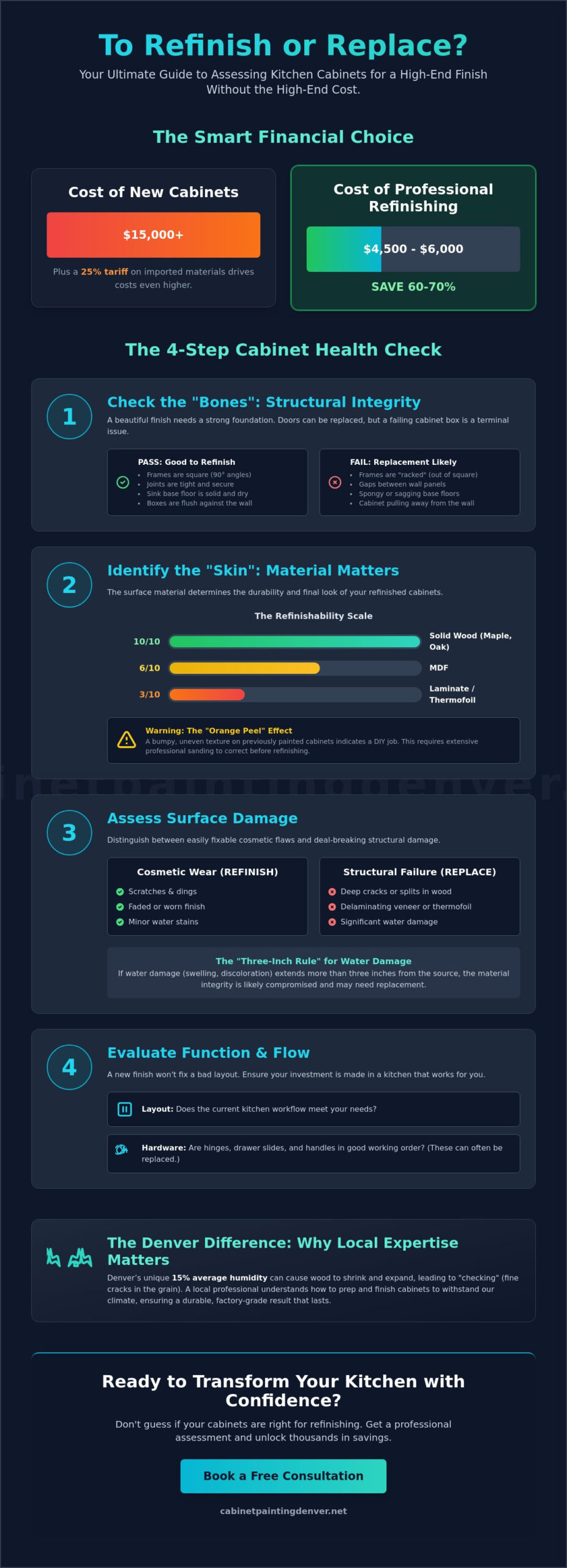
We understand that the confusion between refinishing, refacing, and replacing is enough to stall any renovation. You want a high-end look without the massive price tag of new construction, especially with the 25% tariff on imported cabinets currently driving up replacement costs. This guide promises to give you a clear “yes or no” framework for your specific kitchen. We’ll walk through how to evaluate your cabinet’s structural integrity and explain why this path can save you 60% to 70% compared to the cost of new boxes. By the time you’re done, you’ll have the confidence to book a professional consultation knowing exactly what your cabinets are worth.
Key Takeaways
- Learn why the cabinet box is more important than the door and how to evaluate the “bones” of your kitchen using 2026 cabinetry standards.
- Discover where your surfaces rank on the “Refinishability Scale” to determine if solid wood, MDF, or laminate is a viable candidate for a transformation.
- Master the process of assessing cabinets for refinishing by identifying the “Three-Inch Rule” for water damage and distinguishing between cosmetic wear and structural failure.
- Evaluate your kitchen’s layout and hardware condition to ensure your investment in a new finish isn’t wasted on a dysfunctional workflow or broken hinges.
- Understand how Denver’s unique 15% humidity levels impact wood grain “checking” and why a local expert’s eye is crucial for a durable, factory-grade result.
Evaluating Structural Integrity: The “Bones” of Your Kitchen
Refinishing success starts with the skeleton, not the skin. In 2026, the ANSI/KCMA A161.1-2022 performance standard serves as the benchmark for cabinetry durability. This standard ensures that your cabinet boxes can withstand the weight of modern countertops and the daily rigors of a high-traffic kitchen. When assessing cabinets for refinishing, you must realize that a door can be replaced, but a failing box is a terminal issue. If the frame is “racked,” meaning it has tilted out of square, or the joints are separating, even the most expensive factory-grade finish will eventually crack at the stress points.
A high-quality refinishing project depends on the installation being level and plumb. If your cabinets have shifted over time due to foundation settling, the doors will never hang perfectly straight. Gaining a foundational understanding cabinet construction helps you identify whether you have a face-frame or frameless system. This distinction is vital because it dictates how the box supports weight and where structural failures typically hide. To better understand how professional finishes hold up against structural stress, watch this helpful video:
The Box Test: Checking for Stability
Open every door and look at the corners. High-quality boxes utilize corner braces or gussets to maintain a 90-degree angle. If you see gaps between the back panel and the side walls, the integrity is compromised. Structural stability is the ability of the cabinet box to hold its intended weight without bowing or shifting under pressure. Check the floor of your sink base specifically. This area is prone to soft spots from slow leaks. If the wood feels spongy or sags when you press on it, the box requires a structural repair or replacement before any aesthetic work begins.
Wall Attachment and Load-Bearing Safety
Your cabinets carry immense weight, especially if you’ve upgraded to heavy granite or quartz surfaces. Inspect the hanging rails, which are the strips of wood at the back of the cabinet where screws enter the wall studs. If there is a visible gap between the cabinet and the drywall, the unit is pulling away. This is a common issue in builder-grade cabinets, which often use thin 1/2-inch particle board rather than the 3/4-inch plywood found in custom-built units. Assessing cabinets for refinishing involves ensuring these load-bearing points are secure. If the boxes are failing to stay flush against the wall, painting them is a safety hazard rather than a smart investment.
Material Matters: Assessing Wood, MDF, and Laminate Surfaces
Not all surfaces are created equal. When assessing cabinets for refinishing, the substrate material determines the longevity of your investment. Professional finishers use a “Refinishability Scale” to rank candidates. Solid wood like Maple, Oak, and Cherry sits at the top with a 10/10 rating. These materials are dense, stable, and bond exceptionally well with high-end coatings. MDF (Medium Density Fiberboard) follows at a 6/10 because it’s stable but highly porous. Laminate and Thermofoil rank lowest at a 3/10. While they can be transformed, they require specialized high-adhesion primers and meticulous prep to prevent the paint from peeling away in sheets.
If you’re dealing with previously painted surfaces, look for the “Orange Peel” effect. This bumpy, uneven texture usually indicates a DIY job where the paint was applied with a thick nap roller or without proper thinning. Correcting this requires extensive sanding back to the base layer. If you aren’t sure what your cabinets are made of, a quick consultation with a local pro can save you from a costly material mismatch.
Solid Wood vs. Wood Veneers
Identifying your wood species is the first step in predicting your final look. Maple and Cherry have tight, closed grains that produce a smooth, factory-like finish. Oak has deep, open pores that will remain visible under paint unless a grain filler is applied. Check the edges of your doors for veneer peeling. Veneer is a thin layer of real wood glued to a core. If the edges are bubbling or lifting, moisture has likely compromised the adhesive. You should also test for surface contamination. Wipe a small, inconspicuous area with mineral spirits. If the liquid beads up, your cabinets have a wax or silicone buildup from years of cleaning products that must be chemically stripped before refinishing begins.
The Thermofoil and Laminate Dilemma
Thermofoil is a plastic vinyl layer heat-shrunk over an MDF core. To assess its health, perform a “Heat Test” on the cabinets directly above your stove or next to the dishwasher. If the plastic feels brittle or pulls away from the edge with a light fingernail tug, the glue has failed. In these cases, cabinet refinishing involves completely stripping the vinyl and painting the underlying MDF. Laminate, often found in older “Pinch” style cabinets, lacks a grain for paint to grab onto. Success here depends entirely on using a bonding primer designed for non-porous surfaces. If the laminate is chipped or cracked down to the particle board, replacement is often more cost-effective than a complex repair.
Identifying Surface Damage: When to Refinish vs. Replace
Deciding between a full replacement and a refinish often comes down to a “Red Light, Green Light” assessment of the surface. Most homeowners see a faded door and assume it’s junk; however, cosmetic wear is rarely a reason to scrap a kitchen. Assessing cabinets for refinishing is about finding the line where damage becomes permanent. In Denver, for example, the high altitude increases UV exposure by roughly 20% compared to sea-level cities. This intense light makes old clear coats brittle and yellow, but this is usually a surface-level issue that a professional sand-and-coat process can resolve.
The real danger lies in structural saturation. We use the “Three-Inch Rule” to determine if a cabinet is terminal. If water damage or wood rot extends more than three inches from any edge, corner, or base, the internal fibers of the MDF or particle board have likely “bloomed” beyond repair. At this point, the material loses its ability to hold screws or bond with new paint. If the damage is less than three inches, it can often be patched with high-performance wood fillers and sanded smooth for a seamless finish.
The Water Damage Checklist
Look closely at the areas around your sink and dishwasher. Identifying “blooming” is simple; look for a swollen, wavy texture on the bottom edges of the doors or the side panels. While surface staining is fixable, wood rot is terminal. If you spot black mold in the sink base or if the wood crumbles when poked with a screwdriver, it’s a “Red Light.” These sections must be replaced before any refinishing begins to ensure a healthy and durable result.
Grease, Grime, and Previous DIY Attempts
Kitchens are high-grease environments. If your cabinets feel “sticky” even after a light cleaning, they may be saturated with cooking oils or have a failing previous finish. Professional de-glossing can usually save these surfaces, but “catastrophic” grease saturation can sometimes penetrate deep into the wood grain. Another common hurdle is silicone contamination. If you’ve used products like Pledge or other wax-based cleaners for years, the silicone can cause “fish-eyes” in new paint. Identifying these trouble spots early allows for the aggressive chemical cleaning required to ensure the new finish bonds permanently to the substrate.
Functional Assessment: Layout, Hardware, and Workflow
A beautiful finish can’t fix a kitchen that makes you angry every time you cook. Before you commit to the process, assessing cabinets for refinishing requires a brutal “Workflow Audit.” If your kitchen triangle—the path between the stove, sink, and refrigerator—is fundamentally broken, a new color is just a temporary distraction. However, if your current footprint meets your 2026 lifestyle needs, refinishing becomes the most cost-effective way to modernize. You should also evaluate your drawer glides. If your drawers still use old-school wood-on-wood tracks rather than metal full-extension glides, you’ll want to factor in the cost of hardware upgrades before the paint is applied.
Labor accounts for 60% to 70% of the total cost of a professional project according to Prestigious Custom Cabinets (March 10, 2026). This is because the prep work is so intensive. When you combine refinishing with minor functional upgrades, you maximize that labor investment. If you’re happy with your storage but hate the “clutter” of exposed hinges, now is the time to transition to a more streamlined look. If you aren’t sure if your frames can handle these changes, you can schedule a functional kitchen audit to see what’s possible.
Hinges and Soft-Close Compatibility
Most 2026 homeowners demand the luxury of soft-close doors. You need to check if your current boxes support hidden, European-style hinges. If you currently have exposed “butterfly” hinges, refinishing allows you to hide the old mounting holes. A professional crew will fill, sand, and prime these spots so they disappear completely. This level of detail is a major factor in the cost to paint kitchen cabinets, as filling hardware holes requires specialized high-solids fillers that won’t shrink or “ghost” through the final topcoat.
Storage and Modification Potential
Don’t assume your boxes are “stuck” in their current configuration. “Refinishing Plus” is a growing trend where homeowners add minor modifications like trash pull-outs or spice racks to existing boxes before the painting begins. You can also evaluate the height of your upper cabinets. Adding crown molding extensions to close the gap between the cabinet tops and the ceiling can make a standard kitchen look like a custom 2026 build. If your boxes are sturdy, these small structural additions offer a massive return on investment compared to a full gut-job.
Professional Assessment in Denver: Why Expert Eyes Matter
Living in the Mile High City brings unique challenges to woodwork that national guides often overlook. While the national average for refinishing ranges from $1,993 to $4,495, Denver homeowners typically see project totals between $3,231 and $8,794 due to the specialized materials required for our arid climate. When assessing cabinets for refinishing in Colorado, humidity is the silent killer. Denver’s average humidity can drop to 15%, causing wood joints to contract aggressively. A local cabinet painting denver expert doesn’t just look for surface dirt; they look for “checking.” Checking refers to small, hairline fractures in the wood grain itself. If these aren’t identified and treated with flexible, high-solids primers, they’ll telegraph through your new finish within a single season.
There’s a massive difference between a general house painter and a dedicated cabinet specialist. A specialist understands that Denver’s dry air necessitates specific dry-climate paint formulas. They use products that meet ANSI/KCMA A161.1-2022 standards to ensure the finish doesn’t become brittle and flake off when your furnace runs all winter. During a professional on-site candidacy assessment, an expert will check the tension of your hinges and the “squareness” of your boxes to ensure the final product looks like it came straight from a high-end showroom.
The Altitude and Humidity Challenge
Colorado is a high-desert environment. Cabinets manufactured in more humid, out-of-state climates often struggle when they’re moved here. When they arrive in Denver, the wood loses moisture and shrinks. This movement can break the seals at the rail and stile joints. During a professional assessment, experts use moisture meters to verify that the wood has stabilized. They also check for “dry rot,” which is surprisingly common in older Denver Metro homes where wood has been starved of moisture for decades. Assessing cabinets for refinishing means ensuring the wood is thirsty enough to bond with the primer but stable enough not to shift once the job is done.
Your Next Steps: From Assessment to Transformation
Before your cabinet painter arrives, clear off your counters and identify your “problem” doors. The “Green Light” for your project includes sturdy boxes, minimal water damage (less than three inches), and a layout you still love. If your cabinets pass the “Bones,” “Material,” and “Damage” tests we’ve covered, you’re an ideal candidate for a high-end transformation. Ready to see if your kitchen is a candidate for a factory-grade finish? Schedule your professional Denver cabinet assessment today and skip the $20,000 replacement bill.
Ready to Transform Your Kitchen?
You now have the professional framework for assessing cabinets for refinishing like a seasoned expert. By prioritizing the structural “bones” of your boxes over cosmetic flaws and understanding how Denver’s 15% average humidity affects wood expansion, you’ve already avoided the most common renovation pitfalls. Remember that professional refinishing can save you 60% to 70% compared to the cost of new cabinet boxes according to Painting Kitchen Cabinets Denver (May 1, 2026). This isn’t just about a fresh coat of paint. It’s about achieving a durable, factory-grade transformation that matches the earthy greens and warm neutrals trending for 2026. Whether you’re navigating the “Three-Inch Rule” for water damage or upgrading to modern soft-close hinges, your kitchen is likely a prime candidate for a high-end update.
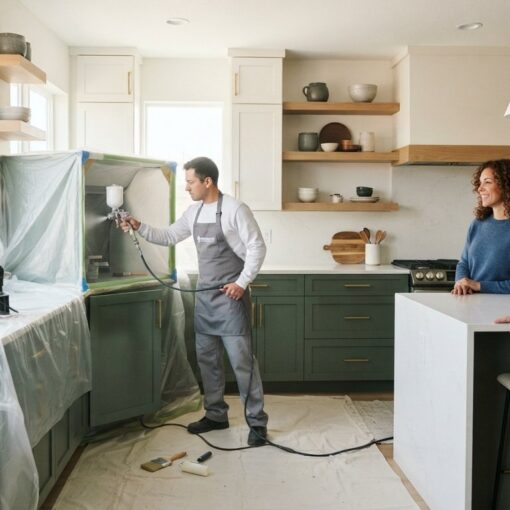
Our team specializes in Denver’s unique climate needs and utilizes a professional off-site spray booth to ensure a flawless finish that lasts 8 to 15 years. We stay ahead of the latest technical standards like ANSI/KCMA A161.1-2022 to protect your investment. Get Your Free Denver Cabinet Assessment & Quote today. Your dream kitchen is closer than you think.
Frequently Asked Questions
How can I tell if my cabinets are real wood or laminate?
Look for repeating grain patterns and edge seams. Real wood has unique, non-repeating grain throughout every door. Laminate often shows a repeat motif every 24 inches and features a visible seam where the surface layer meets the core material. If you see a thin, dark line at the corner of the door, it’s likely a laminate or thermofoil product rather than solid timber.
Is it worth refinishing cabinets that are 20 years old?
Yes, age is secondary to structural integrity. Many cabinets from the early 2000s feature 3/4-inch plywood boxes that are sturdier than today’s builder-grade particle board. If the frames are level and the wood isn’t crumbling, you can achieve a high-end look for a fraction of the cost of new units. It’s a sustainable way to modernize an older home.
Can you refinish cabinets that have already been painted once?
You can certainly refinish previously painted surfaces, though the preparation stage is more intensive. Assessing cabinets for refinishing in this scenario involves checking for “orange peel” textures or adhesion failure from a past DIY job. A professional specialist will sand the surface back to a stable layer to ensure the new industrial-grade coating bonds perfectly without peeling or bubbling.
What are the signs that my cabinets are beyond repair?
Widespread structural failure and mold are the two main “red lights.” If the cabinet boxes have shifted so far that they are no longer square, or if moisture has caused the wood to rot and crumble, refinishing won’t help. Any material that has “bloomed” or swollen significantly from water damage is considered terminal and should be replaced to ensure a safe, long-lasting kitchen.
Does refinishing cabinets increase my Denver home’s resale value?
Kitchen transformations consistently provide a high return on investment in the Colorado market. A professionally finished kitchen in 2026 earthy tones can make a home feel move-in ready, which is a major selling point for local buyers. Because the kitchen is the heart of the home, a factory-quality finish often helps a property sell faster than one with dated, honey-oak cabinetry.
How long does a professional cabinet assessment take?
A thorough on-site candidacy assessment typically takes 30 to 45 minutes. During this window, an expert will test your current finish for wax contamination, measure moisture levels in the wood, and inspect the hinges. This short appointment provides you with a definitive “yes or no” on whether your specific materials can support a high-end, durable refinishing project.
Will refinishing fix the “grainy” look of my oak cabinets?
Standard refinishing will change the color but leave the texture of the grain visible. If you want a smooth, modern look on oak, you must request a grain-filling service. This process involves applying a specialized compound to the deep pores of the wood before priming. It results in a flat, sleek surface that mimics the appearance of naturally smooth woods like maple.
Can I change my cabinet hardware if I decide to refinish?
Changing hardware is one of the best ways to modernize your space during the process. Assessing cabinets for refinishing includes deciding if you want to move from old-fashioned pulls to modern handles. A professional crew will fill the original holes with high-solids wood filler and sand them flush. This allows you to install new hardware in any position without leaving “ghost” marks behind.