Getting a quote for cabinet refinishing can feel like a frustrating guessing game. One contractor gives you a number, another offers something completely different, and you’re left wondering what a fair price actually is. The truth is, the final cabinet refinishing cost isn’t just one simple figure; it’s influenced by a dozen different factors, from the size of your kitchen to the type of wood and the finish you choose. It’s no wonder so many homeowners feel overwhelmed, confused by the options, and worried about hidden fees or being overcharged.
That’s why we created this comprehensive 2026 pricing guide. We’re pulling back the curtain to show you exactly what goes into a professional quote. In this article, you’ll learn every key variable that impacts your total price, get a realistic budget range for your project, and gain the confidence to ask the right questions. By the end, you’ll be able to evaluate any estimate like a pro and decide if refinishing is the perfect, budget-friendly choice for your home’s transformation.
What is the Average Cost to Refinish Kitchen Cabinets?
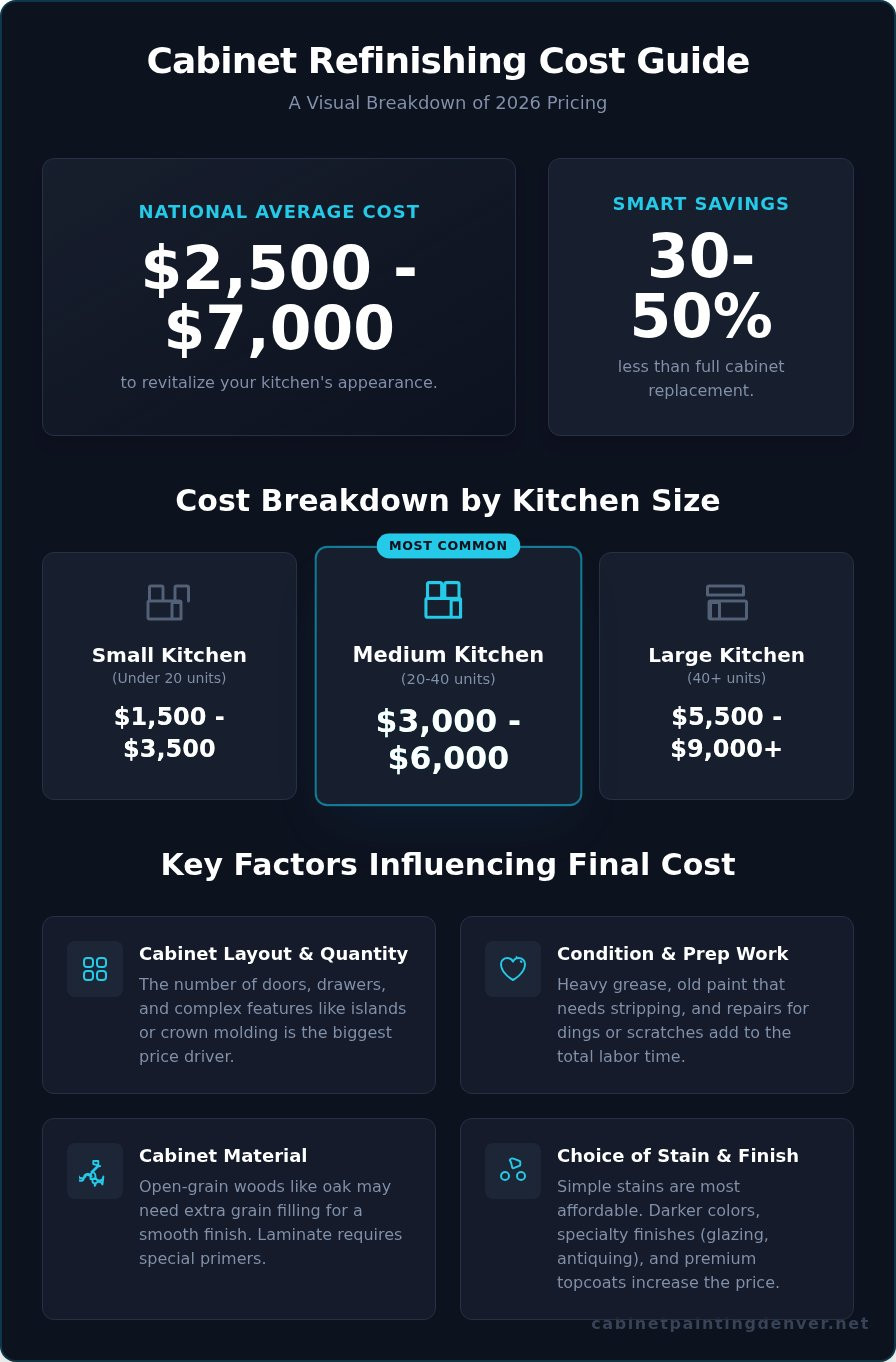
For most homeowners, the national average cabinet refinishing cost falls between $2,500 and $7,000. This investment revitalizes your kitchen’s appearance for a fraction of the price of a full remodel. Opting to refinish is a smart financial decision, typically costing 30-50% less than a complete cabinet replacement, allowing you to achieve a high-end look without the high-end expense.
To see how these costs break down in a real-world scenario, check out this helpful overview:
We proudly provide professional cabinet painting and cabinet refinishing services throughout the Denver Metro Area, including the following cities, towns, and surrounding communities:
- Highlands Ranch, CO – Including Northridge, Eastridge, Westridge, Southridge, and BackCountry
- Parker, CO – Including Stonegate, Clarke Farms, Canterberry Crossing, Idyllwilde, and Tallman Gulch
- Centennial, CO – Including Heritage Hills, Homestead, Willow Creek, Foxridge, and Piney Creek
- Castle Pines, CO – Including Castle Pines Village and surrounding luxury communities
- Castle Rock, CO – Including The Meadows, Founders Village, Red Hawk, Terrain, and Crystal Valley
- All of Douglas County, CO – Including Lone Tree, Larkspur, Franktown, Sedalia, and surrounding areas
- Lakewood, CO – Including Green Mountain, Belmar, Applewood, Bear Creek, and Solterra
- Littleton, CO – Including Ken Caryl, Columbine, Grant Ranch, Roxborough, and Bow Mar
- Jefferson County, CO – Including Golden, Arvada, Wheat Ridge, Evergreen, and Morrison
- Broomfield, CO – Including Anthem, Broadlands, and Northmoor
- Thornton, CO – Including Hunters Glen, Original Thornton, and Cherrywood Park
- Arapahoe County, CO – Including Aurora, Greenwood Village, Englewood, and Cherry Hills Village
- Adams County, CO – Including Westminster, Northglenn, Commerce City, and Brighton
If you’re searching for cabinet painting near me or cabinet refinishing in Denver and surrounding cities, our experienced team delivers a true factory-finish look using professional preparation, premium coatings, and proven techniques.
Professionals typically calculate the final price based on the project’s scope, often quoting per cabinet door and drawer or by the linear foot. This method ensures you only pay for the work being done. The total estimate will account for the materials, the condition of your existing cabinets, and the labor required to achieve a durable, factory-like finish.
We service Denver County, CO and surrounding cities including Lakewood, CO, Littleton, CO, Jefferson County, CO, Broomfield, CO, Thornton, CO, Centennial, CO, Arapahoe County, CO, and Adams County, CO.
Our service areas also extend to Boulder County, CO, including Superior, CO, Louisville, CO, Lafayette, CO, Erie, CO, and Firestone, CO, as well as northern Colorado communities such as Frederick, CO, Longmont, CO, Loveland, CO, and Fort Collins, CO.
Whether you are searching for cabinet painting in Denver, kitchen cabinet painters near me, or professional cabinet refinishing anywhere in Colorado, our experienced craftsmen deliver a smooth, durable factory-finish look using premium coatings, detailed preparation, and proven professional techniques.
National Average Cost Range
The typical $2,500 to $7,000 range reflects a wide variety of kitchen projects. A lower-cost project, around $2,500, usually involves a smaller kitchen with cabinets in good condition that require minimal prep work. Conversely, costs can climb toward $7,000 or more for large kitchens with intricate layouts, extensive surface repairs, or custom color matching. A deeper understanding cabinet construction can help you appreciate why complex designs or materials require more intensive labor, impacting the overall price.
Cost Breakdown by Kitchen Size
To give you a clearer picture, we can break down the average cabinet refinishing cost by the size of the kitchen, measured by the total number of cabinet doors and drawers:
-
Small Kitchen (Under 20 units): Expect to pay between $1,500 and $3,500.
-
Medium Kitchen (20-40 units): The most common size, typically costing $3,000 to $6,000.
-
Large Kitchen (40+ units): These projects usually start at $5,500 and can exceed $9,000.
Cabinet Refinishing Costs in Denver, CO
While national averages provide a great starting point, local market conditions play a crucial role. In Denver, CO, factors such as regional labor rates and local material supplier costs can influence your final quote. The complexity of homes in the Denver area can also affect pricing. For the most accurate and reliable estimate, it is always best to consult with a local professional who can assess your kitchen in person and provide a detailed, customized quote.
Key Factors That Determine Your Final Cabinet Refinishing Cost
No two kitchens are identical, and the same is true for refinishing projects. While online calculators can offer a starting point, your final cabinet refinishing cost is a custom figure based on several key variables. Understanding these factors will help you decipher quotes and set a realistic budget. Refinishing remains a highly cost-effective update, especially when you consider that cabinetry is a primary expense in a full renovation, a fact supported by detailed kitchen remodeling cost data from leading publications like Forbes.
Cabinet Layout and Quantity
The single biggest driver of your project’s price is the sheer volume of work. A larger kitchen with more cabinetry simply requires more time, labor, and materials. Professionals typically assess cost based on:
-
The number of doors and drawer fronts: This is the most common pricing metric, as each piece is handled individually.
-
Total surface area: Some pros quote per linear foot, especially for large banks of cabinets.
-
Complexity: Intricate details like decorative crown molding, island panels, or cabinets with glass inserts require more delicate work and add to the final bill.
Current Condition and Required Prep Work
The state of your existing cabinets determines the intensity of the preparation phase. Cabinets in pristine condition will cost less to refinish than those showing significant wear and tear. Expect costs to increase if your cabinets require:
-
Intensive cleaning: Years of built-up grease and grime must be meticulously removed for the new finish to adhere properly.
-
Paint or varnish stripping: If cabinets have a thick, failing layer of old paint, it must be completely stripped down to the bare wood-a labor-intensive process.
-
Damage repair: Filling dings, scratches, or old hardware holes is essential for a flawless result but adds to the labor time.
Cabinet Material and Wood Type
Not all materials are created equal. The type of wood or substrate your cabinets are made from directly impacts the refinishing process. For example, oak cabinets with a deep, open grain often require extra steps like applying a grain filler to achieve a smooth, modern look. Refinishing previously painted cabinets is also more involved than working with stained wood. Materials like laminate or thermofoil require specialized primers and techniques, making their refinishing process distinct and potentially more complex.
Choice of Stain and Finish
Your desired aesthetic plays a significant role in the overall cabinet refinishing cost. A simple, light stain with a clear protective topcoat is the most budget-friendly option. The price climbs with complexity:
-
Dark or opaque stains: Achieving a deep, even color often requires multiple coats and meticulous application.
-
Specialty finishes: Techniques like glazing, antiquing, or distressing are artisanal skills that add significant labor and cost.
-
Premium topcoats: Investing in a high-performance, durable finish may cost more upfront but provides superior protection against wear and tear for years to come.
Refinishing vs. Painting vs. Replacing: A Cost Comparison
When your kitchen cabinets look dated, you face a major decision with significant budget implications. Should you refinish them to restore their natural beauty, paint them for a modern look, or tear them out and start fresh? Understanding the differences in cost, time, and value is crucial. This comparison will help you determine the best path for your home and your wallet.
| Option | Average Cost Range (2026 Estimate) | Typical Timeframe | Best For |
|---|---|---|---|
| Painting | $2,000 – $6,000 | 3-5 days | Achieving a modern, solid-color look on a budget. |
| Refinishing | $3,000 – $8,000 | 4-7 days | Enhancing natural wood grain or changing stain color. |
| Refacing | $7,000 – $15,000 | 5-10 days | Changing door styles without a full remodel. |
| Replacing | $10,000 – $25,000+ | 2-5 weeks | A complete kitchen layout change or failing cabinets. |
Cabinet Refinishing vs. Painting Costs
The core difference lies in the final look. Painting involves sanding, priming, and applying a solid color finish, completely covering the wood grain. It’s perfect for a dramatic, modern update. Refinishing is a more intensive process of stripping the old finish, sanding, and applying a new stain and protective coat. This enhances the natural wood, making it ideal if you love the grain but want to change the color or restore its original luster. Painting is often slightly less expensive due to less labor-intensive stripping.
Refinishing vs. Refacing Costs
Cabinet refacing is a middle-ground option between refinishing and a full replacement. The process involves keeping your existing cabinet boxes but replacing all the doors and drawer fronts. The exterior of the boxes is then covered with a matching veneer. While this allows you to completely change the style of your cabinets (e.g., from traditional raised-panel to modern Shaker), it costs significantly more than refinishing-often twice as much.
The Ultimate Question: Refinish or Replace?
Full cabinet replacement is the most expensive and disruptive choice, easily costing two to three times more than refinishing. According to Bob Vila’s cost analysis, the price of new cabinets can quickly escalate with custom options and installation labor. The high cabinet refinishing cost is a far better value if your existing cabinets are structurally sound and you are happy with your kitchen’s layout. Choose replacement only when your cabinets are failing beyond repair or you are planning a complete kitchen reconfiguration.
Not sure which is right for you? Talk to our Denver experts! We can help you assess your cabinets and find the perfect solution for your home and budget.
How Professionals Calculate a Refinishing Quote (And What to Look For)
Receiving a quote for your project can feel overwhelming, but a professional estimate is more than just a number-it’s a comprehensive plan for your kitchen’s transformation. Understanding how contractors arrive at your final cabinet refinishing cost empowers you to compare bids accurately and hire with confidence. A transparent, detailed quote is the first sign of a trustworthy professional.
What a Detailed Quote Must Include
A vague quote is a recipe for surprise charges and mismatched expectations. A reputable contractor will provide a clear, itemized document that leaves no room for doubt. Look for these essential components to ensure you know exactly what you’re paying for:
-
Labor and Material Breakdown: The quote should separate the cost of labor from the cost of materials. This shows you where your money is going.
-
Specific Prep Work: It should detail the entire process, including degreasing, sanding, grain filling, and priming. "Prep and paint" is not enough detail.
-
Exact Products Used: The brand and specific product line for the primer, stain or paint, and topcoat (e.g., Sherwin-Williams Emerald Urethane Trim Enamel) should be listed.
-
Projected Timeline: A professional provides a clear start date and an estimated completion date, outlining the major phases of the project.
Common Pricing Models
Contractors typically use one of three models to calculate the project’s scope. Some charge per door and drawer front, which is a straightforward method for standard kitchens. Others use the linear foot of your cabinetry, a common method for larger or more complex layouts. Finally, many pros provide a lump-sum project fee after a thorough in-home assessment of the cabinet condition, layout, and desired finish.
Red Flags in a Cabinet Refinishing Estimate
Your quote is also a tool for vetting your contractor. Be cautious if you encounter any of these warning signs, as they often point to inexperience or a lack of professionalism:
-
Vague Descriptions: Ambiguous terms like "standard prep" or "quality finish" without specifics.
-
An Unusually Low Price: A bid that dramatically undercuts others may signal cut corners, inferior materials, or an uninsured operator.
-
High-Pressure Tactics: Demands for a large cash deposit upfront or pressure to sign a contract on the spot.
-
No Proof of Insurance or Portfolio: A professional will readily provide a certificate of insurance and show you examples of their completed work.
Ultimately, the quote should form the basis of a detailed, written contract. This document protects both you and the contractor, ensuring your project is completed to the agreed-upon standards. For a transparent estimate that checks all the right boxes, consider contacting a trusted local expert.
Is Professional Cabinet Refinishing Worth the Cost?
When homeowners evaluate the cabinet refinishing cost, they are weighing more than just an upfront price; they are considering long-term value. Is investing in a professional service a better decision than a weekend DIY project? For most homeowners, the answer is a resounding yes. A professional job is not just a cosmetic update-it is a durable, high-value investment in your home’s beauty and functionality.
The Value of a Flawless, Professional Finish
The difference between an amateur and a professional finish is immediately obvious. Experts use commercial-grade spray equipment to apply a perfectly even, hardened enamel, creating a smooth, factory-like surface free of drips or brush marks. More importantly, a pro’s meticulous preparation-sanding, cleaning, and priming-ensures the finish bonds permanently. This process and the use of high-end materials prevent the chipping, peeling, and yellowing common with DIY jobs, all while saving you from weeks of kitchen chaos.
Long-Term Durability and Return on Investment (ROI)
A professionally refinished cabinet is built to last. With proper care, a high-quality finish can look pristine for 10 years or more, withstanding the daily wear and tear of a busy kitchen. This longevity translates directly into a fantastic return on investment. Kitchen updates consistently rank among the home improvements with the highest ROI, and refinishing offers a dramatic transformation for a fraction of a full remodel cost. If you’re planning to sell, this update can significantly boost your home’s appeal and resale value.
DIY vs. Hiring a Pro: A Cost-Benefit Analysis
While a DIY approach can save on labor, the material costs for quality primers, paints, and tools are still significant. The true cost of DIY, however, often comes from the risks and the final result. Common DIY pitfalls include:
-
Visible brush strokes and roller marks
-
Drips, runs, and uneven coverage
-
Premature chipping due to improper surface prep
-
A finish that fails to cure, leaving cabinets sticky
Hiring a professional eliminates these risks entirely. You get the peace of mind that comes with expertise, a guaranteed beautiful result, and a kitchen you will be proud of for years to come. When you weigh the potential for a failed project against a flawless, durable outcome, the choice is clear.
Ready for a guaranteed result? Get your free quote from Cabinet Painting Denver today!
Transform Your Kitchen for Less: Final Thoughts on Refinishing Costs
As we’ve explored, understanding the average cabinet refinishing cost is the first step toward a stunning kitchen transformation. The key takeaway is that professional refinishing offers a dramatic, high-value upgrade for a fraction of the price of a full replacement. While your final investment depends on factors like kitchen size and cabinet condition, the return in both home value and daily enjoyment is undeniable.
When you’re ready to move from planning to action, trust Denver’s cabinet experts to deliver a flawless, factory-sprayed finish that revitalizes your space. We help homeowners increase their home’s value without the stress and expense of a major remodel. Don’t guess at the numbers-get a precise, transparent quote tailored to your unique kitchen.
Take the next step towards the kitchen of your dreams. Get Your Free, No-Obligation Cabinet Refinishing Quote in Denver today and discover just how affordable a beautiful, high-end update can be!
Frequently Asked Questions About Cabinet Refinishing Costs
How long does a professional cabinet refinishing project usually take?
A standard professional cabinet refinishing project typically takes between 5 to 7 days from start to finish. This timeline allows for proper preparation, including cleaning, sanding, and priming, as well as multiple coats of paint and adequate drying and curing time. Larger kitchens with more intricate details or extensive repairs may extend the project duration. The majority of the work on doors and drawers is often completed off-site to minimize disruption in your home.
Can you refinish laminate, MDF, or thermofoil cabinets, and how does it affect cost?
Yes, non-wood surfaces like laminate, MDF, and thermofoil can be successfully refinished, but they require specialized preparation. These materials need thorough scuff-sanding and a high-adhesion bonding primer to ensure the new finish lasts. Because of the additional materials and labor required for proper adhesion, the cabinet refinishing cost for these surfaces is often slightly higher than for solid wood cabinets. Always ensure your contractor has experience with these specific materials.
Does the cost of cabinet refinishing include new hardware installation?
Typically, a standard cabinet refinishing quote includes the removal and reinstallation of your existing hardware (knobs, pulls, and hinges). If you plan to install new hardware, this may be considered an add-on service. Some contractors will install new handles and pulls at no extra charge if they fit the existing holes, but installing new hinges or drilling new holes will almost always incur an additional fee. It’s essential to clarify this with your contractor beforehand.
Is it cheaper to refinish bathroom cabinets than kitchen cabinets?
Yes, it is almost always cheaper to refinish bathroom cabinets, often called a vanity, compared to an entire kitchen. The primary reason is the smaller scope of the project-there are significantly fewer cabinet doors and drawers to prep and paint. While the cost-per-door might be similar to a kitchen project, the overall project total is much lower due to the reduced surface area and labor time involved, making it a very cost-effective update.
What’s the best way to get an accurate cabinet refinishing quote for my Denver home?
The most accurate way to determine your cabinet refinishing cost is to schedule an in-home consultation. This allows a professional to see the layout, assess the condition of your cabinets, and discuss your desired finish. For a preliminary estimate, you can often send photos of your kitchen along with a count of all doors and drawer fronts. Be sure to mention the material of your cabinets (e.g., wood, laminate) to get the most precise initial quote.
Will there be a strong smell in my house during the refinishing process?
While some odor is unavoidable, professional refinishers take steps to minimize it significantly. Many companies now use high-quality, low-VOC (Volatile Organic Compounds) water-based lacquers and paints that have a much milder scent than traditional oil-based products. Furthermore, professionals use proper ventilation systems, such as fans and air scrubbers, and seal off the kitchen work area with plastic sheeting to contain fumes and dust, ensuring minimal impact on the rest of your home.