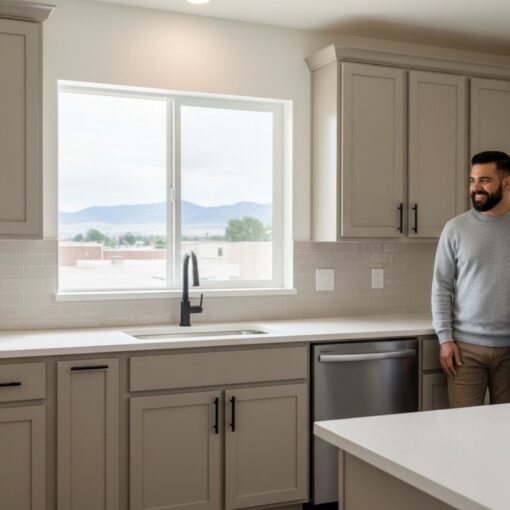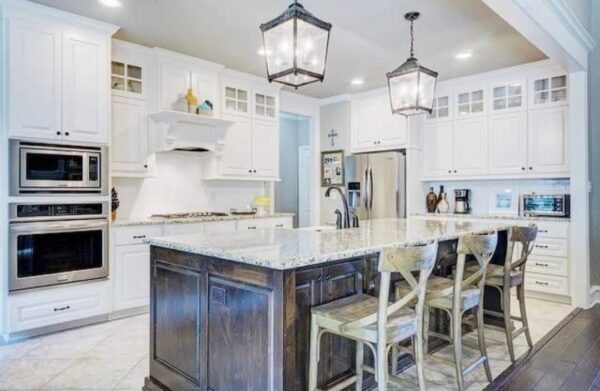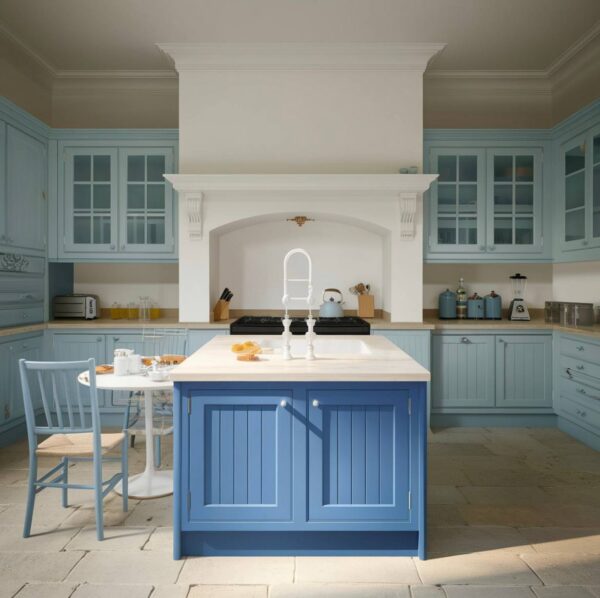

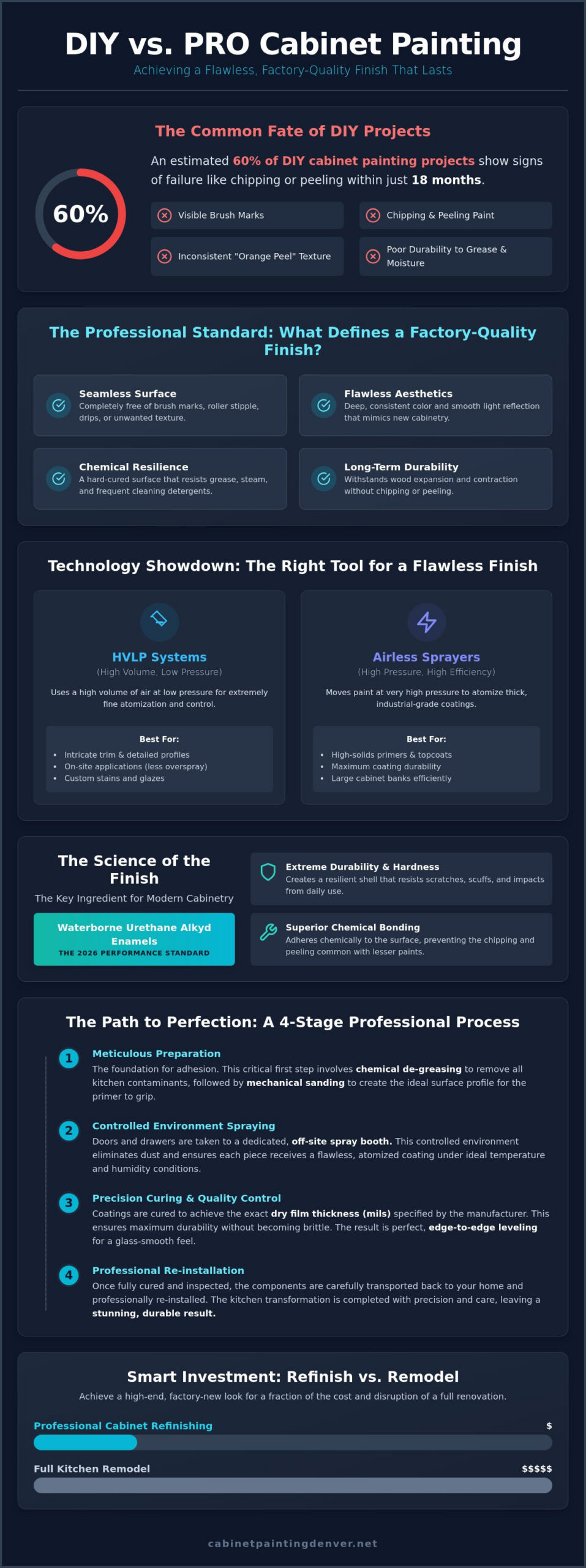
An estimated 60% of DIY cabinet painting projects show signs of failure, such as chipping or peeling, within only 18 months. It’s a frustrating outcome for homeowners who invest significant time only to be left with visible brush marks or an inconsistent orange peel texture. You likely expect your kitchen to look high-end while remaining durable against daily grease and moisture. Achieving a professional spray finish for cabinets is a result of mechanical precision and chemical bonding, rather than just the specific tool used.
It’s common to feel overwhelmed by technical choices like HVLP versus airless technology or the strict 2026 Colorado VOC regulations. This guide provides the procedural clarity required to understand how factory-quality results are produced. You’ll learn about the specialized equipment, off-site spray booth standards, and the rigorous preparation steps necessary for a glass-smooth surface. We’ll outline the professional standards that ensure your kitchen cabinet painting project delivers long-term performance and a flawless aesthetic.
Key Takeaways
- Identify the technical requirements that separate a factory-quality finish from standard brush-and-roll methods.
- Compare the benefits of HVLP and Airless technology to determine which equipment best suits high-viscosity professional coatings.
- Understand why modern waterborne urethane alkyd enamels are the 2026 standard for achieving a durable professional spray finish for cabinets.
- Follow a structured preparation workflow involving chemical de-greasing and mechanical sanding to ensure long-term paint adhesion.
- Evaluate the cost-effectiveness of professional cabinet painting compared to a full kitchen remodel within the Denver market.
What Defines a Professional Spray Finish for Cabinets?
A high-quality professional spray finish for cabinets is defined by its mechanical perfection and chemical resilience. It’s a seamless, high-performance coating that remains entirely free of brush marks, drips, or unwanted texture. Unlike traditional hand-applied methods, this process results in a surface that mimics the appearance of new, pre-manufactured cabinetry. This factory-quality standard is the benchmark for modern kitchen renovations, providing a level of refinement that brushing or rolling simply cannot replicate.
To better understand the precision required for these results, watch this video on fine finish technology:
Achieving this standard requires adherence to specific technical metrics. Professionals monitor dry film thickness, often measured in mils, to ensure the coating is durable without being prone to cracking. Proper spray painting techniques facilitate edge-to-edge leveling. This allows the coating to flow out and flatten perfectly before it cures. This precision eliminates the orange peel texture common in amateur applications and ensures a consistent sheen across every door and drawer front in the kitchen.
The Aesthetic Advantage
Spraying provides a clear aesthetic advantage by eliminating mechanical marks. Brushes leave behind bristle lines, and rollers create a textured stipple that traps dust and grime. Modern kitchen aesthetics demand the deep, consistent color and smooth light reflection that only atomized pigment distribution can provide. This is especially noticeable on satin or semi-gloss surfaces. On these finishes, imperfections are easily highlighted by overhead lighting, making a smooth spray application essential for a high-end look.
Durability and Longevity
A professional spray finish for cabinets relies on chemical bonding rather than simple mechanical adhesion. This creates a surface that resists the daily rigors of a high-use kitchen. These rigors include exposure to steam, grease, and frequent cleaning with detergents. High-traffic areas, such as drawer fronts and cabinet doors, benefit from the impact resistance inherent in professional-grade coatings. These systems are specifically designed to withstand the expansion and contraction of wood without chipping or peeling over time.
HVLP vs. Airless Sprayers: Choosing the Right Technology
Selecting the right equipment is a technical requirement that dictates the success of a professional spray finish for cabinets. While hobbyist forums often debate which gun is easier for beginners, professional contractors select sprayers based on coating viscosity and job site conditions. High Volume Low Pressure (HVLP) and Airless systems serve distinct roles in the refinishing process. Understanding these differences is essential for achieving a result that mimics factory production.
Tip size is often as critical as the sprayer itself. A professional uses Fine Finish Low Pressure (FFLP) tips to ensure a consistent fan pattern without the “tails” or uneven edges seen in amateur work. Even a high-end machine will fail if the tip isn’t matched to the specific solids content of the paint. For those interested in the broader workflow, reviewing a step-by-step guide to painting cabinets can clarify how these tools fit into the larger project timeline.
When to Use HVLP Systems
HVLP systems are preferred for intricate trim work and detailed door profiles. These sprayers use a high volume of air at low pressure to atomize paint, which significantly minimizes overspray. This makes them ideal for on-site applications where containment is a primary concern. When applying small-batch custom stains or glazes, the precision of HVLP allows for granular control over the finish. It’s the best choice for delicate surfaces that require a thin, perfectly leveled layer of material.
The Power of Airless and Air-Assisted Systems
Modern industrial-grade topcoats and high-solids primers often require the raw power of an airless sprayer. These machines move paint at high pressure through a small orifice, which is necessary to atomize the thick, durable coatings used in 2026. Airless sprayers provide the efficiency needed for large cabinet banks, ensuring the coating remains “wet” long enough to level out before drying. This prevents the “dry spray” texture that ruins the look of a professional spray finish for cabinets.
Top-tier professionals often utilize Air-Assisted Airless (AAA) technology. This hybrid system combines the speed and power of airless with the fine atomization of HVLP. It provides the highest level of procedural clarity for complex kitchen cabinet painting projects. By using a small amount of compressed air to refine the spray fan, contractors achieve a glass-smooth finish on both doors and frames. This technology is particularly effective for the high-viscosity waterborne urethane alkyds that have become the industry standard.
Modern Coating Science: The Best Paints for Spraying
Standard latex wall paint is unsuitable for cabinetry because it lacks the necessary surface hardness. It remains flexible and prone to “blocking,” a condition where the cabinet door sticks to the frame and eventually peels. In 2026, achieving a professional spray finish for cabinets requires advanced waterborne urethane alkyd enamels. These coatings are engineered to provide the durability of traditional oil-based paints without the high VOC levels or slow drying times that complicate residential projects.
Research indicates that over 90% of professional painters now prefer these hybrid coatings over traditional oil-based options. This shift is driven by both performance and regulatory requirements. For example, Colorado regulations effective in April 2026 have established strict emission control requirements for priority toxic air contaminants like formaldehyde and benzene. Professional-grade acrylics and hybrids meet these standards while offering a cure time that allows for faster re-installation. While a finish may be dry to the touch in hours, these modern coatings reach maximum hardness within 14 to 30 days.
Urethane Alkyd Hybrids: The Professional Standard
These hybrid formulas represent the current industry benchmark for kitchen and bathroom cabinet painting. They utilize oil-like leveling properties that allow the paint to flow out smoothly after atomization, eliminating any micro-texture. Unlike older oil paints, these formulas are non-yellowing. This is a critical requirement for the white and “Warm Linen” neutrals currently popular in Denver homes. The urethane component provides a high hardness rating, which balances the need for scratch resistance with the flexibility to handle wood expansion.
Primers: The Foundation of the Finish
A high-quality topcoat is only as effective as the primer beneath it. For woods like oak or cherry, professionals utilize stain-blocking primers to prevent tannins from bleeding through the finish. If you’re working with laminate or previously painted surfaces, a bonding primer is required to ensure chemical adhesion. In 2026, high-build primers are frequently used for grain filling. These products are sanded down to create a perfectly flat profile, which is the only way to achieve a “glass-smooth” factory look on open-grain wood species. This procedural step ensures the final spray layers sit on a uniform foundation.
The Professional Spray Process: Prep to Re-Installation
A professional spray finish for cabinets is 70% to 80% labor, with the actual application of paint representing only a small fraction of the total project time. Amateur guides often suggest that spraying can be completed in a single weekend. However, bypassing the rigorous cleaning and sanding phases is the primary reason why 60% of DIY projects fail within 18 months. Achieving a factory-quality result requires a disciplined, multi-step workflow that begins long before the sprayer is even pressurized.
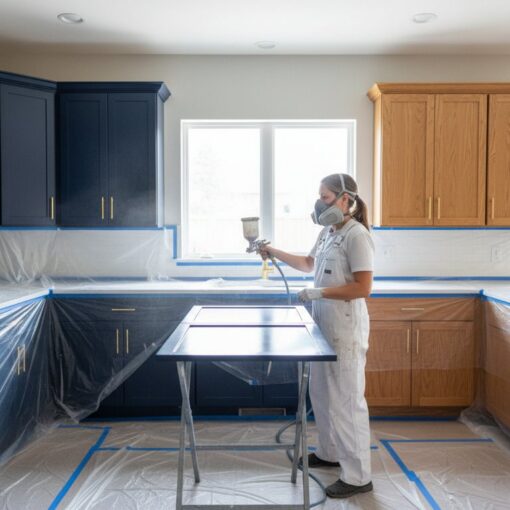
The process starts with chemical de-greasing to remove kitchen contaminants like cooking oils and skin proteins. These substances prevent paint from bonding. Following the cleaning, mechanical sanding creates a “profile” on the substrate. This physical roughening of the surface is essential for long-term adhesion. Professionals then manage the environment by using a dual-location strategy. While cabinet frames are prepared and sprayed on-site under strict masking protocols, doors and drawer fronts are processed in a controlled, off-site spray booth to ensure a dust-free environment.
Preparation: The Most Critical Phase
Complete disassembly is mandatory. This includes removing all hardware, hinges, and felt bumpers. Any holes from old hardware or cracks in the wood must be filled and sanded flush. Before any coating is applied, a tack-cloth cleaning removes every trace of micro-dust. This level of detail ensures that the final professional spray finish for cabinets is free of inclusions. If you’re planning a renovation, you can request a detailed quote for kitchen cabinet painting to see how this procedural clarity applies to your home.
The Spray Sequence
Success in spraying depends on applying multiple thin coats rather than one heavy layer. Heavy coats lead to drips and uneven curing. Between each application, inter-coat sanding with fine-grit abrasives removes minor imperfections and prepares the surface for the next layer. This builds the “glass-smooth” texture associated with factory finishes. Finally, the curing phase is respected. While modern waterborne enamels dry quickly, they require significant time to reach maximum hardness. Homeowners should exercise caution during the first 14 to 30 days of use to prevent damage to the new surface while it reaches its full durability.
Why Denver Homeowners Choose Professional Spraying
Denver’s semi-arid climate presents unique technical challenges for achieving a professional spray finish for cabinets. In low-humidity environments, moisture evaporates from coatings at an accelerated rate. This rapid drying can prevent the paint from leveling properly, often resulting in a textured orange peel surface rather than the intended glass-smooth finish. Local expertise is required to manage these atmospheric conditions through controlled application environments and specific product selections that account for Colorado’s thin air and lack of moisture.
As of 2026, the preference for refinishing over replacement has intensified due to the cost-effectiveness of the process. While a full kitchen remodel involves significant demolition and material costs, professional spraying focuses on the existing substrate. This approach utilizes the high-performance waterborne urethane alkyd enamels discussed earlier to provide a factory-quality surface. Cabinet Painting Denver ensures these results by utilizing a specialized off-site spray booth for doors and drawer fronts, while maintaining strict on-site protocols for cabinet frames.
Climate Considerations in Colorado
Managing rapid drying times is a primary concern for contractors in the Denver area. Professionals often use retarders or specific spray tip sizes to keep the “wet edge” of the paint open long enough for the coating to flow out. Dust control is another critical factor during Denver’s windy seasons. High-velocity winds can introduce particulates into a home even through closed windows. A professional setup includes heavy-duty masking and air filtration to ensure the substrate remains pristine during the sensitive application phase. Temperature-controlled spraying environments are used to maintain a consistent 65 to 75 degrees Fahrenheit, which is the optimal range for modern coating chemistry.
Maximizing Home Value
A professional kitchen update remains one of the highest return-on-investment projects in the Denver metro area. In 2026, local market trends have shifted toward “heritage hues,” with sage green being the most requested color for lower cabinets. Warm neutrals like “Oatmeal” and “Warm Linen” have replaced the stark whites of previous years. Choosing a satin finish provides the best balance of cleanability and light reflection for these popular colors. Professional spraying is also a sustainable, “green” remodeling choice. It prevents high-quality wood cabinets from ending up in local landfills while delivering a finish that is indistinguishable from new cabinetry. For more detailed information on local standards and processes, consult Cabinet Painting Denver: Your Local Expert Guide.
Transforming Your Kitchen with Factory-Quality Precision
Achieving a professional spray finish for cabinets is a technical undertaking that requires more than just the right sprayer. It demands a sophisticated understanding of modern coating science and the discipline to follow a rigorous preparation sequence. By utilizing advanced waterborne urethane alkyd enamels and precision application techniques, you can secure a kitchen aesthetic that matches the durability and appearance of new, pre-manufactured cabinetry. This approach provides a high-end look while remaining a sustainable alternative to full replacement.
Cabinet Painting Denver specializes in this high-performance refinishing process. We utilize a specialized off-site spray facility for doors and a detailed 10-step preparation process for frames to ensure a flawless result. Our Denver-based local expertise allows us to navigate the specific climate challenges of the Rocky Mountain region, delivering a finish that remains resilient against moisture and daily use. We prioritize procedural clarity to ensure your project meets the highest industry standards.
If you’re ready to modernize your home with a sustainable, high-ROI solution, we invite you to take the next step. Request a Professional Spray Finish Quote from Cabinet Painting Denver today. You can achieve a factory-quality transformation that enhances both the value and functionality of your kitchen.
Frequently Asked Questions
Is a spray finish more durable than a brushed finish?
A spray finish is significantly more durable because it creates a uniform film thickness without the ridges or valleys left by brush bristles. These mechanical marks are common weak points where kitchen grease and moisture accumulate, leading to premature failure. A professional spray finish for cabinets utilizes chemical bonding that resists chipping and impact better than any hand-applied method.
How long does a professional spray finish take to cure?
While the surface is often dry to the touch within a few hours, a full cure takes between 14 and 30 days. This is the specific timeframe required for modern waterborne urethane alkyd enamels to reach their maximum hardness. You should handle the cabinets with extreme care during this period to avoid scuffing or denting the finish while it’s still reaching its peak durability.
Will there be a paint smell or mess in my house during spraying?
Odor and mess are kept to a minimum through the use of low-VOC coatings and heavy-duty on-site masking. Most of the intensive spraying occurs in an off-site booth for the doors and drawer fronts. For the frames sprayed on-site, professionals utilize plastic sheeting and air filtration systems to manage overspray and ensure that your living space remains clean and habitable.
Can you spray over previously painted or stained cabinets?
You can spray over existing finishes provided the substrate is correctly prepared through chemical cleaning and mechanical sanding. This process removes old oils and creates a profile for the new coating to grip. The application of a high-quality bonding primer is essential to ensure a professional spray finish for cabinets adheres permanently to the previous paint or stain layer.
What is the best sheen for a professional spray finish?
Satin is the most recommended sheen for Denver kitchens in 2026. It provides a balance of cleanability and the ability to hide minor substrate imperfections. While semi-gloss is a functional choice for bathroom cabinet painting due to its moisture resistance, it reflects more light and can highlight surface flaws more clearly than a satin finish.
How much does a professional spray finish for cabinets cost in Denver?
The total investment for a professional project depends on variables like kitchen size, the total number of doors and drawers, and the complexity of the cabinet profiles. Projects are typically calculated based on the labor required for preparation and the specific high-performance coatings selected. You should request a detailed assessment to understand how your kitchen’s layout and condition impact the final project cost.
Do I need to empty my cabinets before they are sprayed?
You must empty all cabinet contents before the on-site phase of the project begins. This is a requirement because the doors and drawer fronts are removed, leaving the cabinet interiors exposed during the cleaning, sanding, and spraying of the frames. Removing your items prevents dust contamination and ensures that the masking materials can be applied securely to the cabinet interiors.