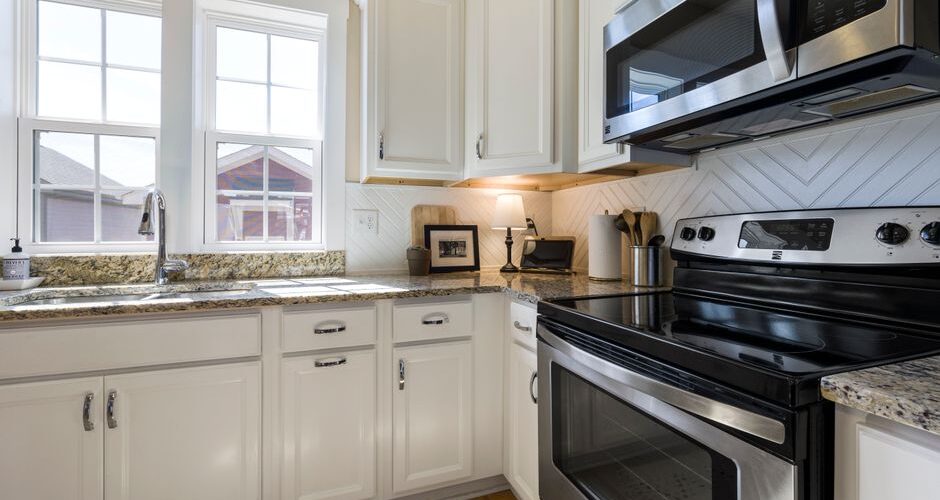
A white kitchen looks clean, bright, and current, which is exactly why so many Denver homeowners pick it. It is also the finish that shows every fingerprint, grease splatter, and scuff, so the question of durability comes up fast. Professionally prepared and sprayed cabinets typically hold up for 8 to 15 years before they need repainting, and that range depends heavily on prep work, the coating system, how hard the kitchen gets used, and how the finish is maintained. A busy household with kids, daily cooking, and a coffee station running all morning sits at the harder end of that range. The good news is that the variables are mostly controllable.
Why White Is the Most Demanding Color to Keep Looking New
Color choice does not change how long paint physically bonds to a cabinet door, but it absolutely changes how long the finish looks good. White and other light shades reflect light across the full surface of the door, which means a small chip at a drawer pull or a dark smudge beside the stove reads louder than it would on a walnut stain or a deep green. In a busy kitchen, the wear points are predictable: the area around handles and knobs, the doors closest to the range, the cabinet run above the sink, and the lower doors that get bumped by hips, stools, and vacuum cleaners.
That does not mean white is a bad choice. It means the quality of the base layer underneath it matters more. A sprayed white finish with proper bonding and a hard topcoat can be wiped down daily for years without dulling. A thin coat applied over a greasy surface will start failing at those same high-touch points within months, and white makes that failure obvious.
What Denver’s Dry Air Does to a Cabinet Finish
Denver’s humidity sits low for most of the year, and that single detail reshapes how cabinet paint behaves from the moment it leaves the spray gun. Water evaporates out of the coating quickly here in a way it does not in coastal or midwestern markets. That fast dry can be an advantage in the right hands, since off-gassing happens quickly and a sprayed door can be handled sooner. It can also cause problems when the process is sloppy.
Homeowners who have watched a careful brush job dry with visible lap marks, or a freshly coated door come out slightly gritty, usually blame the paint. The bigger variable is the air around it. Low humidity pulls moisture out of the film fast, and if the product is not formulated or thinned for those conditions, the result can be a finish that never lays down flat. Solid prep is what keeps a finish bonded through a decade of dry winters and kitchen steam. In practical terms, that means degreasing, sanding, and a bonding approach suited to the door material, not just a scuff and a coat of wall paint.
The Three Factors That Decide How Long the Finish Lasts
The gap between a homeowner repaint and a factory-grade result comes down to three things: surface prep, spray equipment, and the coating itself. Each one moves the lifespan needle independently, and a weak link in any of them shortens the life of the whole job.
| Factor | What It Controls | What Shortens It |
|---|---|---|
| Surface prep | Whether the coating bonds and stays bonded through dry winters and kitchen steam | Grease left on doors, skipped sanding, no adhesion strategy for the material |
| Spray application | Film thickness, smoothness, and whether the finish looks factory-made | Brush and roller marks, thin coverage, overspray in a dusty workspace |
| Coating system | Hardness, scrub resistance, and how the white holds its tone | Wall paint used on cabinetry, incompatible primer, too few coats |
| Daily use and cleaning | How quickly high-touch areas wear | Abrasive cleaners, scrubbing pads, spills left to sit on the film |
Sprayed Versus Brushed: Why Application Method Matters
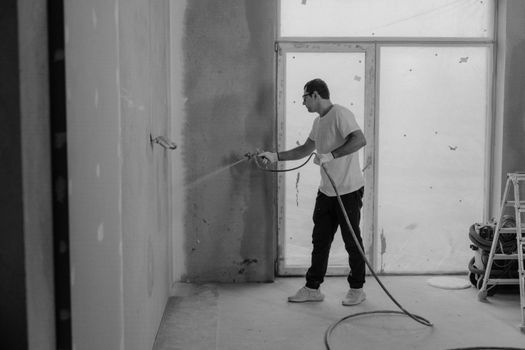
Spray application is what separates a finish that looks built-in from one that looks repainted. An HVLP sprayed finish lays the coating down in an even film with no brush marks and no stipple, which is the texture most homeowners are trying to avoid on flat-panel doors. That matters beyond looks. A uniform film thickness wears more predictably, so the finish does not thin out unevenly around the most-used cabinet pulls and start showing color underneath after a few years.
The best results often happen away from the house. Off-site cabinet door spraying, where doors and drawer fronts leave for roughly one to two weeks depending on the size of the kitchen, avoids dust settling into wet film and removes the smell of curing paint from the living space. It also means the doors can be sprayed flat and cured in a controlled environment rather than propped up in a working kitchen. For white cabinets, where particles and dust show immediately, that control is a real durability advantage, not just a convenience.
Cure Time: Why the First Two Weeks Set Up the Next Ten Years
A sprayed finish feels dry long before it is hard. General trade guidance puts dry time at a few hours, with light use around 24 to 48 hours and full hardness arriving over a longer stretch, often cited in the range of 7 to 14 days. Actual timing depends on ventilation, the specific paint product, and the temperature in the home. A cool, closed-up house slows the process. Good airflow and normal indoor temperatures speed it up.
Those first weeks matter because a finish that gets scrubbed, leaned on, and slammed before it fully cures can develop soft spots that never quite firm up. Treat the new finish gently at the start. Avoid stacking dishes against the cabinet doors, skip the heavy scrubbing, and let the film finish what it is doing.
Signs It Is Time for a Repaint
Most painted cabinets do not fail all at once. They degrade in a pattern across the doors that get the most contact. Watch for chipping or peeling at the corners and edges, a worn ring of dullness around the hardware, dark residue that no longer wipes clean, visible drips or grain texture that has lifted, or a sheen that has gone chalky in the sunniest part of the kitchen. Any one of these is cosmetic. Several together usually means the coating has reached the end of its service life and a fresh spray is more efficient than spot repair.
Habits That Add Years to a White Kitchen Finish
You do not need a complicated routine. You need consistency at the high-touch spots.
- Wipe the doors nearest the range and sink weekly with a soft cloth and a mild cleaner, not an abrasive pad.
- Clean up grease splatter before it hardens, since cooked-on grease is harder on the film than the paint is on the cabinet.
- Keep cabinet doors away from direct steam from the dishwasher and kettle where possible.
- Touch up chips at the edges early, before moisture gets behind the film.
- Avoid harsh solvents and scrubbing sponges on the finish, even when a stain looks stubborn.

Getting a Firm Answer for Your Kitchen
Two kitchens in the same Denver neighborhood can land years apart in lifespan. A household that cooks twice a day with four people cycling through the same three cabinet doors is a different environment than a couple who orders in most nights. Prep quality, product choice, spray application, and daily habits all compound over time, which is why a single number is less useful than a realistic range. Professionally prepared and sprayed cabinets in a busy home should be planned around that 8 to 15 year window, with maintenance in between.
A free on-site estimate is the most reliable way to get a specific answer for your cabinets, since the condition of the existing finish, the door material, and the layout of your kitchen all factor into the recommendation. Cabinet Painting Denver works across the metro area, including Arvada, LoHi, RiNo, Cherry Creek, Park Hill, Aurora, and Lakewood, and backs its sprayed finishes with a 3 year workmanship warranty.
Frequently Asked Questions
How long before I can use my painted kitchen cabinets again?
Plan on light use somewhere around 24 to 48 hours after spraying, with full hardness developing over roughly 7 to 14 days. Ventilation, temperature, and the specific paint product all shift the timeline. Treat the first two weeks as a settling-in period and keep heavy scrubbing, leaning, and stacking to a minimum while the film finishes curing.
Does Denver’s dry climate shorten the life of cabinet paint?
Not automatically, but it changes how the coating behaves. Low humidity pulls moisture out of the film quickly, which can cause lap marks or a gritty texture when a product is not suited to those conditions. Proper prep is what keeps the finish bonded through dry winters and kitchen steam, so the climate is manageable with the right process.
How long will a sprayed white finish actually look good?
Well-prepared, professionally sprayed cabinets commonly look good for 8 to 15 years before repainting is needed. White is less forgiving than darker colors because chips, grease, and scuffs read more clearly against a bright surface, so the high-touch areas around hardware and the range will show age first.
Can sprayed cabinets be repainted later instead of replaced?
Yes. Refinishing is designed to be repeatable, and the door and box stay in place while the coating is renewed. If the finish is still sound, the prep work is usually lighter than the original job. If there is peeling or lifting, that needs to be addressed before a new coat goes on.