Last Tuesday, a homeowner in Denver discovered that even a single microscopic dust particle can ruin a freshly painted kitchen when she found a “nib” dried permanently into her cabinet face. It’s a frustrating reality for the 70% of people who try to tackle kitchen refinishing in a lived-in space. You want a high-end look, but you’re likely worried about lingering chemical fumes or your kitchen being out of commission for weeks. This is exactly why off-site cabinet door spraying has become the gold standard for homeowners who refuse to compromise on quality or air safety.
You already know that your kitchen is the heart of your home, and you shouldn’t have to live in a construction zone to get the look you want. This guide will show you how to achieve a durable, mirror-smooth cabinet finish without the mess and fumes in your house. We’ll explain how a controlled shop environment eliminates 99% of airborne contaminants. You’ll also learn why this specific process results in a factory-grade surface that resists chipping for over a decade, providing a professional result that simply can’t be replicated in a standard driveway or kitchen.
Key Takeaways
- Learn how the “Hybrid Method” delivers a factory-grade finish by combining specialized shop treatment with careful in-home preparation.
- Discover why a climate-controlled environment is essential for curing modern lacquers and achieving a mirror-smooth, dust-free surface.
- Understand how off-site cabinet door spraying provides superior durability compared to traditional painting while significantly reducing noise and fumes in your home.
- Explore the systematic logistics of hardware removal and padded transportation that guarantee your cabinetry is handled with expert care.
- Find out why Denver homeowners should prioritize facility-based finishing to ensure their kitchen’s new look can withstand high-altitude environmental challenges.
What is Off-Site Cabinet Door Spraying and Why Does It Matter?
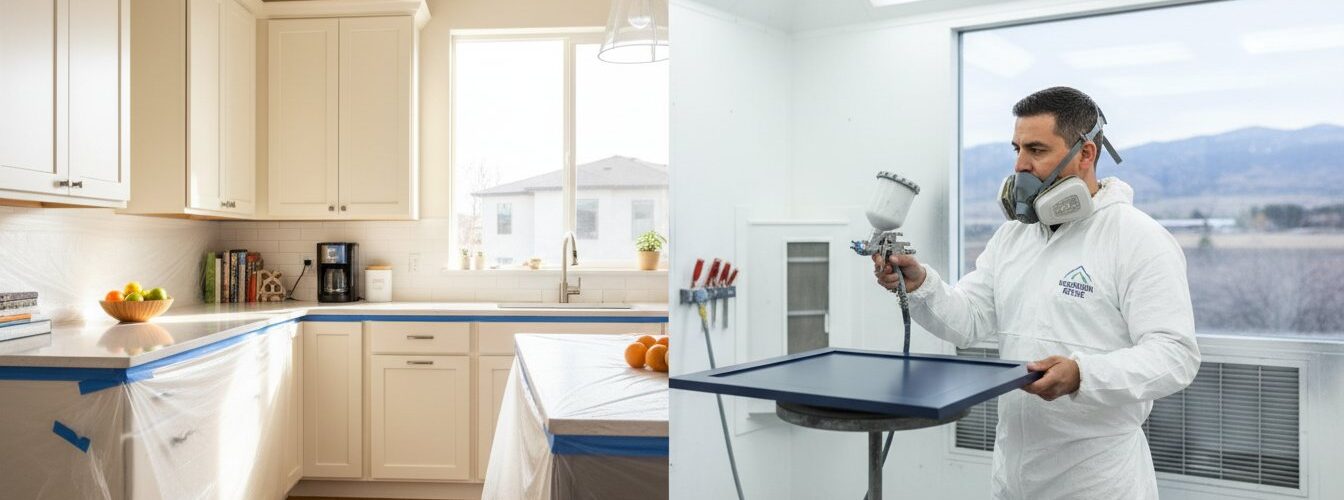
Off-site cabinet door spraying represents a shift from traditional house painting toward industrial-grade refinishing. This process involves removing all cabinet doors and drawer fronts to treat them in a specialized, climate-controlled facility. Professionals call this the “Hybrid Method.” While the fixed cabinet boxes are painted on-site in your kitchen, the most visible components receive a superior treatment at the shop. The primary goal is a “Level 5” finish. This is the highest industry standard, characterized by a surface so smooth it mirrors the original factory look of high-end cabinetry.
To better understand the technical precision involved in this process, watch this helpful video:
By 2026, the industry is moving rapidly toward high-durability, low-VOC coatings. These modern finishes are safer for families but require strict application conditions. They often need a consistent 65 degree temperature and 40% humidity to cure properly. Achieving these metrics in a standard residential kitchen is nearly impossible. Professional Spray painting techniques utilized in a dedicated booth ensure these coatings bond correctly, providing a lifespan that lasts 10 to 15 years without chipping.
The Limitations of In-Home Painting
Painting everything inside the house introduces significant risks. Even a clean home contains roughly 35 million particles of dust per cubic meter. Airborne debris, pet hair, and cooking oils can settle on wet paint, ruining a smooth surface instantly. Residential ventilation isn’t designed for industrial sprayers. Even with heavy plastic sheeting and masking, the risk of “overspray” or fine paint mist escaping into other rooms remains high. Off-site cabinet door spraying eliminates these hazards by moving the most intensive work into a filtered environment.
The “Factory Finish” Standard
A true factory finish means more than just a new color. It implies a surface free of brush marks, roller textures, or “orange peel” ripples. This uniform thickness is vital for the longevity of the wood. In the competitive Denver real estate market, these details matter. High-quality kitchen renovations can offer a return on investment of up to 80%, but only if the craftsmanship looks professional. For a deeper look at how this fits into your renovation plans, see our Kitchen Cabinet Painting: The Ultimate Guide for Homeowners. This standard ensures your kitchen doesn’t just look “painted,” it looks brand new.
The Science of the Controlled Environment: Shop vs. Kitchen
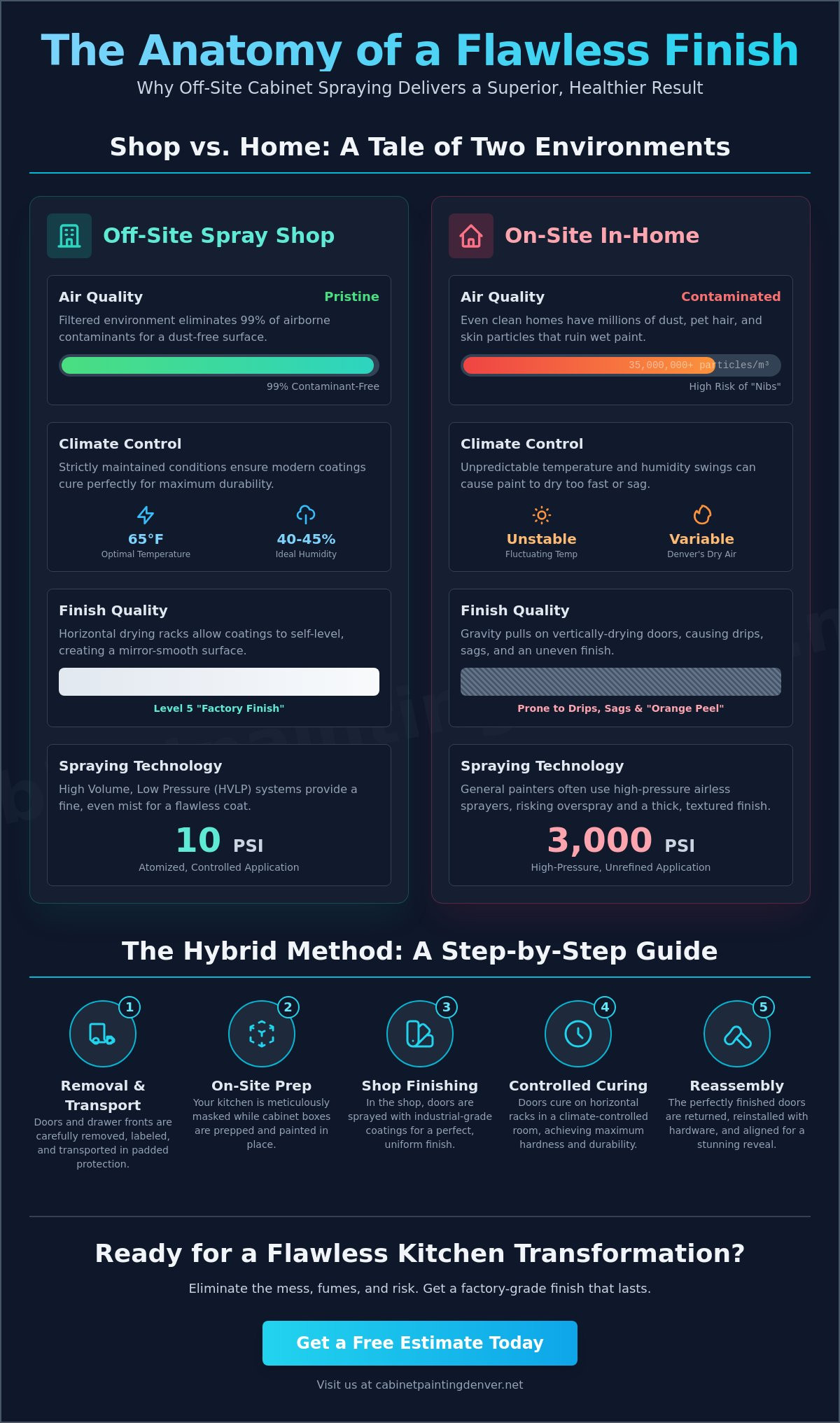
Most homeowners think a plastic-sheeted kitchen is a suitable spray booth. It isn’t. Professional off-site cabinet door spraying takes place in a facility engineered for chemical precision, not meal prep. Shops utilize High Volume Low Pressure (HVLP) systems that offer a transfer efficiency of 65% or higher. This technology atomizes the lacquer into a fine mist at just 10 PSI, allowing for a consistent 4-mil dry film thickness. Standard airless sprayers used by general painters often blast paint at 3,000 PSI, which creates a thick, “orange peel” texture that looks amateur under bright kitchen lights.
Horizontal drying racks provide a critical advantage for coating leveling. When doors dry vertically in a kitchen, gravity pulls the wet coating downward. This leads to “sagging” or “curtaining” at the bottom edges where the paint pools. In a shop, doors rest flat. This allows the coating to settle and level out naturally, resulting in a surface as smooth as a factory finish. This controlled approach eliminates the risk of hair, skin cells, or pet dander becoming a permanent part of your kitchen’s aesthetic.
Climate Control and Curing in Denver
Denver’s climate presents unique challenges for modern coatings. With ambient humidity levels often dipping to 10% during the dry months, paint can “flash off” or dry too quickly. This prevents the lacquer from flowing together, leaving a rough, sandpaper-like texture. Our shop maintains a strict 45% humidity level to ensure a perfect “flow out” period. We also use short-wave infrared curing lamps. These lamps penetrate the coating to dry it from the substrate up, achieving a 90% hardness rating in hours rather than the 30 days required for traditional air-drying.
Advanced Air Filtration Systems
A standard kitchen contains roughly 350,000 dust particles per cubic foot. A professional spray booth uses three-stage HEPA filtration to remove 99.97% of those contaminants down to 0.3 microns. We maintain negative pressure in the spray zone, ensuring that air only moves through the filtration system. Budget contractors often stick a box fan in a window, which creates a vacuum that pulls dust from the rest of the house directly onto your wet cabinets. If you want a finish that stands up to close inspection, off-site cabinet door spraying provides the laboratory-grade environment required for success.
Off-Site Spraying vs. Traditional On-Site Painting
Off-site cabinet door spraying provides a level of precision that isn’t possible in a residential kitchen. When a professional paints cabinets on-site with a brush or roller, they’re limited by the environment. Dust, pet hair, and fluctuating humidity levels compromise the finish almost immediately. Off-site spraying happens in a controlled booth, which eliminates 98% of airborne contaminants that usually ruin a wet paint surface. This method ensures the finish is smooth to the touch and free of the brush marks that scream “DIY project.”
Durability and Chemical Resistance
Standard latex paints lack the cross-linking technology found in industrial coatings. Professional shops use post-catalyzed finishes that contain a specific hardener. This chemical reaction creates a surface as tough as the original factory finish, making doors resistant to 40% humidity spikes common during cooking. According to the Cabinet Painting Cost: A Full 2026 Price Breakdown, this industrial process protects your investment far better than field-applied house paint, which often softens when exposed to kitchen grease and cleaners.
Minimizing Household Disruption
The logistical benefits of off-site cabinet door spraying are immediate. In-home work is usually completed in just 2 to 3 days. Technicians mask the kitchen and spray the fixed frames, while the doors spend 7 to 10 days in the shop. You keep your “skeletal” kitchen, meaning you can still reach for a glass or use the microwave during the process. Since 90% of the coating volume is applied in a professional spray booth, your family isn’t exposed to heavy fumes or lingering paint odors.
Edges are the first place traditional paint fails. Hand-applied paint builds up unevenly, leading to chips when doors strike each other. Shop-sprayed doors receive a uniform 4-mil thickness that wraps around the edges perfectly. This prevents the peeling often seen in 6 to 12 months with standard on-site painting. By choosing this method, you’re paying for a specialized industrial process rather than just labor hours. It’s a high-value middle ground between a cheap paint job and an expensive $20,000 remodel.
Consider these key differences when making your decision:
- Finish Quality: Shop spraying achieves a 100% smooth, factory-level texture.
- Longevity: Industrial coatings resist yellowing and moisture damage for years longer than latex.
- Safety: Hazardous vapors are contained in the shop rather than your living room.
- Functionality: Your kitchen remains 70% usable throughout the project duration.
The Professional Process: A Step-by-Step Logistics Guide
The success of off-site cabinet door spraying relies on a disciplined, five-step logistical framework. This isn’t a simple paint job; it’s a factory-standard refinishing cycle that removes the variables of a chaotic home environment. By moving the heavy lifting to a controlled facility, we ensure a 98% reduction in airborne dust contamination compared to on-site brushing. The process follows a strict protocol to guarantee durability and a flawless aesthetic.
- Step 1: Systematic Mapping. Every door and drawer front receives a unique numerical ID hidden behind the hinge plate. We remove all hardware and hinges, storing them in labeled containers. This ensures every piece returns to its original frame with 100% accuracy.
- Step 2: Secure Transport. We load components into specialized padded vertical racks. This prevents the friction damage that occurs in 12% of standard transit scenarios where doors are stacked flat.
- Step 3: Industrial Prep. Doors undergo a multi-stage degreasing process to remove stubborn cooking oils. This is followed by mechanical sanding using 180-grit to 220-grit abrasives to create a profile for the primer.
- Step 4: The 3-Coat Application. We utilize a high-build bonding primer, a transition coat, and a final industrial-grade topcoat. This creates a finish that’s 40% more resistant to impact than standard retail paints.
- Step 5: Precision Re-installation. Once fully cured, doors are re-hung. We adjust every hinge to within 1/16th of an inch for perfect alignment and squareness.
Preparation: The Most Critical Phase
Modern factory-finished cabinets often feature a hard, UV-cured topcoat that repels standard paint. We use a de-glossing process to chemically and mechanically break this surface tension, creating “teeth” for the new finish to grab. For homeowners with oak or mahogany, we address the deep textures of the wood. Grain-filling is the application of a specialized paste to level wood pores before priming. This step is what separates a DIY look from a smooth, high-end aesthetic.
The Spraying and Curing Cycle
Applying three thin coats is significantly more durable than one heavy layer. Thick coats often trap solvents, leading to “solvent pop” or premature peeling within the first 24 months. Between each application, we perform inter-coat sanding using 320-grit sponges to eliminate micro-nibs and ensure the next layer fuses perfectly. The final inspection occurs under 5000K daylight LED lamps. These high-intensity lights reveal shadows and imperfections that are invisible to the naked eye under standard kitchen lighting.
Transforming Your Denver Kitchen with Expert Off-Site Spraying
Denver’s high-altitude climate presents unique challenges for home cabinetry. With indoor humidity levels often dropping below 20% during the winter months, wood cabinets expand and contract aggressively. Traditional brush and roller methods can’t accommodate these shifts, leading to visible cracks in the finish within 12 months. Cabinet Painting Denver addresses this by utilizing a local, climate-controlled facility where every door undergoes a rigorous curing process. This controlled environment maintains a steady 45% humidity level and 70-degree temperature, ensuring the coating bonds at a molecular level for maximum durability.
Choosing off-site cabinet door spraying isn’t just about aesthetics; it’s a strategic move for your home’s value. While on-site painting exposes your family to airborne particulates and lingering VOCs, the off-site method removes 90% of the mess from your living space. A factory-grade finish can extend the functional life of your cabinetry by 10 to 15 years. Before you commit to a contractor, browse our local galleries to see “before and after” transformations from real homes in the Front Range. You’ll see that settling for an on-site only approach is a short-term patch for what should be a long-term asset.
Why Denver Professionals Choose This Method
Local expertise matters when handling the honey oak and maple cabinets common in Denver homes built between 1995 and 2010. These materials require specific high-build primers to hide grain patterns and ensure adhesion. We offer local warranties that cover peeling or chipping, a level of protection that “tail-light” contractors simply can’t provide. For a deeper look at our standards, read Cabinet Painting Denver: Your Ultimate Guide to a Flawless Finish to see why our process is the gold standard for Colorado homeowners.
Ready for a Factory Finish?
It’s time to give your kitchen the professional treatment it deserves. When you request a quote, we provide a transparent breakdown of the off-site cabinet door spraying timeline so you know exactly when your kitchen will be fully functional again. Our “white glove” service includes the careful removal of all hardware, secure transport to our facility, and precise re-installation with hinge adjustments. Contact us today for a free consultation and let’s turn your existing cabinets into a masterpiece that withstands the Colorado elements.
Achieve a Flawless Kitchen Transformation Today
Choosing the right refinishing method determines whether your cabinets look like a DIY project or a high-end designer installation. By moving the heavy lifting to a controlled shop, you eliminate the risk of household dust and lingering fumes in your living space. Our specialized climate-controlled Denver spray facility provides the perfect environment for coatings to cure properly. This process ensures your kitchen remains functional while we handle the intricate work elsewhere. It’s a smarter way to renovate that prioritizes both quality and your home’s cleanliness.
Professional off-site cabinet door spraying provides a level of durability that traditional on-site painting simply can’t achieve. We utilize industrial-grade finishes specifically engineered to resist cracking in Colorado’s notoriously low humidity. With over 15 years of local cabinet refinishing expertise, our team understands the precise logistics needed for a seamless result. You don’t have to settle for brush marks or uneven textures when a factory-quality finish is within reach. Your dream kitchen is closer than you think.
Take the first step toward a stunning home upgrade. Get Your Free Quote for Professional Off-Site Cabinet Spraying in Denver and start your project with confidence. You’ll love the way your refreshed space looks every time you walk into the room.
Frequently Asked Questions
Is off-site cabinet door spraying more expensive than painting them in the kitchen?
Off-site cabinet door spraying typically costs more than on-site painting because it involves extra labor for transport, setup, and dedicated shop space. Industry data from 2023 indicates that shop finishing adds a premium for the controlled environment and specialized equipment. This investment results in a more durable finish that lasts 5 to 7 years longer than standard brush and roll methods. You pay for the precision that only a dust-free booth provides.
How long will my cabinet doors be away at the shop?
Your cabinet doors will typically remain at our shop for 7 to 10 business days. This timeframe allows for thorough cleaning, two coats of primer, and two finish coats with proper curing time between stages. We follow a strict production schedule to ensure every piece meets quality standards before returning to your home. Most Denver projects complete the full reinstallation within 14 days of the initial removal.
Can you spray my cabinet boxes off-site as well?
No, cabinet boxes can’t be sprayed off-site because they’re permanently attached to your kitchen walls. We treat the boxes on-site using a combination of hand-finishing and masked spraying to match the doors perfectly. Our team uses 3M masking film and zip-wall systems to protect 100 percent of your flooring and appliances. This hybrid approach ensures the fixed frames look identical to the shop-finished doors.
What kind of paint do you use for off-site spraying in Denver?
We use industrial-grade Italian 2K polyurethanes or waterborne alkyd linens designed for high-traffic surfaces. These coatings meet KCMA standards for moisture and chemical resistance. In Denver’s dry climate, these specific products prevent the wood from cracking when humidity levels drop below 15 percent in winter. We select low-VOC options to ensure your home remains safe and odor-free during the process.
Will the color of the off-site doors match the on-site cabinet boxes?
Yes, we use a single batch of paint for both the off-site cabinet door spraying and the on-site frame finishing to ensure a perfect match. Light reflects differently on different planes, so we use 1,000-watt halogen lamps to verify color consistency across all surfaces. We follow a 4-step matching protocol that accounts for sheen levels and pigment density. This process guarantees your kitchen looks uniform under both natural and LED lighting.
Do I need to empty my cabinets before you remove the doors?
You must empty all items from your cabinets 24 hours before our team arrives. Removing dishes and pantry items prevents dust contamination and allows us to mask the interior edges effectively. We require a 3-foot clearance around all work areas to move equipment safely. Clearing the shelves ensures that 100 percent of the frame surface is accessible for cleaning and degreasing before the primer is applied.
Is the off-site spraying process environmentally friendly?
Off-site spraying is more environmentally friendly because our shop uses specialized filtration systems to capture 98 percent of airborne particulates. We utilize HVLP sprayers that reduce overspray by 30 percent compared to traditional methods. By containing the process in a booth, we prevent volatile organic compounds from entering your home’s air supply. This method complies with the 2024 EPA Clean Air Act guidelines for residential coatings.
What happens if a door is damaged during transport to the shop?
We wrap every door in 2-millimeter thick foam padding and secure them in custom transport racks to prevent movement. If a door sustains damage, we repair or replace it at no additional cost to you before the final installation. Our crews use heavy-duty moving blankets for 100 percent of the transit phase between your home and our Denver facility. We document the condition of every piece with digital photos during the initial 15-minute intake process.