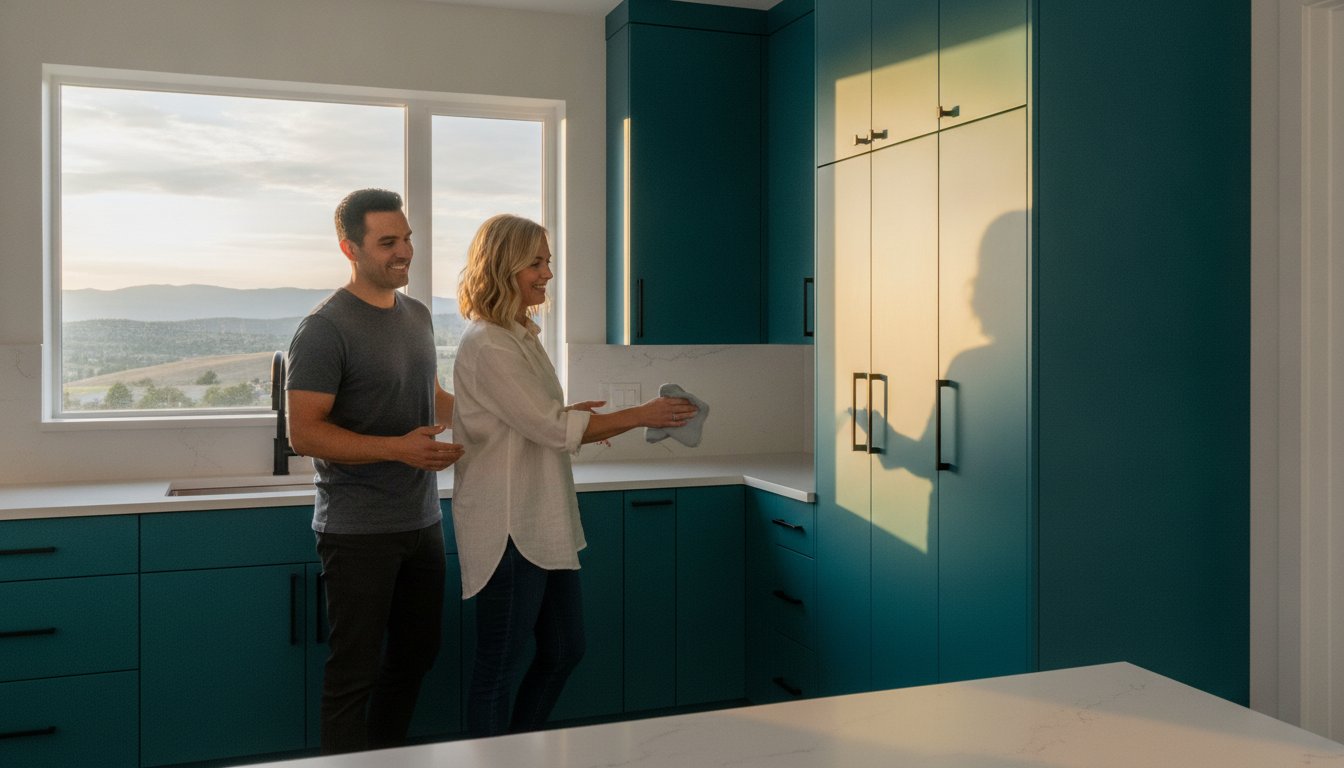
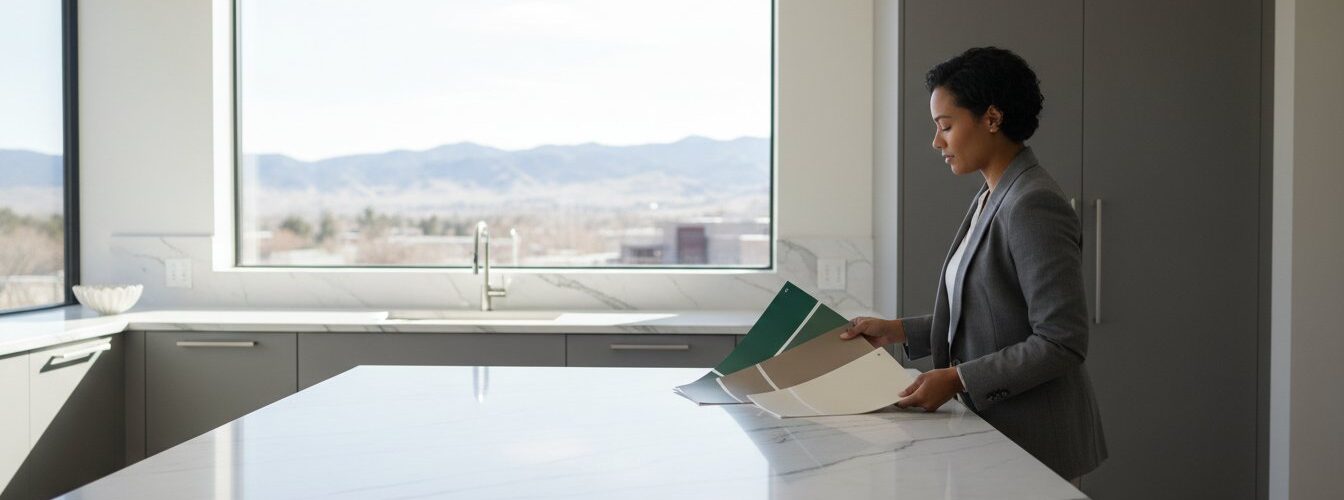
Your countertops are the undisputed boss of your kitchen, and your cabinet paint is simply the supporting actor tasked with making them look good. If you are struggling with how to match cabinet color with countertops, you aren’t alone. It is easy to feel overwhelmed by thousands of swatches, especially when you realize that the wrong white can suddenly make your expensive marble look yellow or your granite look perpetually dirty. In Denver, this challenge is even harder because our intense, high-altitude sunlight shifts colors in ways that standard design blogs just don’t account for.
Serving Lakewood, CO, Littleton, CO, Golden, CO, Roxborough Park CO. Ken Carl Ranch CO, Washington Park Area,
Cabinet Painting Service Areas in Denver & Surrounding Cities, Cabinet Refinishing in Denver County,
Arvada, CO, Wheat Ridge, CO,
and Castle Pines CO. Englewood CO. Centennial CO.
Cabinet Painting in Arapahoe County, CO
Including Centennial, CO, Greenwood Village, CO,
Cherry Hills Village, CO,
and Aurora, CO.
Cabinet Painting in Adams County & Broomfield, CO
Cabinet Painting Service Areas in Denver & Surrounding Cities, Cabinet Refinishing in Denver County,
Serving Lakewood, CO, Littleton, CO, Golden, CO, Roxborough Park CO. Ken Carl Ranch CO, Washington Park Area,
Arvada, CO, Wheat Ridge, CO,
and Castle Pines CO. Englewood CO. Centennial CO.
Cabinet Painting in Arapahoe County, CO
Including Centennial, CO, Greenwood Village, CO,
Cherry Hills Village, CO,
and Aurora, CO.
Cabinet Painting in Adams County & Broomfield, CO
We understand that you want a high-end look without the $25,000 price tag of a full replacement. Since professional Kitchen Cabinet Painting can save you 60% to 70% compared to buying new units, getting the color right is the most important part of your investment. This guide shares the professional designer’s framework for pairing paint colors with stone or wood surfaces. You will learn how to master color theory, identify tricky undertones, and see which warm neutrals and earthy greens are dominating the 2026 design scene so you can start your project with total confidence.
Key Takeaways
- Treat your stone as the design anchor by using the Countertop-First Rule to pull paint colors from its natural mineral flecks.
- Avoid costly mistakes by learning to identify subtle undertones that can make expensive stone surfaces look dingy or mismatched.
- Master professional strategies for how to match cabinet color with countertops to create either a bold high-contrast look or a soothing monochromatic feel.
- Adjust your color palette for Denver’s unique high-altitude light, which can shift the appearance of paint throughout the day.
- Learn why custom-tinted industrial coatings outshine DIY methods for achieving a durable, high-end finish on your kitchen cabinets.
Table of Contents
The Countertop-First Rule for Kitchen Design
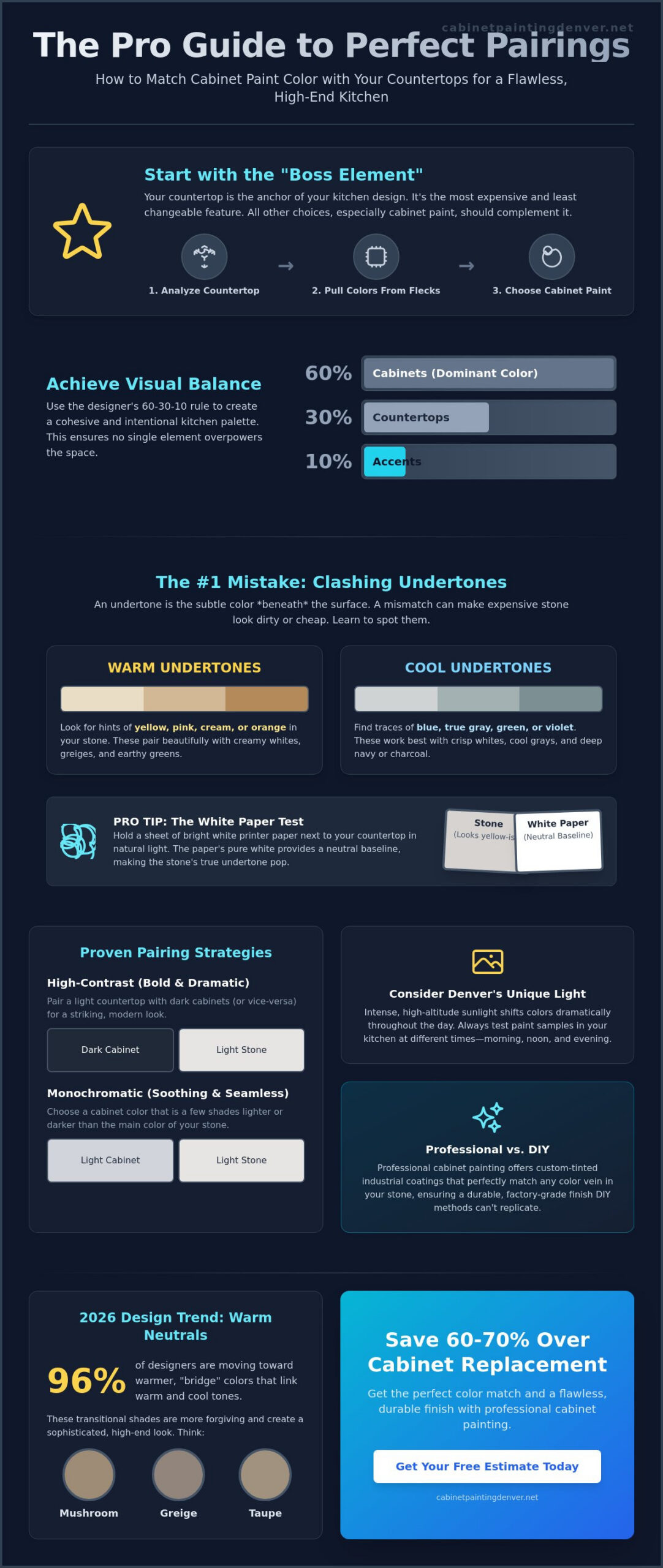
Countertops act as the anchor of your kitchen because they are the most expensive and hardest to change. While you can repaint a wall in an afternoon, swapping out a quartzite slab requires a massive financial and logistical commitment. A "Boss Element" is the fixed feature in a room with the most complex color profile that dictates all other design choices. In most kitchens, your stone slab is that boss. It sets the tone for the entire room, meaning every other material must bow to its colors and patterns.
Understanding how to match cabinet color with countertops requires applying the Countertop-First Rule. This means you must select your paint color based on the stone’s dominant mineral flecks rather than trying to force a pre-selected paint to work with a natural slab. Designers often use color theory principles to follow the 60-30-10 rule: 60% of the visual space is your cabinet color, 30% is your countertops, and 10% is dedicated to hardware and accents. This balance ensures your kitchen feels intentional and cohesive rather than cluttered.
To better understand how these elements interact, watch this helpful video:
Identifying Your Kitchen’s Fixed Elements
Finding the "true" color of your stone means looking past the surface. A slab that looks gray from a distance might actually be full of green or blue undertones when you look closely. You must also evaluate your flooring and backsplash as secondary constraints. If your floors have a strong yellow oak tone, choosing a cool gray cabinet paint will create a jarring visual clash. Determine if your kitchen is naturally warm-leaning or cool-leaning by looking at these existing materials as a collective whole before you ever open a paint deck.
Why Painting Cabinets is the Ultimate Color Hack
Choosing professional kitchen cabinet painting gives you a level of flexibility that factory-finished cabinets simply cannot match. You aren’t limited to a dozen stock colors. Instead, you can custom-tint industrial coatings to perfectly align with a specific vein in your marble or quartz. This approach is the best way to transition from outdated wood stains to modern solid colors. It allows you to keep high-quality cabinet boxes while completely refreshing the palette. Professional refinishing is the most effective method for homeowners learning how to match cabinet color with countertops without the stress of a full demolition.
Decoding Undertones: The Secret to a Cohesive Kitchen
Understanding the difference between mass color and undertone is the biggest hurdle when learning how to match cabinet color with countertops. Mass color is the dominant hue you notice immediately, like "gray" or "beige." Undertones are the subtle colors beneath the surface that only become obvious when compared to something else. This is why a kitchen remodel can feel "off" even if the colors seem similar on paper. If you pair a "clean" blue-toned white paint with a "creamy" yellow-toned marble, the countertop will instantly look dingy or stained. It sets the tone for the entire room.
The #1 reason kitchen designs fail is a clash of these hidden hues. To fix this, designers use "bridge colors." These are transitional shades, like mushroom or taupe, that contain elements of both warm and cool palettes. They act as a visual handshake between your stone and your cabinetry. This aligns with the 2026 trend where 96% of designers are moving toward these warmer neutrals. These tones are more forgiving. They help create a cohesive, high-end look that feels intentional rather than accidental.
Warm vs. Cool Undertones in Stone
Identifying these hues doesn’t require a degree in fine arts. For beige granites, look for hints of pink, yellow, or orange. In grey or black stones, you’ll often find traces of blue, green, or even violet. The most reliable way to spot these is the "White Paper Test." Hold a sheet of bright white printer paper against your countertop in natural light. The paper provides a neutral baseline, making the stone’s true undertone pop. If the stone looks yellow against the paper, it’s warm. If it looks blue, it’s cool. The paper doesn’t lie. Don’t skip this step.
Matching Paint to Veining and Patterns
Your stone’s pattern also dictates your paint choice. Busy granites with heavy movement require a quiet, neutral paint color to avoid visual clutter. If you have marbled quartz, try pulling a secondary vein color for your cabinet paint instead of the primary background shade. This creates a sophisticated, layered look. Using the best paint for cabinets ensures that your chosen color has the depth and finish needed to highlight your stone’s texture. If you’re feeling overwhelmed by swatches, reaching out for professional cabinet painting advice can save you from a costly color mistake.
4 Proven Strategies for Pairing Paint with Stone
Selecting a design direction helps narrow down thousands of swatches into a manageable shortlist. When you are deciding how to match cabinet color with countertops, you must choose whether you want the cabinets to disappear into the background or stand out as a bold statement. Most successful Denver kitchens follow one of these four professional frameworks to ensure a high-end result that feels intentional rather than accidental.
Strategy 1: High Contrast (Light vs. Dark)
High contrast is a timeless choice for modern kitchens. This involves pairing light cabinets with dark stones, such as white paint with deep black granite or dark soapstone. Conversely, you can pair navy or charcoal cabinets with a bright white quartz. In smaller Denver kitchens, white cabinets with dark countertops can actually make the space feel larger by reflecting more light at eye level. This strategy is particularly effective for updating "legacy" stones like Uba Tuba. While Uba Tuba often looks dated with honey oak wood, pairing it with a crisp off-white or a sophisticated soft gray can make its subtle green flecks look modern and expensive.
Strategy 2: Ton-sur-Ton (Tone on Tone)
The monochromatic approach, or ton-sur-ton, creates a seamless and calming environment. This strategy involves matching your cabinet paint to the secondary colors in your stone. For example, if you have Carrara marble with prominent gray veining, choosing a gray paint in that exact same hue creates a "quiet" kitchen where the elements blend together perfectly. Using "Greige" is another excellent way to soften the transition between a beige-heavy stone like Santa Cecilia and white walls. Instead of fighting the gold tones in Santa Cecilia, a mushroom or taupe paint color bridges the gap. This makes the stone feel like a luxury feature rather than an outdated relic.
Strategy 3: The Island Accent
If you can’t decide on just one color, the "Island Accent" strategy allows you to bridge different stone tones. You might paint your perimeter cabinets a neutral white to match the background of your quartz, while using a deep charcoal or a muted olive for the island to pull out the darker veining. This two-tone approach is a favorite for homeowners who want to add visual depth without committing to a single dark color across the entire room.
Strategy 4: Complementary Pairs
This strategy uses the color wheel to find hues that sit opposite each other, making the stone’s natural colors "pop." If your countertops have warm, copper-colored flecks, a cool slate blue on the cabinets will make those warm tones glow. It’s a sophisticated way to use how to match cabinet color with countertops to highlight the natural artistry of the stone itself. By choosing colors that provide a visual foil to the stone, you create a vibrant energy that keeps the kitchen from feeling flat or one-dimensional.
Testing Your Palette in Denver’s Unique Light
Denver’s geography plays a massive role in how to match cabinet color with countertops. At an altitude of 5,280 feet, the thinner atmosphere allows more ultraviolet light to penetrate. This creates a natural light that is noticeably cooler and more blue-tinted than the light found at sea level. If you choose a paint color based on an East Coast design blog, you might be disappointed. A warm white that looks creamy in a coastal showroom can often look stark or even slightly blue in the intense Colorado sun. The 300+ days of annual sunshine we enjoy means your kitchen is constantly flooded with light that can drastically shift your color perception.
Metamerism is the scientific reason behind this frustration. It is the phenomenon where two colors appear to match under one light source but look drastically different when the lighting changes. In a high-altitude kitchen, this effect is amplified. Your cabinet color will undergo a dramatic transformation from sunrise to sunset. This makes testing your palette in your actual space a non-negotiable step for anyone learning how to match cabinet color with countertops.
The 24-Hour Sample Test
You must view your potential paint colors at three specific times: 8 AM, 12 PM, and 8 PM. Morning light is often soft and blue, while midday sun is intense and direct. By 8 PM, you are likely relying on artificial light. The orientation of your home also matters. North-facing Denver kitchens receive a consistent, cool light that can make dark colors feel heavy. South-facing kitchens endure a barrage of warm, intense light that can wash out subtle neutrals. Instead of small swatches, use large-format peel-and-stick samples. Place them directly against your backsplash and stone to see how the boss element responds to the shifting light throughout the day.
Artificial Lighting and Color Temperature
Your choice of light bulbs is just as important as the paint itself. LED bulb temperature is measured in Kelvins (K), and it can make or break your design. Using 2700K bulbs creates a heavy yellow cast. This is the quickest way to make brand-new white cabinets look aged and dingy. On the other end of the spectrum, 5000K bulbs feel clinical and cold. For most Denver homes, the 3000K to 3500K range is the Goldilocks zone. It provides a clean, neutral light that accurately reflects your paint’s true undertones without adding unwanted warmth or coolness.
If you want to ensure your chosen colors stand up to the Colorado sun, book a professional color consultation to see how industrial-grade coatings perform in your specific kitchen layout.
Professional Cabinet Painting: Achieving the Perfect Match
Once you have mastered the theory of how to match cabinet color with countertops, the final step is execution. Many homeowners try a DIY approach using off-the-shelf latex paint, but this often results in visible brush strokes and poor adhesion. Kitchen cabinets are high-touch surfaces that endure heat, grease, and moisture. Standard house paint isn’t designed for that level of wear. Professional cabinet painting in Denver utilizes custom-tinted industrial coatings that provide a factory-smooth finish. These coatings are chemically bonded to the wood, ensuring that the sophisticated color you chose doesn’t chip or peel after six months of use.
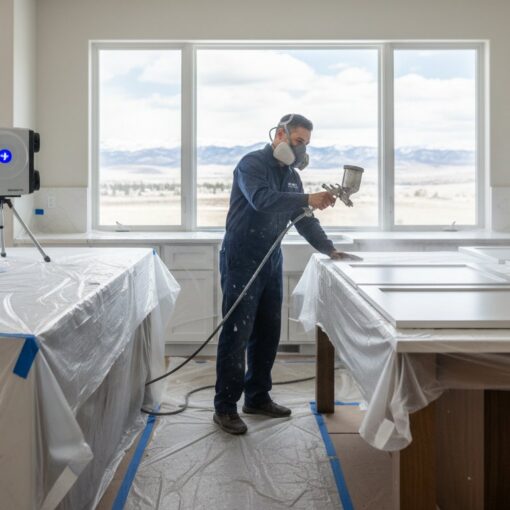
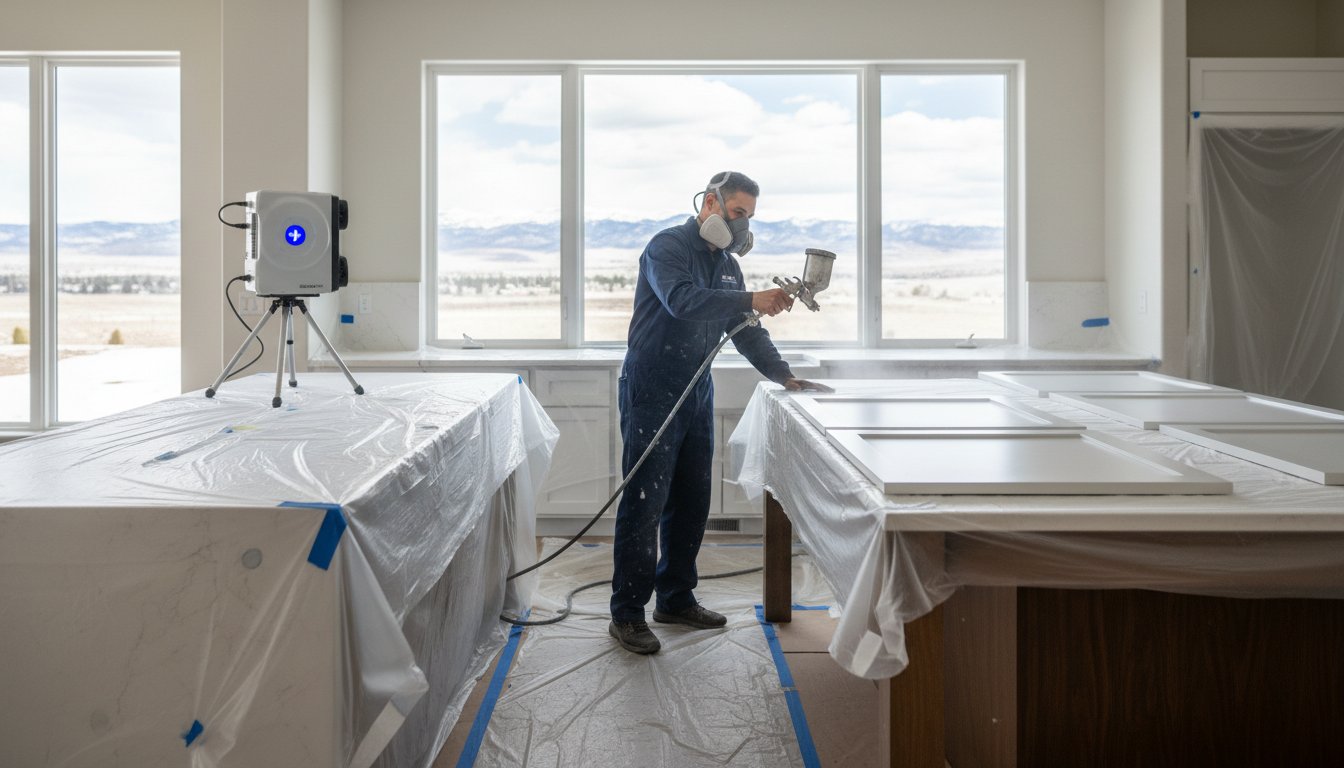
Achieving a high-end look also requires a professional spray application. This technique eliminates the texture of a roller and ensures the color is perfectly consistent across every door and drawer front. Before you consider the project finished, go through your final checklist. Ensure your minimalist hardware complements your new palette and that your LED bulbs are set to the 3000K-3500K range discussed earlier. This final reveal is where your careful planning of how to match cabinet color with countertops finally comes to life.
The Refinishing Advantage
When looking at the cabinet refinishing cost, the financial benefits are clear. In Denver, professional cabinet painting typically costs between 30% and 50% of the price of new custom cabinets, which can range from $10,000 to $25,000 or more. With average professional labor rates in the city ranging from $40 to $100 per hour, you are investing in craftsmanship that produces a durable result for a fraction of a full remodel’s price. Beyond the savings, painting your cabinets is an environmentally responsible choice. You are keeping high-quality wood out of Colorado landfills while giving your kitchen a completely new aesthetic. Professional spraying ensures the color you picked is exactly the color you get on the finished product.
Ready for a Kitchen Transformation?
Starting a project of this scale can feel daunting, but you don’t have to do it alone. A professional color consultation can help you navigate thousands of swatches and find the perfect match for your specific stone. During the process, your cabinet doors are typically removed and finished in a controlled environment to ensure a dust-free, factory-grade result. The frames are then carefully painted on-site to match. This meticulous process is what separates a painted kitchen from a designer kitchen. If you are ready to see your vision come to life, get a free quote from Cabinet Painting Denver to start your match today.
Step Into Your Designer Kitchen
Your kitchen transformation depends on more than just picking a pretty swatch. By mastering the Countertop-First Rule and identifying those tricky undertones, you’ve gained the designer framework needed to succeed. You now understand how Denver’s intense sunlight can shift your palette and why testing samples in your own space is the only way to avoid a mismatched result. Learning how to match cabinet color with countertops is the first step toward a cohesive, high-end home that reflects your personal style.
Achieving that flawless, factory-quality look requires professional precision. We specialize in Denver’s unique lighting conditions and color theory to ensure your cabinets perfectly complement your stone surfaces. Our professional HVLP spray finish provides a durable result that outshines any DIY effort. It’s a highly cost-effective alternative to a full kitchen remodel, giving you the luxury aesthetic you want for a fraction of the price. Transform your kitchen with a professional color match from Cabinet Painting Denver and start your project today. You’re just one color away from the kitchen you’ve always wanted.
Frequently Asked Questions
How do I match my cabinets if I have busy granite countertops?
Choose a solid, neutral paint color that matches the background shade or the most subtle fleck in the stone. Avoid adding more patterns or complex textures to the cabinetry. This prevents the kitchen from feeling visually chaotic. If your granite has heavy movement, a creamy white or a soft charcoal provides the necessary visual rest. This allows the stone to remain the focal point without competing for attention.
Should cabinets be lighter or darker than the countertops?
Your choice depends entirely on the desired mood and the size of your kitchen. Lighter cabinets with darker countertops create a grounded, classic look that feels balanced. Darker cabinets with lighter tops feel modern and bold. In smaller spaces, keeping cabinets lighter than the countertops often helps the room feel more open. There is no wrong answer as long as the undertones are harmonious.
Can I match my cabinets to quartz veining?
Pulling a color from the secondary veining is a sophisticated way to handle how to match cabinet color with countertops. If your quartz has subtle gold or grey veins, using that exact shade for the cabinetry creates a high-end, custom look. This technique makes the countertops appear as if they were specifically sourced to match the room. It creates a seamless transition that feels intentional and professionally designed.
What are the most popular cabinet colors for 2026?
Earthy, nature-inspired tones like muted olive green, terracotta, and deep navy are leading the 2026 trends. While neutrals remain a staple for most designers, there is a significant shift toward warmer "mushroom" and taupe shades. These colors provide more character than traditional stark whites. Learning how to match cabinet color with countertops using these warmer tones helps create a cozy, inviting atmosphere that feels current and stylish.
How does lighting affect my cabinet and countertop color match?
Lighting can completely change the appearance of your paint’s undertones. Natural light in Denver tends to be cooler and blue-tinted, while artificial bulbs can add unwanted yellow casts. A color that looks perfect at noon might look completely different under evening lamplight. Always test your color choices under your specific kitchen lighting to ensure the match remains consistent throughout the day and night.
Do I need to change my backsplash if I paint my cabinets?
You don’t always need a new backsplash, but your existing tile must harmonize with the new cabinet color. If your backsplash is very busy or has strong undertones, your new paint choice must account for it. Often, a simple cabinet color refresh can make an existing backsplash look brand new. The right paint can highlight subtle colors within the tile that were previously unnoticed.
Can I use two different colors for my upper and lower cabinets?
Using two different colors, often called a "Tuxedo" kitchen, is a great way to add visual interest. Typically, designers use a darker color for the lower cabinets to ground the space and a lighter color for the uppers. This keeps the kitchen feeling bright and airy at eye level. This approach works best when both colors share a similar undertone to ensure the room feels like a single, cohesive design.
How do I know if my countertops have warm or cool undertones?
Compare your stone to a piece of pure white paper in natural daylight to reveal its hidden colors. If the stone looks yellow, orange, or gold against the paper, it has warm undertones. If it appears blue, gray, or violet, it is cool-toned. Identifying this correctly is the most important factor in ensuring your cabinet paint doesn’t clash with your stone or make it look dirty.