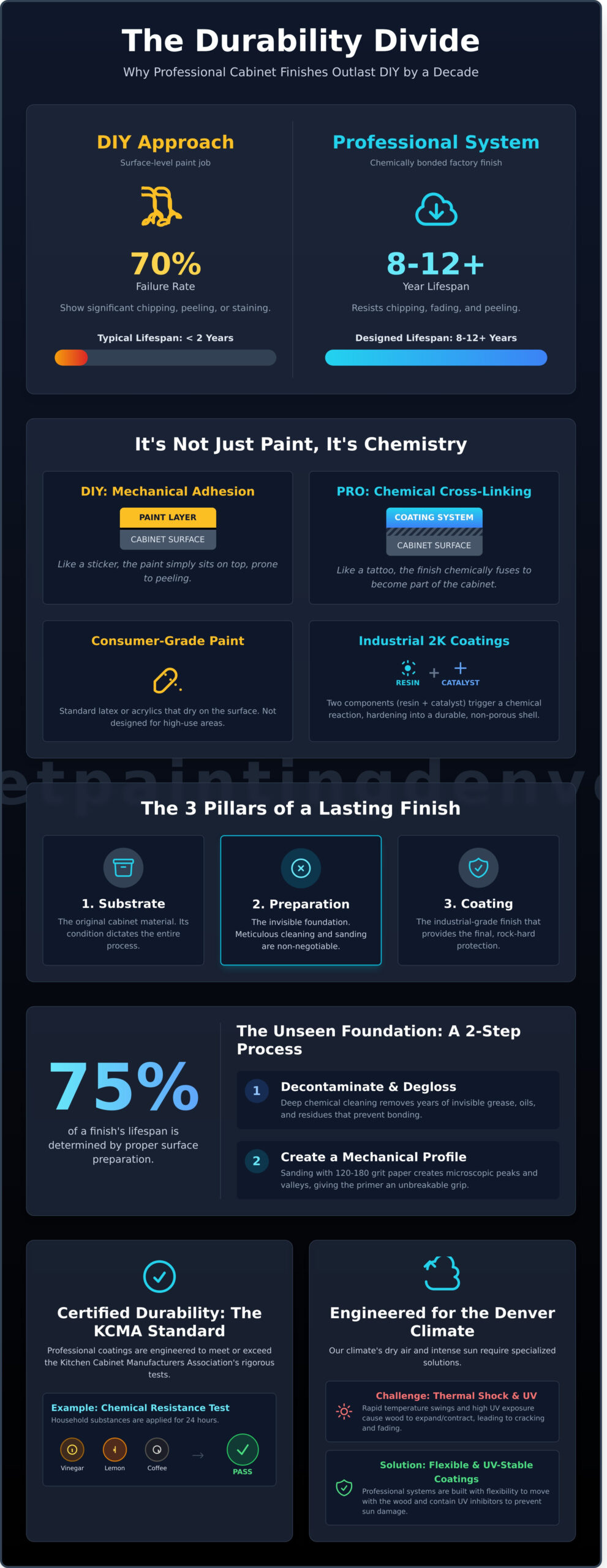
Did you know that industry data reveals over 70% of DIY cabinet painting projects show significant chipping, peeling, or staining in under 24 months? It’s a staggering failure rate for one of the most impactful home updates. That’s two years of careful work down the drain.
It’s a scenario that keeps homeowners up at night. You invest thousands of dollars and surrender your kitchen for a week, all while worrying if the new finish can actually stand up to daily life. The anxiety over choosing the right paint and the fear of a peeling mess is completely valid.
This guide is here to replace that anxiety with confidence. We’ll unpack the science-backed data on the real durability of professionally painted cabinets, showing you exactly how a multi-stage, expert process achieves a factory-hard finish designed to last 8-12 years, not two. You’ll discover the critical prep work that ensures longevity and why professional-grade coatings are the key to a kitchen that looks brand new well into 2026.
Key Takeaways
- Learn why a professional finish isn’t just paint, but a chemically bonded system designed to resist chipping and peeling for over a decade.
- Understand the “Big Three”-substrate, preparation, and coating-that truly determine the long-term durability of professionally painted cabinets in your home.
- Discover the simple maintenance steps and the common “finish killers” to avoid, ensuring your cabinets look brand new for years to come.
- See how Denver’s unique climate impacts cabinet paint and what professional solutions prevent cracking and fading in our dry, sunny environment.
The Science of Durability: Why Professional Finishes Outlast DIY
When you hear “durability,” you might think of a thick coat of paint. But true professional cabinet durability isn’t about thickness; it’s about chemistry. A professionally painted cabinet finish is a multi-layer system where each layer chemically bonds to the next, creating a single, hardened shell. This process, known as chemical cross-linking, creates a finish that is fundamentally different from what you can achieve with a brush and a can of store-bought paint. The result is a rock-hard surface designed to last 8 to 12 years without chipping, fading, or peeling under the stress of daily kitchen life.
To see how preparation and application technique contribute to this durable finish, watch this short video:
This “factory finish” is impossible to replicate with DIY methods because the products and processes are completely different. A DIY job relies on mechanical adhesion, where the paint simply dries on top of the cabinet surface. A professional finish chemically fuses with the cabinet, becoming part of it. It’s the difference between a sticker and a tattoo.
Industrial Coatings vs. Consumer Grade Paint
The paint aisle at your local hardware store is filled with latex and acrylic paints, some even labeled “Cabinet Grade.” This label can be misleading. While these paints are more durable than standard wall paint, they are worlds apart from the industrial coatings used by professionals. We use two-component (2K) products like conversion varnishes or polyurethanes. Understanding The Science of Paint Finishes reveals that these coatings aren’t just paint; they are chemical systems. They consist of a resin and a catalyst. When mixed, the catalyst initiates a chemical reaction that hardens the finish into a non-porous, incredibly durable surface resistant to household chemicals, grease, and moisture.
The Role of KCMA Standards
How do we measure this superior durability? The benchmark is set by the Kitchen Cabinet Manufacturers Association (KCMA). The KCMA performs a series of 13 rigorous lab tests on cabinet finishes to certify their durability. For example, in the chemical resistance test, substances like vinegar, lemon juice, and coffee are placed on the cabinet surface for 24 hours. A passing grade means the finish shows no discoloration, blistering, or staining. Professional cabinet painters use coating systems specifically formulated to meet or exceed these KCMA standards, ensuring the ultimate durability of professionally painted cabinets and giving you peace of mind that your investment is protected against real-world kitchen messes.
Critical Factors That Determine How Long Your Cabinets Will Last
A beautiful finish is only half the story. The true durability of professionally painted cabinets is a direct result of a system where every component works together. Think of it as a three-legged stool: the cabinet material itself (Substrate), the meticulous Preparation, and the industrial-grade Coating. If any one of these is weak, the entire finish is compromised. What separates a 10-year finish from one that fails in 18 months are the details hidden beneath the surface and the environment they must endure.
Surface Preparation: The Invisible Foundation
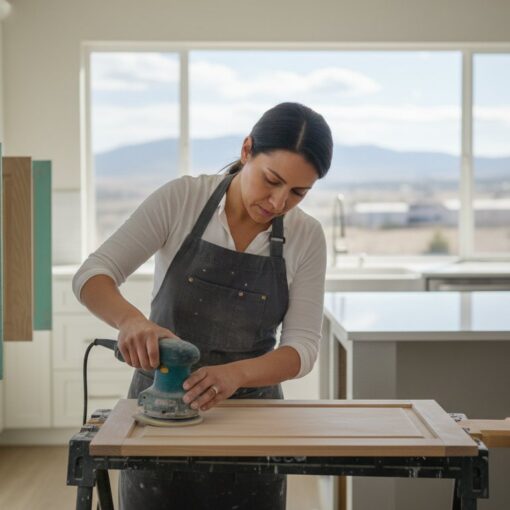
Industry experts agree that up to 75% of a coating’s lifespan is determined before a single drop of paint is applied. Years of atomized cooking grease, cleaning product residue, and hand oils create an invisible barrier that new paint simply cannot bond to. That’s why the first step is always a deep chemical cleaning and de-glossing, a critical process that ensures the surface is sterile. After cleaning, a professional creates a “mechanical profile” by sanding with 120- to 180-grit paper. This isn’t about stripping the old finish; it’s about creating microscopic peaks and valleys for the primer to grip, forming an unbreakable bond. The entire professional application process hinges on this foundational work.
Environmental Stressors in the Modern Kitchen
Your kitchen isn’t a static showroom; it’s a working environment with unique micro-climates. The cabinet above your dishwasher is regularly blasted with steam, while the ones flanking your oven experience “thermal shock,” or rapid temperature swings of 50°F or more. This causes the wood to expand and contract, putting immense stress on the paint, especially at the joints of five-piece doors. This is where most DIY paint jobs fail first, as the inflexible paint cracks under pressure.
High-traffic touchpoints also dictate wear patterns. The top edge of your trash pull-out, the corners of your most-used drawers, and the areas around handles are constantly exposed to skin oils. These oils can soften and break down inferior paints over time. A key factor in the long-term durability of professionally painted cabinets is the use of a catalyzed topcoat, which is chemically engineered to repel these oils and resist abrasion. Furthermore, sunlight from a kitchen window bombards cabinets with UV radiation, which can cause white paints to yellow and dark colors to fade within 3-5 years. Professional cabinet coatings contain UV inhibitors to protect the color and integrity of the finish for a decade or more. Understanding these variables is why our detailed consultation process always begins with a thorough assessment of your kitchen’s unique conditions.
The Professional Application Process for Maximum Longevity
The secret to a painted cabinet finish that lasts 10 years or more isn’t found in a can of paint from a big-box store. It’s forged through a meticulous, multi-stage process that prioritizes preparation and controlled application over speed. A professional workflow transforms a standard kitchen into one with a durable, factory-grade finish. While a DIY job might look good for a year, this professional system is what truly determines the long-term durability of professionally painted cabinets.
The journey from old to new begins long before any color is applied. Professionals remove all doors and drawer fronts, transporting them to an off-site facility. Here’s a typical workflow:
- Step 1: Degreasing and Cleaning. Every surface is deep-cleaned with industrial-grade degreasers to remove years of accumulated oils and contaminants that prevent adhesion.
- Step 2: Sanding and Repair. Surfaces are scuff-sanded to create a microscopic profile for the primer to grip. Dings and imperfections are filled and sanded perfectly smooth.
- Step 3: Priming. One to two coats of a high-adhesion, stain-blocking primer are applied to create a uniform, bondable base.
- Step 4: Intermediate Sanding. Each coat of primer and paint is sanded with fine, 220-grit or higher sandpaper to ensure a flawless surface and promote inter-coat adhesion.
- Step 5: Topcoating. Multiple thin topcoats of industrial-grade paint are applied, typically a two-component polyurethane or conversion varnish.
A critical distinction lies in where this work happens. On-site spraying within your home introduces dust, variable humidity, and temperature swings. A professional takes doors and drawers to a dedicated spray booth, a clean-room environment designed for one purpose: creating a perfect finish. This controlled setting prevents airborne dust and debris from settling on the wet paint, which creates tiny bumps that can become the starting point for future chips and failures.
The Spray Booth Advantage
Inside the booth, painters use High Volume Low Pressure (HVLP) sprayers. These tools atomize the paint into a fine mist, allowing for the application of exceptionally thin, even layers measuring just 3-5 wet mils (a mil is one-thousandth of an inch). Applying two or three of these thin coats creates a stronger, more flexible finish than one thick, heavy coat, which is brittle and prone to cracking. The controlled environment also maintains ideal conditions, typically around 70°F with 50% humidity, allowing the finish to cure correctly and achieve maximum hardness.
Priming and Sealing Strategies
The primer isn’t just a base layer; it’s a problem solver. For grainy woods like oak, a high-build primer is used to fill the grain, creating a glass-smooth foundation. For woods like cherry or mahogany, a stain-blocking primer is essential to prevent “tannin bleed,” where natural wood oils leach through and discolor the paint. This meticulous process is engineered to meet and often exceed tough industry benchmarks like the KCMA cabinet durability standards, which test finishes against common household chemicals and heat. Pros also seal the raw end-grain on MDF or wood doors, a crucial step that prevents moisture from wicking in and causing swelling over time.
Finally, understanding the curing timeline is key. A cabinet door might be “dry to the touch” in just a few hours, but it isn’t fully cured. Full chemical curing, where the paint molecules cross-link to form their hardest, most durable state, can take anywhere from 7 to 21 days. During this period, the finish is still vulnerable. A professional painter will provide precise instructions for this final, critical phase to ensure the ultimate durability of professionally painted cabinets.
Long-Term Maintenance: How to Preserve Your Professional Finish
You’ve invested in a premium, factory-like finish for your kitchen. Now, the key is protecting that investment. The long-term durability of professionally painted cabinets isn’t just about the quality of the initial application; it’s equally dependent on a consistent and correct maintenance routine. A pro-grade finish is tough, but it’s not invincible. Following a simple care protocol will keep your cabinets looking brand new for 10 years or more, preventing the premature breakdown of the protective topcoat and preserving the rich color beneath.
Think of your cabinet finish like the clear coat on your car. You wouldn’t wash your car with a Brillo pad and bleach, and the same logic applies here. The goal is to gently remove kitchen grease and grime without abrading or chemically stripping the surface. Immediate attention to spills, especially water, oil, or acidic liquids like tomato sauce, is critical. Any moisture left to sit for more than 20-30 minutes can begin to compromise the finish, particularly around seams and joints.
The Do’s and Don’ts of Cabinet Cleaning
Establishing a safe cleaning routine is the single most effective way to preserve your cabinet’s sheen and color. Forget aggressive scrubbing. A gentle, consistent approach is all you need. For routine cleaning, use the “Microfiber Method”: a soft, clean microfiber cloth dampened with a simple solution of warm water and a few drops of mild dish soap (like original Dawn). The microscopic fibers grab grease without scratching the surface.
- Safe Cleaners (The Do’s): A solution of 1 teaspoon of mild dish soap per gallon of warm water. Always use a second microfiber cloth dampened with only water to “rinse” any soap residue, then dry completely with a third clean, dry cloth.
- Finish Killers (The Don’ts): Avoid these at all costs. They will permanently dull, soften, or strip your cabinet’s finish.
- Vinegar and other acidic or citrus-based cleaners.
- Ammonia, bleach, or any harsh chemical degreasers.
- Abrasive powders like Comet or scrub pads like Scotch-Brite.
- Silicone-based polishes (e.g., Pledge), which leave a residue that’s difficult to remove and can cause issues with future touch-ups.
Monitoring Hardware and Hinges
Mechanical wear is just as damaging as chemical wear. Over time, the repeated opening and closing of cabinet doors can cause hinge screws to loosen. Even a 1-millimeter sag in a door can cause its edge to rub against the cabinet frame or an adjacent door, creating a friction point that quickly wears away the paint. Check your hinges every six months; if a door isn’t closing perfectly, simply tighten the screws. Also, ensure the small, clear rubber or felt bumpers on the inside corners of your doors are intact. These bumpers prevent the hard slam that chips paint over time. If they fall off, replace them immediately. It’s a 5-cent fix that prevents hundreds of dollars in damage.
For minor scuffs or tiny nicks from daily life, use the touch-up kit your painter provided. But for anything larger than a pencil eraser or for issues caused by hardware rubbing, it’s best to call in the experts. A professional can make a seamless repair that amateurs can’t replicate. If you notice your cabinet hardware is causing chipping or wear, contact us for a professional tune-up and touch-up service to restore your finish to its original glory.
Durability in the Denver Climate: Local Challenges and Solutions
A gallon of paint behaves differently at 5,280 feet. Here in Denver, our unique high-altitude environment presents a set of challenges that can compromise a standard cabinet paint job in as little as 18 months. The intense UV exposure and chronically low humidity demand a specialized approach. Without it, you’re not just painting; you’re setting a timer for chipping, cracking, and fading.
The primary culprit is wood’s natural “breathing” process. Wood expands and contracts with changes in moisture. In Denver’s arid climate, where indoor humidity often plummets below 30% during winter, wood releases its moisture and shrinks significantly. This movement puts immense stress on the rigid paint film covering it, especially at the joints where stiles and rails meet. The result is premature failure that standard painters simply aren’t equipped to handle.
Managing Colorado’s Low Humidity
That hairline crack you see on a cabinet door joint isn’t a sign of poor craftsmanship; it’s a sign of the wrong materials for our dry air. We prevent this “cracking at the joints” by using advanced coatings formulated with elasticized additives. These professional-grade urethane and acrylic coatings offer up to 150% more flexibility than off-the-shelf paints, allowing the finish to stretch and move with the wood instead of fracturing. For ultimate protection, we recommend clients consider a whole-home humidification system to maintain a stable 35-45% humidity level, safeguarding all the woodwork in your home.
The second environmental assault comes from the sun. Denver receives over 300 days of sunshine a year, and our thinner atmosphere means the UV radiation is roughly 25% more intense than at sea level. This relentless UV exposure breaks down the chemical binders in paint, leading to chalking and color fade, particularly for cabinets near south-facing windows. A generic paint job can look washed out in just two to three years.
This is why the long-term durability of professionally painted cabinets in the Front Range depends entirely on a painter’s understanding of local material science. It’s not just about color; it’s about chemistry.
Why Denver Homeowners Choose Cabinet Painting Denver
Our entire process is engineered to combat the Mile High climate. We don’t fight Denver’s environment; we build for it. Our “Denver Durability” protocol includes:
- Meticulous Surface Prep: We use a proprietary degreasing and scuff-sanding process to ensure the primer achieves a deep, mechanical bond with the wood substrate.
- Flexible, High-Adhesion Primer: We apply a specialized primer that acts as a flexible base layer, moving with the wood to prevent joint cracks from appearing.
- UV-Resistant Topcoats: Our finish coats are a 2K polyurethane fortified with industrial-grade UV inhibitors, the same technology used to protect high-end automotive finishes. This topcoat is proven to resist fading 95% better than standard cabinet paint over a 10-year period.
This localized expertise is our promise. We back our work with a comprehensive local warranty because we know our finishes are built to last in your home. Ready to see the difference a climate-specific approach makes? Get your free durability-focused quote from Cabinet Painting Denver today!
Final Verdict: Is professional cabinet painting worth the investment in 2026?
Absolutely, but with a critical condition: you must hire a true local specialist. As material costs continue to rise, a refinishing project that fails in three years is a financial disaster. Investing in a scientifically formulated, climate-adjusted finish from a professional like Cabinet Painting Denver doesn’t just give you a new look. It provides a resilient, factory-grade surface engineered to withstand everything our beautiful but demanding Colorado climate throws at it for a decade or more.
Ensure Your Cabinets Look Flawless Beyond 2026
Your kitchen is the heart of your home, and its finish should stand the test of time. The secret to a lasting cabinet transformation isn’t just paint; it’s the industrial-grade materials and a meticulous, multi-step application process designed to withstand years of daily use. Simple, consistent maintenance then preserves that pristine look. Ultimately, the long-term durability of professionally painted cabinets isn’t a matter of luck; it’s the direct result of expert craftsmanship tailored to withstand even Denver’s unique climate challenges.
With over 15 years of experience serving the Denver metro area, our 5-star rated team delivers a true factory-grade finish using a specialized industrial spray booth. We don’t just paint; we build a finish that lasts. Take the first step toward a kitchen you’ll love for the next decade. Request Your Free Professional Cabinet Painting Estimate in Denver and let’s create a beautiful, durable heart for your home.
Frequently Asked Questions About Painted Cabinet Durability
How many years do professionally painted cabinets actually last?
Professionally painted cabinets typically last 8 to 15 years before needing a refresh. The lifespan depends heavily on the quality of the preparation, the type of paint used, and your household’s daily use. A meticulous process involving cleaning, sanding, and priming is key to a long-lasting finish. The overall durability of professionally painted cabinets far exceeds a typical DIY job, which might only last 2-3 years before showing significant wear and tear.
Will my painted cabinets chip if I hit them with a vacuum or pot?
While no finish is indestructible, professionally applied cabinet paint is highly resistant to chipping from everyday impacts. We use industrial-grade, urethane-based enamels that are much harder than standard latex paint. A light bump from a vacuum cleaner or a dropped utensil likely won’t cause damage. However, a direct, forceful blow from a heavy object like a cast-iron skillet could still cause a chip. We always provide touch-up paint for these rare instances.
Are painted cabinets harder to keep clean than stained cabinets?
No, professionally painted cabinets are often easier to clean. The smooth, non-porous surface of a quality enamel finish prevents grease and grime from penetrating, unlike the open grain of some stained woods. Most spills and smudges can be wiped away with a simple damp microfiber cloth and a drop of mild dish soap. This factory-like finish provides a uniform surface that doesn’t trap dirt, making daily maintenance quick and simple.
Can you paint over previously painted or peeling cabinets?
Yes, but proper preparation is absolutely critical for success. You can’t just paint over a failing finish. Any peeling, chipping, or bubbling paint must be completely removed by sanding the surface down to a stable, sound layer. After that, the cabinets must be thoroughly cleaned and primed with a high-adhesion bonding primer. Skipping these essential steps guarantees the new paint will fail, often within 12 months of application.
Do professionally painted cabinets increase the resale value of a Denver home?
Absolutely. A modern, professionally painted kitchen can increase a Denver home’s resale value by an estimated 5-7%, according to Zillow’s 2023 market analysis. A bright, updated kitchen is one of the top features buyers look for. It presents a move-in-ready appeal that helps a property stand out and can often lead to it selling 10-15 days faster than homes with dated, dark wood cabinets in the competitive Denver real estate market.
How long do I have to wait for the paint to “harden” before using my kitchen?
The paint will be dry to the touch in about 24 hours, but it takes a full 21 to 30 days to fully cure, or harden. During this curing period, the finish is still susceptible to dents, scratches, and scuffs. We recommend re-installing hardware after 48 hours but using your kitchen with extra care for the first three weeks. Avoid harsh chemical cleaners and abrasive sponges, and be gentle when closing doors and drawers to protect the new finish.
Is there a difference in durability between matte and semi-gloss finishes?
Yes, a semi-gloss finish is more durable and easier to clean than a matte or satin finish. The higher level of sheen in semi-gloss paint corresponds to a higher ratio of resin, which creates a harder, less porous, and more moisture-resistant surface. While a matte finish offers a trendy, modern aesthetic, it can be more prone to burnishing or scuffing in high-traffic areas. For most kitchens, a semi-gloss offers the best combination of style and resilience.
What happens to the paint joints when the wood expands and contracts in Denver?
Wood naturally expands and contracts with Denver’s significant humidity shifts, which can cause hairline cracks to appear at the cabinet joints. This is a normal characteristic of all wood cabinets and is not a sign of paint failure. Professionals use high-quality, flexible paints to minimize this effect. These tiny lines are typically only visible up close and do not affect the structural integrity or overall beauty of your painted cabinets.