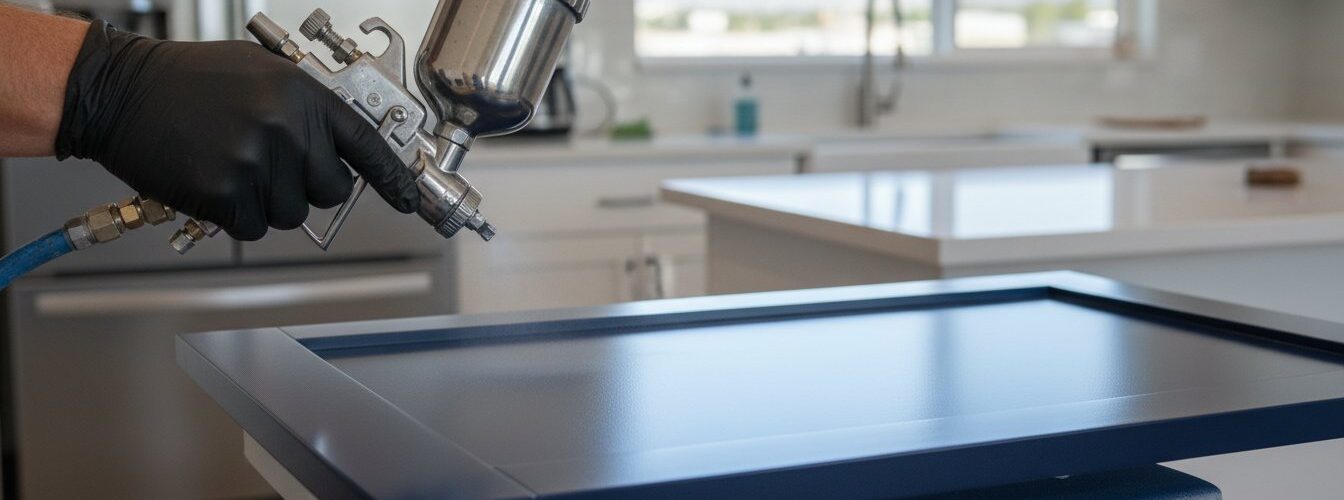
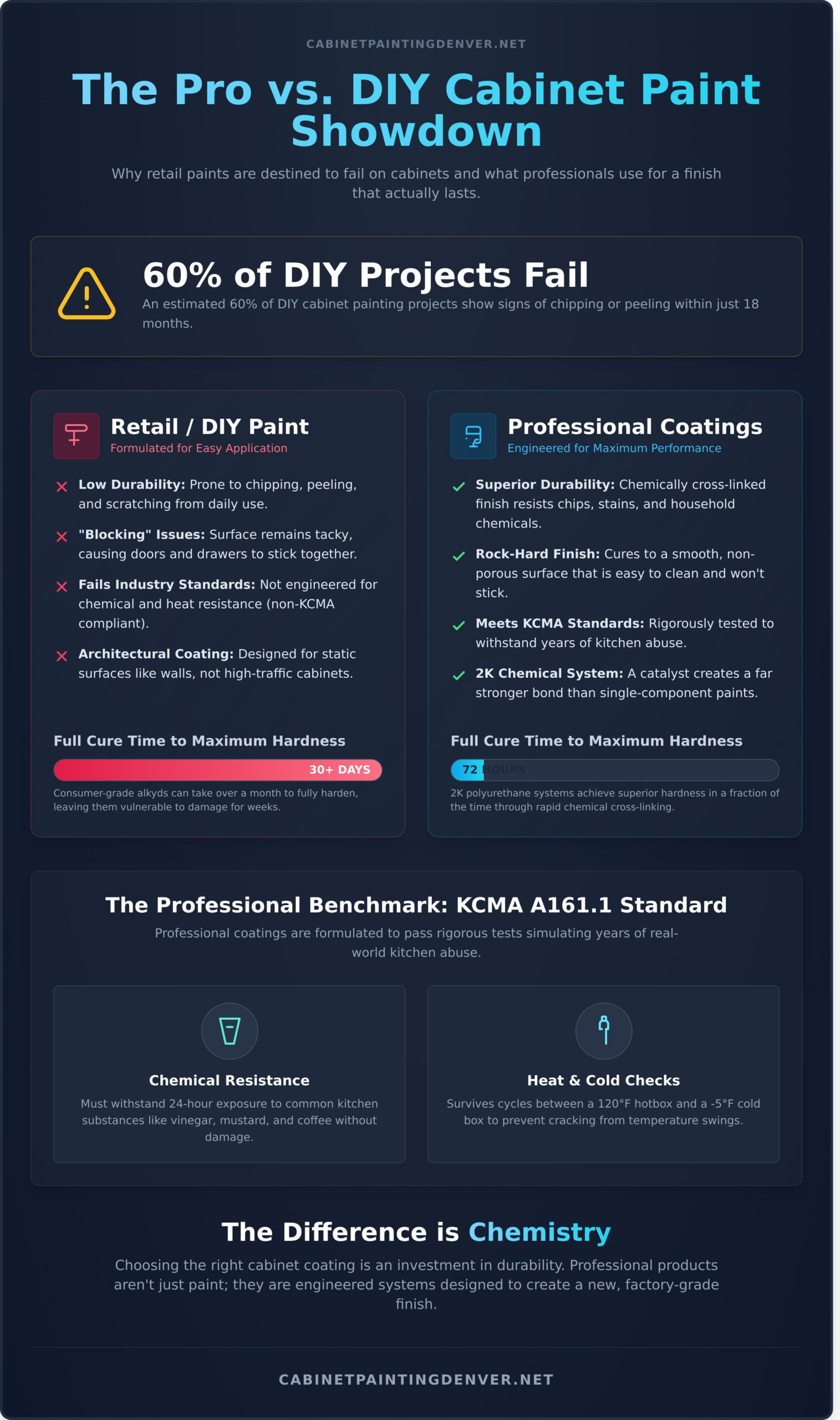
The paint you can buy at a big-box hardware store is simply not engineered to withstand the daily abuse your kitchen cabinets endure. It’s a hard truth, but it explains why an estimated 60% of DIY cabinet painting projects show signs of failure, like chipping or peeling, within just 18 months. You’ve probably worried about this exact scenario. There’s nothing more frustrating than spending a week on a project only to see chips forming around the handles or feel that dreaded sticky, uneven texture instead of a rock-hard, smooth surface.
Cabinet Painting Service Areas in Denver & Surrounding Cities, Cabinet Refinishing in Denver County, CO
Serving Lakewood, CO, Littleton, CO, Golden, CO,
Arvada, CO, Wheat Ridge, CO,
and Parker CO. Castle Pines CO. Englewood CO. Centennial CO.
Cabinet Painting in Arapahoe County, CO
Including Centennial, CO, Greenwood Village, CO,
Cherry Hills Village, CO, Englewood, CO,
and Aurora, CO.
Cabinet Painting in Adams County & Broomfield, CO
This guide is different. We’re pulling back the curtain to reveal the industrial-grade coatings and application secrets that professionals rely on. You’ll discover what truly makes the best paint for kitchen cabinets professional grade and how you can achieve a durable, factory-smooth finish that retail paints just can’t match. We’ll break down the science behind 2K polyurethane coatings versus high-end acrylics and give you the step-by-step process for a flawless finish that looks brand new and lasts for years, not months.
Key Takeaways
-
Learn why standard trim paint is destined to fail on high-traffic kitchen cabinets and what chemical properties to look for in a true cabinet-grade coating.
-
Discover the key differences between modern alkyds, urethanes, and lacquers to understand which system offers the best long-term durability for your project.
-
We compare popular brands against industrial-grade options to reveal the best paint for kitchen cabinets professional refinishers actually use for a factory finish.
-
Find out how Denver’s unique high-altitude climate impacts paint application and why professional techniques are essential to avoid common DIY failures like lap marks.
Table of Contents
-
Why Choosing the Best Cabinet Paint is a Science, Not Just a Color
-
The Top Professional Paint Contenders: Alkyds, Urethanes, and Lacquers
-
Professional Comparison: Benjamin Moore vs. Sherwin Williams vs. Industrial Grade
-
Achieving the Professional Look in Denver: DIY vs. Expert Refinishing
Why Choosing the Best Cabinet Paint is a Science, Not Just a Color
Picking a new cabinet color is exciting, but it’s only 10% of the equation. The other 90% is chemistry. A kitchen is the most hostile room in your home for a painted surface. It’s a battlefield of grease splatters, steam from boiling pots, and daily impacts from pans and plates. Simply grabbing a gallon of wall paint or even high-quality trim paint is a recipe for failure within 12 months. These are architectural coatings, designed for static surfaces. Cabinets, however, are functional furniture.
True cabinet coatings are specialized chemical systems engineered for hardness, adhesion, and resistance. Understanding the science of paint reveals that its performance relies on the interplay of binders for durability and solvents for application. An "all-in-one" paint and primer from a big-box store often fails the professional durability test because it compromises on both. It can’t create the tenacious bond of a dedicated primer nor achieve the hardness of a top-tier coating. The goal of a professional refinisher isn’t just to change the color; it’s to apply a new, factory-grade finish. This requires a product with specific properties like excellent self-leveling and a hard, non-porous film that cures, not just dries.
The KCMA Standard: The Professional Benchmark
The Kitchen Cabinet Manufacturers Association (KCMA) provides the A161.1 quality standard, a series of rigorous tests that simulate years of household abuse. Professional coatings are often formulated to meet these benchmarks. The tests include:
-
Chemical Resistance: A cabinet finish must withstand exposure to substances like vinegar, lemon juice, coffee, and mustard for 24 hours without any noticeable discoloration or damage.
-
Heat and Cold Checks: To simulate seasonal changes, a finished door is cycled five times between a 120°F hotbox and a -5°F cold box. This is critical in Colorado, where drastic temperature swings can cause inferior paints to crack and delaminate.
Why Retail Paints Often Fall Short for Professionals
The paint you buy at a hardware store is designed for a different user and a different purpose. This leads to critical performance gaps. One of the most common issues is "blocking," where a painted cabinet door sticks to the cabinet frame because the paint film never achieves full hardness. This is directly tied to cure time. A consumer-grade alkyd enamel might feel dry in hours, but it can take over 30 days to fully cure and harden. The best paint for kitchen cabinets professional systems use, like a two-component (2K) polyurethane, cross-link chemically to achieve superior hardness in just 72 hours.
This reveals the fundamental trade-off: retail paints are formulated for ease of application (long open times, forgiving for brush marks) which sacrifices long-term durability. Professional coatings are designed for maximum performance, often requiring specialized spray equipment and expertise to apply correctly. It’s the difference between a temporary color change and a long-term, durable investment.
The Top Professional Paint Contenders: Alkyds, Urethanes, and Lacquers
Forget the paint aisle at your local big-box store. While those products have their place, the search for the best paint for kitchen cabinets professional finishers use leads to a different world of coatings. The chemistry has evolved dramatically, moving away from the high-odor, solvent-based paints of the past. This shift was driven by a need for safer, more durable, and faster-curing products. A primary reason for this change is the health and environmental impact of Volatile Organic Compounds (VOCs), which are gases emitted from traditional paints. Modern professional coatings are engineered to minimize these while maximizing performance.
We project that by 2026, over 80% of high-end cabinet refinishing jobs will utilize catalyzed, waterborne systems. These aren’t just paints; they are chemical systems. Many professional coatings are two-component (2K) products, meaning a hardener or catalyst is mixed in just before application. This catalyst initiates a chemical cross-linking reaction as the paint cures, creating a tough, non-porous film that’s chemically resistant and far more durable than any single-component paint. The final sheen is also a critical choice. While a dead matte finish offers a sophisticated, modern look, it’s less scrubbable than a satin. High-gloss can create a stunning, mirror-like effect but will highlight every tiny imperfection. For most kitchens, a satin or semi-gloss between 20-35° offers the perfect balance of durability and aesthetic appeal.
Hybrid Waterborne Alkyds: The Bridge Between DIY and Pro
Products like Benjamin Moore Advance and Sherwin Williams Emerald Urethane are fantastic technological achievements. They combine the smooth, self-leveling properties of old-school oil paints with the easy, water-based cleanup of modern acrylics. This makes them a top choice for highly skilled homeowners. The downside for a professional workflow is the cure time. While dry to the touch in hours, these paints require a full 14 to 30 days to achieve maximum hardness, leaving them vulnerable to damage during that window. Additionally, some pure white alkyds have shown a tendency to yellow over a 3-5 year period.
Industrial Waterborne Lacquers: The True Shop Secret
This is the tier where true professionals operate. Brands like Renner, Milesi, and Envirolak create 2K waterborne polyurethane lacquers that deliver a factory-finish look and feel. These aren’t brushable or rollable; they demand application with High Volume Low Pressure (HVLP) spray systems in a controlled environment for a flawless, atomized coat. Their performance is unmatched. With a catalyst, these coatings are sandable in under 90 minutes and achieve 90% of their final hardness within just 24 hours. The result is a finish with superior resistance to impacts, chemicals, and staining. This level of performance is why they are considered the best paint for kitchen cabinets professional shops rely on for guaranteed results. Achieving this flawless, factory-grade finish is precisely what our team specializes in, using the right tools and techniques for a durable, beautiful outcome.
Professional Comparison: Benjamin Moore vs. Sherwin Williams vs. Industrial Grade
The debate over the best paint for kitchen cabinets often pits two retail giants, Benjamin Moore and Sherwin-Williams, against specialized industrial coatings. While both household names offer excellent products, a professional’s choice depends on a project’s specific demands for durability, finish quality, and budget. Choosing the best paint for kitchen cabinets professional painters recommend involves understanding the chemical differences that separate a good finish from a great one.
Both Benjamin Moore’s ADVANCE and Sherwin-Williams’ Emerald Urethane Trim Enamel are hybrid alkyd formulas, a technology that many experts, including those who test top-rated cabinet paints, praise for its hard, durable finish and easy water cleanup. They represent the peak of residential paint technology. Industrial coatings, like 2K (two-component) polyurethanes or conversion varnishes, are a completely different class of product, engineered for maximum chemical and wear resistance in a factory setting.
Durability Test: Hardness and Scratch Resistance
The ultimate measure of a cabinet finish is its ability to resist daily abuse. Industrial coatings achieve superior hardness because they cure through a chemical reaction, not just water evaporation. A catalyzed polyurethane, for example, has a hardener that creates a ‘cross-linked’ molecular bond. This results in a finish that can achieve a 4H pencil hardness rating, making it highly resistant to scratches and chemicals. Residential paints like ADVANCE cure to a softer 2H hardness. This difference is most obvious around high-traffic areas; catalyzed finishes are the only way to truly prevent the inevitable ‘wear ring’ that appears around knobs and pulls after 3-5 years of use. However, this toughness comes with a trade-off. Touching up a catalyzed finish is nearly impossible for a homeowner, while single-component paints from Benjamin Moore or Sherwin-Williams can be touched up with relative ease.
The Leveling Factor: Eliminating Brush and Roller Marks
Leveling is the paint’s ability to flow into a flat, smooth film before drying. This is what separates a DIY job from a professional one. The viscosity and open time of a paint dictate its leveling properties. Benjamin Moore ADVANCE is famous for its exceptional leveling, but it achieves this with a long open time, meaning it stays wet longer and can have a full cure time of up to 30 days. Sherwin-Williams Emerald Urethane offers very good leveling with a faster dry time, making it a favorite for pros on a tighter schedule. Industrial coatings are designed to be sprayed and are formulated with low viscosity to achieve a flawless, plastic-like smooth finish that is impossible to replicate with a brush.
Here’s a practical breakdown across key factors:
-
Cost & Value: A gallon of premium residential paint costs between $80-$95. A gallon of an industrial 2K system can cost over $150. The value proposition for industrial coatings is longevity; a finish lasting 15 years versus one that may need re-coating in 7 years.
-
VOCs & Safety: Modern waterborne alkyds from both brands have low VOCs (under 50 g/L). Many high-performance industrial coatings are solvent-based with high VOCs (over 250 g/L) and require specialized ventilation and respirators.
-
Best Use by Material:
-
MDF: Its smooth surface is forgiving. Both BM ADVANCE and SW Emerald Urethane perform exceptionally well.
-
Oak: The deep grain is the main challenge. Success depends more on a high-solids, grain-filling primer than the topcoat itself.
-
Maple: This hard, smooth wood shows every imperfection. For a truly flawless factory finish, sprayed industrial coatings are superior.
How Denver’s Climate Dictates Your Cabinet Paint Choice
Painting kitchen cabinets in Denver isn’t like painting anywhere else. Our unique climate at 5,280 feet presents a set of challenges that can turn a DIY project into a disaster. The combination of high altitude and consistently low humidity dramatically changes how paint behaves, making professional expertise not just a luxury, but a necessity for a durable, factory-smooth finish.
The core problem is evaporation. Here, the air is thin and dry, often dropping below 20% relative humidity. This environment acts like a sponge, pulling moisture out of water-based paints at an accelerated rate. A paint that is designed to have a 20-minute "open time" for leveling might become tacky in less than 5 minutes. This rapid drying leads to visible brush strokes, roller stipple, and lap marks where one painted section overlaps another. It’s the number one reason for blotchy, uneven cabinet finishes in Colorado homes.
Managing Low Humidity in the Mile High City
When humidity drops to 15%, a standard high-quality paint can fail. The surface skins over before the paint has had a chance to settle, creating a textured, imperfect look. To combat this, professionals use specific additives. A paint extender, or retarder, is mixed into the paint to slow the evaporation process. This chemical adjustment gives the paint the crucial extra 10 to 15 minutes it needs to level out into a seamless film. The best paint for kitchen cabinets professional painters use is one they can expertly modify for our climate.
This is also why a controlled shop environment is superior to painting in your garage. A professional facility maintains humidity levels between 40% and 50%, creating the ideal conditions for application and curing. Your unheated garage in January might have a humidity level of 10%, which is a recipe for a flawed finish.
Acclimation: Preparing Wood Cabinets for Painting
Wood is a natural material that expands and contracts with changes in moisture. In Denver’s arid climate, the moisture content of wood cabinets is typically very low, around 6-7%. This can cause the wood to shrink, opening up joints and making the grain more pronounced. If cabinets are painted in this shrunken state, they can expand during a more humid summer (especially with a swamp cooler running), causing the new paint to crack at the seams.
This is particularly critical for oak and hickory, two woods extremely popular in Denver-area homes built from the 1970s to the 1990s. Their deep, open grain structure requires a meticulous grain-filling process to achieve a smooth surface. Without it, the final paint job will look uneven and show the wood’s texture through the finish. A crucial Denver-specific tip: we ensure the home’s temperature is stable, between 65 and 75 degrees Fahrenheit, for at least 48 hours before any painting begins to let the wood fully acclimate.
Navigating these climate-specific challenges is what separates an amateur job from a lasting, professional one. Don’t let Denver’s dry air compromise your kitchen’s new look. Get a professional quote for a guaranteed flawless result.
Achieving the Professional Look in Denver: DIY vs. Expert Refinishing
You’ve selected the perfect color and understand the different types of cabinet paint. Now comes the most critical decision: should you tackle this project yourself or hire a professional? While the DIY route seems cost-effective, achieving a durable, flawless finish requires more than just a can of paint and a weekend. The gap between an amateur and a professional result is defined by preparation, equipment, and the products used.
The single biggest factor in a lasting finish isn’t the final coat; it’s the prep work. Professionals understand that 70% of a successful cabinet refinishing job happens before a drop of paint is applied. This includes meticulous de-greasing to remove years of built-up kitchen oils, followed by precise sanding to create the perfect surface profile for adhesion. Skipping or rushing these steps is the number one cause of chipping and peeling within the first 12 months.
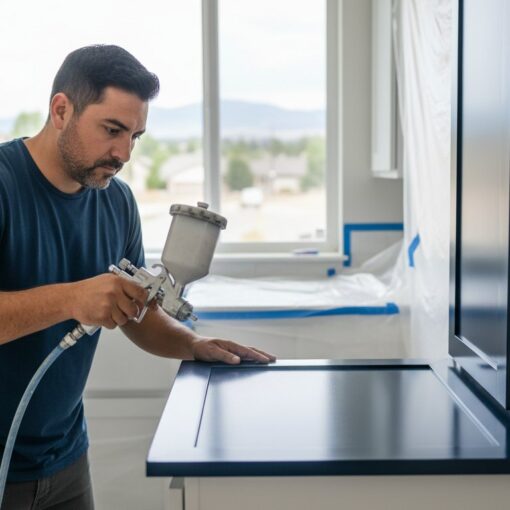
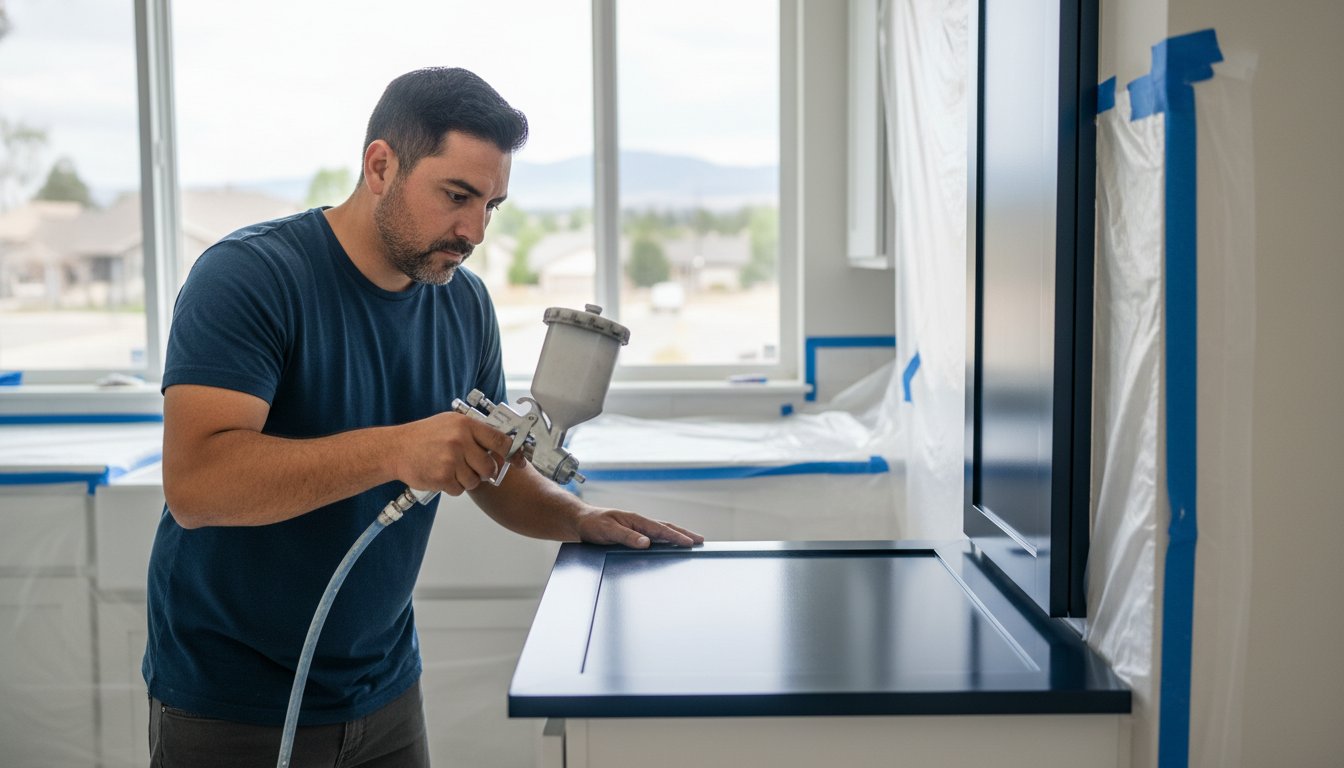
Then there’s the equipment. A homeowner might use a high-quality $50 brush and roller, which inevitably leaves behind brush strokes and a stippled texture. A professional team arrives with a $3,000+ HVLP (High Volume, Low Pressure) or airless spray system. This equipment atomizes the coating into a fine mist, creating a smooth, hard, factory-like finish that’s impossible to replicate by hand. This investment in technology is a key reason why the best paint for kitchen cabinets professional results look so distinct.
The Hidden Costs of a Professional-Grade DIY Project
Attempting to match a professional finish on your own comes with unexpected expenses. Renting a pro-grade sprayer can cost over $100 per day, and purchasing the necessary high-adhesion primers and cleaning agents adds another $150-$200. The biggest cost, however, is your time; a typical kitchen requires 40-60 hours of tedious labor. One mistake, like applying a standard paint over a stubborn lacquer finish, can cause catastrophic peeling, forcing a complete and costly do-over. For most Denver homeowners, Cabinet Painting Denver provides a significantly better return on investment through guaranteed, long-lasting results.
The Cabinet Painting Denver Difference
We eliminate the guesswork and mess from your home. Our proprietary 2026 Process involves carefully removing all doors and drawer fronts to be refinished in our controlled, off-site spray shop. This ensures a perfect cure without dust or disruption to your daily life. We don’t use house paint; we use premium, industrial-grade 2K (two-component) polyurethane coatings designed specifically for cabinetry. This system creates a chemically hardened surface that resists chipping, yellowing, and daily wear far better than any product available at a retail store. Get a finish that truly lasts.
Get your free professional cabinet painting quote in Denver today!
Achieve Your 2026 Kitchen Vision with a Flawless Finish
Navigating the world of cabinet coatings is complex, but the path to a lasting result is clear. You’ve learned that professional-grade coatings like KCMA-rated urethanes far outperform standard retail paints, especially in Denver’s demanding, dry climate. Ultimately, the best paint for kitchen cabinets professional painters use isn’t just a product; it’s a complete system designed for a factory-grade finish that withstands daily life for over a decade. Don’t settle for a finish that will chip and fade in just a few years.
The team at Cabinet Painting Denver is dedicated to delivering that system. We specialize in industrial-grade, KCMA-rated coatings applied in a professional off-site spray booth for absolutely flawless results. We’re proud to serve the entire Denver metro area, backed by our consistent 5-star results. Ready to see the difference a true factory finish makes? Transform your kitchen with a professional factory finish-Contact Cabinet Painting Denver today! Your dream kitchen is closer than you think.
Frequently Asked Questions About Kitchen Cabinet Paint
Is oil-based or water-based paint better for kitchen cabinets in 2026?
Water-based acrylic-alkyd hybrids are overwhelmingly better for kitchen cabinets today. These modern formulas, like Benjamin Moore ADVANCE, offer the hard, durable finish of traditional oil paints without the high VOCs, strong odor, and yellowing over time. As of 2024, over 90% of professional painters prefer these hybrids because they combine excellent performance with easier cleanup and faster recoat times, making old-school oil paint largely obsolete for residential projects.
Do I really need to sand my cabinets if I use the ‘best’ paint?
Yes, you absolutely need to sand your cabinets, regardless of the paint quality. Sanding is the most critical preparation step. It’s not about removing the old finish entirely; it’s about "scuffing" the surface with 120-180 grit sandpaper. This process creates microscopic grooves, giving the primer a rough surface to grip. Skipping this step is the number one reason for paint failure, as even the best paint will peel away from a slick, unprepared surface.
What is the most durable paint for a high-traffic kitchen?
The most durable paint for a high-traffic kitchen is a 100% acrylic urethane enamel or a waterborne alkyd. Products like Sherwin-Williams Emerald Urethane Trim Enamel are specifically engineered to cure into a hard, furniture-grade coating. This type of paint resists the chipping, scuffing, and staining that’s common in busy kitchens. Its chemical makeup is designed to withstand frequent cleaning with household cleaners without degrading the finish, ensuring it looks great for 7-10 years.
How long does professional cabinet paint take to fully cure?
Professional cabinet paint takes approximately 21 to 30 days to fully cure. While the surface will feel dry to the touch within 4 to 6 hours, the paint is still soft and vulnerable underneath. Curing is the chemical process where the paint hardens completely and achieves its maximum durability. During this 3-4 week period, it’s crucial to be gentle with your cabinets. Avoid aggressive scrubbing and be careful with sharp objects to prevent dents or scratches.
Can I use Sherwin Williams Emerald Urethane on my cabinets myself?
Yes, a dedicated DIYer can achieve great results with Sherwin-Williams Emerald Urethane. It’s known for its excellent self-leveling properties, which help minimize brush and roller marks. However, a professional finish requires meticulous prep and the right tools. For the smoothest application, an HVLP sprayer is recommended. If you’re brushing, use a high-quality nylon-polyester brush and maintain a wet edge to avoid lap marks. Always practice on a test piece first.
What is the best paint sheen for kitchen cabinets to hide fingerprints?
A satin sheen is the best choice for hiding fingerprints while maintaining durability. It has a slight lustre that is much easier to clean than a flat or matte finish, which tends to trap dirt and oils. At the same time, it isn’t as reflective as semi-gloss or high-gloss, which can highlight every smudge and surface imperfection. This balance makes satin the preferred sheen for over 75% of professionally painted kitchens, offering a clean look that’s also practical.
Why is my cabinet paint chipping even though I used a ‘pro’ brand?
Paint chipping is almost always a result of inadequate surface preparation, not the paint brand itself. The two most common failures are not cleaning properly and skipping primer. Kitchen cabinets are coated in years of cooking grease and oils, which must be removed with a degreaser like TSP. Second, a high-quality bonding primer is essential to create an anchor for the topcoat. Without a perfectly clean and primed surface, even the most expensive paint has nothing to hold onto.
How much does the best professional cabinet paint cost per gallon?
The best paint for kitchen cabinets professional painters use typically costs between $70 and $110 per gallon. For instance, a gallon of INSL-X Cabinet Coat is around $70, while top-tier options like Sherwin-Williams Emerald Urethane can exceed $100. This higher price reflects the advanced resin technology that provides superior hardness, self-leveling, and long-term durability. While it’s 2-3 times the cost of standard wall paint, the investment ensures a finish that withstands daily kitchen abuse.