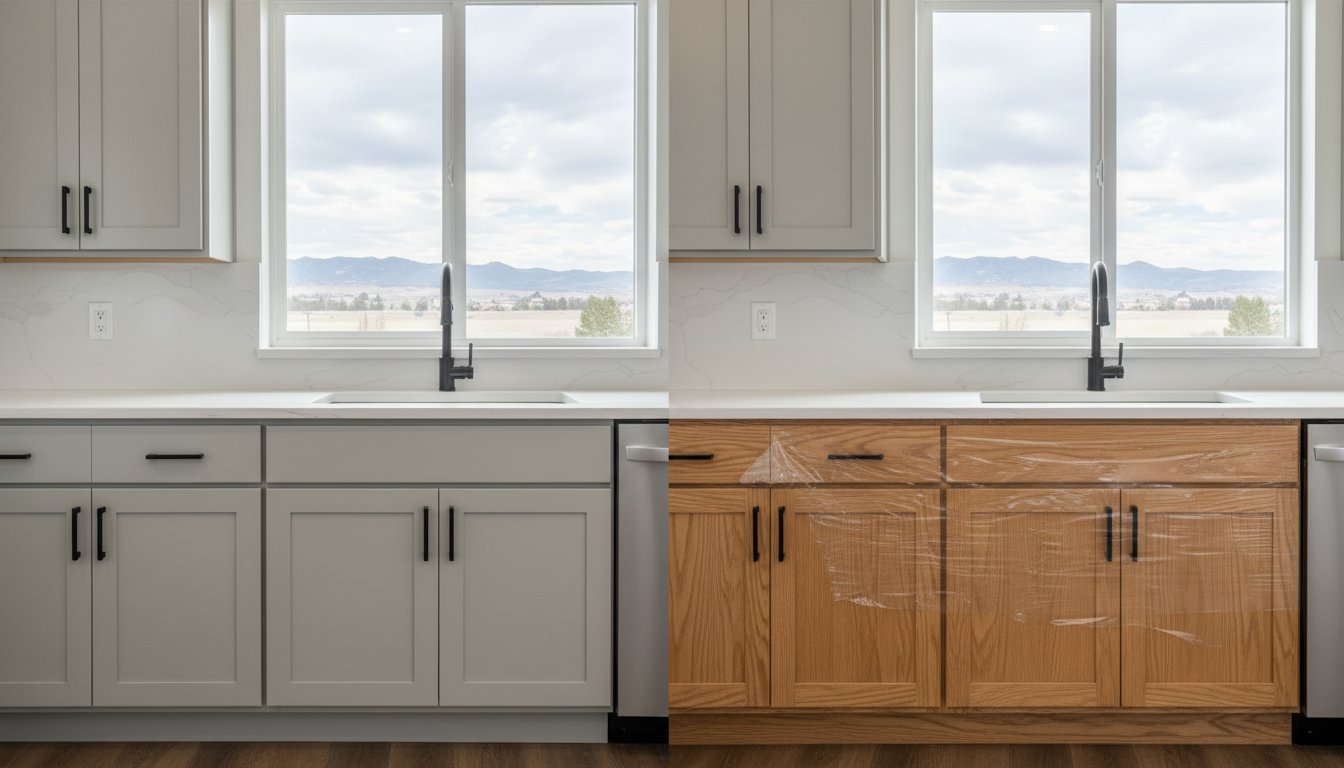

Choosing a kitchen finish based on color alone is the fastest way to ensure your cabinets look worn again in eighteen months. That orange-looking oak in your kitchen isn’t just an eyesore. It’s a sign that traditional finishes often fail against the friction of daily use and Denver’s low humidity. It’s common to feel conflicted when choosing between the natural grain of a stain and the clean aesthetic of paint, especially when the durability of painted cabinets is your primary concern. Your existing cabinets are likely structurally sound but require a professional update to match current design standards.
Cabinet Painting Service Areas in Denver & Surrounding Cities, Cabinet Refinishing in Denver County,
Serving Aurora CO, Lakewood, CO, Littleton, CO, Golden, CO, Roxborough Park CO. Ken Carl Ranch CO, Washington Park Area,
Arvada, CO, Wheat Ridge, CO,
and Cherry Hills CO, CO. Englewood CO.
Cabinet Painting in Arapahoe County, CO
Including Centennial, CO, Greenwood Village, CO,
This guide provides a clear, objective comparison between staining and painting for your home. You’ll learn which option offers the best protection for your specific wood species and how the refinishing process works for properties in the Denver metro area. We will examine the technical requirements for a factory-like spray finish. We’ll also help you determine the most cost-effective path to a kitchen transformation that stands up to the Colorado climate. By the end of this article, you’ll understand exactly how to achieve a durable, professional result without the expense of a full cabinet replacement.
Key Takeaways
- Understand the functional difference between semi-transparent stains that penetrate wood fibers and paint finishes that create a protective surface film.
- Assess your cabinet wood species to determine if it is a suitable candidate for restaining or if painting is the more durable path for aging oak.
- Compare the durability of painted cabinets against stained surfaces to decide which finish best resists Denver’s unique low-humidity environment.
- Learn why professional preparation, including off-site spraying and detailed hardware labeling, is the most critical factor for a factory-like finish.
- Discover how professional cabinet painting provides a high-end kitchen transformation at a fraction of the cost of full cabinet replacement.
Understanding Cabinet Staining and Painting Durability
Cabinet staining and painting serve different functional purposes despite often being used interchangeably in home improvement discussions. A Wood stain is a semi-transparent finish that penetrates deep into the wood fibers. It alters the color while keeping the natural grain and texture visible. Painting behaves differently; it creates a solid, protective film that sits on top of the wood surface. This physical barrier is a key factor when homeowners evaluate the durability of painted cabinets for their kitchen renovation projects.
Homeowners frequently use the term "staining" when they actually require a comprehensive refinishing service. The primary goal of staining is to revitalize the organic wood grain, whereas painting is intended to hide it completely in favor of a modern solid color. If your cabinets are currently an outdated orange oak, you must decide if you want to see a darker wood grain or a smooth, opaque surface. Each approach requires a specific set of technical steps to ensure the finish does not peel or chip over time.
To better understand how different materials react to these finishes, watch this helpful video:
What Is Professional Cabinet Refinishing?
Professional cabinet refinishing is a systematic process that goes beyond simple surface cleaning. It involves the total removal of old clear coats, lacquers, and sealants to reach the original raw wood. This step is vital because new finishes cannot bond effectively to old, greasy coatings. Once the wood is exposed, technicians apply toners and stains to correct color imbalances or achieve a specific wood tone. The final stage involves applying a high-performance topcoat. This layer provides the necessary longevity and resistance to the oils and heat found in a typical kitchen.
Staining vs. Painting: The Core Visual Differences
The visual impact of these two methods is distinct. Staining highlights the organic texture and unique patterns of the wood, which is ideal for traditional or rustic designs. However, stain is less forgiving than paint. It will not hide deep scratches, water stains, or mismatched wood grains. Professional cabinet painters often recommend painting for homeowners who want a clean, contemporary look. High-build paint coatings provide a smooth surface that masks minor imperfections. When applied correctly, the durability of painted cabinets offers a factory-like finish that is easier to wipe down and maintain than many stained surfaces.
Is Your Wood a Candidate for Professional Staining?
Determining if your cabinets are suitable for staining begins with identifying the wood species. The anatomical structure of wood determines how it absorbs pigment and reflects light. Research on the Finishing of Wood shows that different species possess varying levels of porosity and extractives. If your cabinets have been previously painted, returning to a stained look is often cost-prohibitive. Paint particles lodge deep within the wood pores. Removing them entirely requires aggressive sanding that can compromise the structural integrity of the doors. For many homeowners in this situation, the durability of painted cabinets is the more reliable and aesthetic choice.
Woods like oak and mahogany contain high levels of water-soluble tannins. Without proper sealing, these tannins can bleed through the finish, causing unsightly brown or yellow discolorations. Professional refinishers identify these risks early. We also inspect for grease saturation around handles and water damage near the sink. Saturated wood fibers cannot bond with new stain or paint. If the wood is soft or delaminating, structural repairs are mandatory before any finish is applied. If you want to see if your current setup is viable, you can explore our professional cabinet painting services for an expert assessment.
Best Wood Species for Staining
Oak remains the most popular candidate for staining because of its prominent grain pattern. It is ideal for modern cerused or dark espresso finishes that provide high contrast. Maple features a tight, uniform grain that requires expert sanding and pre-stain conditioners to avoid blotchiness. Premium woods like cherry and walnut should almost always be stained. These species have an inherent depth and color that adds significant value to a home. Staining these woods preserves their natural beauty while offering a high-end, furniture-grade look.
Evaluating Current Cabinet Condition
Examine your cabinets for veneer peeling. Many modern cabinets use thin wood veneers over particle board. If the veneer is lifting, staining is rarely an option because the underlying glue prevents even absorption. Identifying whether the current finish is oil-based or water-based is also critical for the preparation phase. Oil-based finishes require specific chemical strippers and primers to ensure the new coating adheres properly. This evaluation is a core part of the cabinet refinishing process. Structural integrity must be confirmed before proceeding. No amount of stain or paint can fix a cracked frame or a rotted panel. When the wood is in poor condition, the durability of painted cabinets often provides a more forgiving and long-lasting solution.
Durability of Painted Cabinets vs. Stained Wood
The functional choice between staining and painting involves a trade-off between labor intensity and surface protection. It’s a common misconception that staining is a simpler process. Professional staining requires the complete removal of all existing clear coats through chemical stripping and deep sanding. This process is physically demanding. The wood must be perfectly uniform to accept the new pigment without blotching. Painting relies on a rigorous cleaning and priming phase to create a high-strength mechanical bond. Staining often costs more because reaching raw wood on every inch of a cabinet door is time-consuming. However, the durability of painted cabinets provides a robust shield against the moisture and heat typical of modern cooking environments.
The Investment of Cabinet Refinishing in Denver
In the 2026 Denver real estate market, kitchen aesthetics remain a primary factor in home valuations. Homeowners must weigh the cost to paint kitchen cabinets against the significant expense of full replacement. Project scope is generally dictated by the total number of doors and drawer fronts rather than just square footage. Achieving a high-end look that supports resale value requires specialized equipment. Professional results depend on off-site spray facilities. These controlled environments eliminate dust and debris. This ensures a factory-quality finish that on-site application methods cannot replicate.
Durability and Maintenance Over Time
Denver’s climate presents specific challenges for wood finishes. Low humidity causes wood to contract, while high-altitude UV rays can degrade standard coatings. Industrial-grade topcoats are essential for long-term protection. A professional stain typically maintains its integrity for 10 to 15 years before the protective lacquer wears thin. The durability of painted cabinets is similar, but the maintenance requirements differ. Stained wood is often more forgiving of daily fingerprints and smudges. Painted surfaces show oils more readily but are easier to sanitize because of their smooth, non-porous film. If damage occurs, matching a solid paint color for a touch-up is much simpler than trying to blend a transparent stain.
The Professional Cabinet Staining and Painting Process
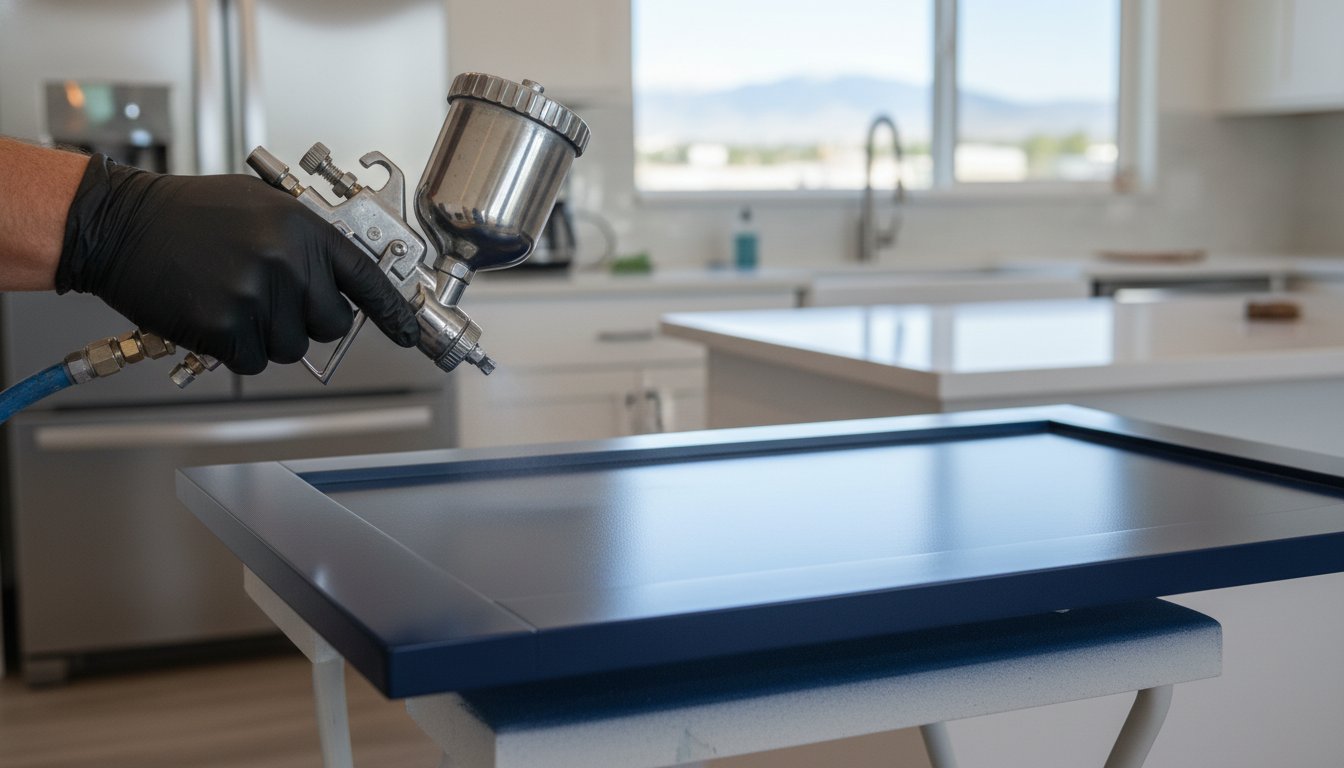
A durable finish is achieved through 70% preparation and 30% application. The process begins with the complete removal of all hinges, handles, and bumpers. Every door and drawer is labeled using a systematic numbering scheme. This ensures precise re-installation and maintains the original alignment of the cabinetry. We use High Volume Low Pressure (HVLP) sprayers to apply all coatings. This equipment allows for a fine atomization of the material. It results in a smooth, factory-grade finish that brushes and rollers cannot replicate. The durability of painted cabinets is also determined by the curing environment. Our off-site facility provides a controlled, dust-free space where finishes can harden without interference from airborne contaminants.
The chemical bonding of the primer to the substrate is the most critical technical stage. We utilize industrial-grade cleaners to remove every trace of cooking oils and skin contact grease. If these contaminants remain, the finish will eventually delaminate. Once the surface is chemically clean, we perform mechanical sanding to create a profile for the primer to grip. This rigorous preparation is why professional results last significantly longer than amateur attempts. If you want to ensure your kitchen remains functional and beautiful for years, contact us for high-quality Kitchen Cabinet Painting.
Why DIY Staining Often Fails
DIY staining projects frequently fail due to improper sanding techniques. Using the wrong grit or applying uneven pressure creates pigtail marks. These swirl patterns are invisible on raw wood but become glaringly obvious once the stain is applied. Many homeowners also rely on all-in-one stain and polyurethane products found at local hardware stores. These products are designed for convenience rather than the high-traffic demands of a kitchen. They lack the chemical resistance needed to withstand constant cleaning and heat. Without a professional spray booth, dust and pet hair will inevitably settle into the wet finish, creating a textured surface that is difficult to clean.
The Professional Refinishing Workflow
The professional refinishing workflow requires reaching raw, absorbent wood fibers through a combination of chemical stripping and mechanical sanding. Once the wood is exposed, we apply a wood conditioner. This step is essential for species like maple or birch to prevent blotchy, uneven color absorption. We then apply the stain in thin, even layers to achieve the desired depth of color. The process concludes with multiple coats of industrial-grade sealer and a clear conversion varnish. This varnish is a post-catalyzed coating that offers superior durability of painted cabinets and stained surfaces alike. It creates a hard, moisture-resistant barrier that protects the wood from the daily rigors of a busy household.
Expert Cabinet Refinishing and Staining in Denver
Cabinet Painting Denver serves as the specialized authority for homeowners seeking high-end wood transformations throughout the Denver metro area. General house painters often lack the technical equipment and controlled environments necessary for cabinetry. Our team understands the specific architectural styles found in Colorado homes, from traditional suburban kitchens to modern urban lofts. We provide a factory-quality finish that general contractors cannot achieve with standard brushes or rollers. The durability of painted cabinets we produce is a result of our focus on existing cabinet transformations. For inspiration on your next project, explore our Cabinet Painting Denver gallery to see real-world examples of our professional finishes.
The durability of painted cabinets in the Rocky Mountain region depends heavily on how the finish interacts with extreme dryness. Standard interior paints often fail in our low-humidity climate, which leads to premature cracking at the wood joints. We utilize industrial-grade coatings specifically formulated to maintain flexibility while providing a hard, impact-resistant surface. This technical approach ensures that your kitchen remains functional and beautiful despite the environmental challenges unique to Denver. We prioritize procedural clarity in every project, moving from an objective assessment of your wood’s condition to a precise application of the final topcoat.
Why Cabinet Painting Denver Is Your Best Choice
Our specialization sets us apart from general painting companies. We focus exclusively on kitchen cabinet painting, bathroom cabinet painting, and bookshelves cabinet painting. This narrow focus allows us to refine our techniques and maintain a high standard of quality. Transparency is a core value of our business. We provide direct, professional communication from the initial estimate through the final walkthrough. You will receive a clear understanding of the requirements and status of your project at every stage. Our use of premium materials designed for the Colorado climate ensures that your investment provides long-term value and aesthetic appeal.
Getting Your Free Professional Estimate
The quoting process for Denver residents is designed to be efficient and straightforward. To receive an accurate estimate, please have photos of your current kitchen ready for review. A rough count of your cabinet doors and drawer fronts helps us determine the project scope and material requirements. We provide detailed information regarding the timeline and preparation steps needed for your specific wood species. Once we review your information, we provide a formal proposal that outlines the costs and expectations. Book your consultation today to begin your kitchen transformation and achieve a professional, durable finish for your home cabinetry.
Achieve a Factory-Grade Finish for Your Denver Kitchen
Selecting the right finish for your cabinetry requires a balance of aesthetic preference and technical requirements. Your wood species dictates whether staining or painting will provide the best result. The durability of painted cabinets is a significant advantage for homeowners seeking a modern look that resists daily wear and Denver’s dry climate. Proper preparation remains the most critical factor in preventing peeling and ensuring a smooth, professional surface that lasts for years.
Our specialized cabinet refinishing experts utilize off-site spraying to deliver a factory-quality spray finish. We focus exclusively on cabinet transformations, serving the entire Denver metro area with transparent and efficient service. You can modernize your kitchen without the high cost and disruption of a full replacement. Transform your kitchen with a professional cabinet staining quote today and start your journey toward a high-end kitchen look that stands the test of time. Your cabinets have the potential for a complete revival with the right professional approach.
Frequently Asked Questions
Can you stain over already stained cabinets?
You can stain over previously stained cabinets only after removing the existing protective topcoat and pigment. Applying new stain directly over an old finish prevents the wood from absorbing the material, resulting in a sticky, uneven surface. Professional refinishing requires chemical stripping and mechanical sanding to reach raw wood fibers. This ensures the new stain bonds correctly and provides the expected longevity for your kitchen update.
How long does the professional cabinet staining process take?
A professional cabinet staining project typically requires five to ten business days to complete. The timeline depends on the total number of doors and the complexity of the stripping process. Doors are processed off-site in a controlled environment to ensure a dust-free finish. On-site work involves masking the kitchen and refinishing the cabinet frames. This structured workflow allows for proper curing times between coats of industrial-grade varnish.
Is it better to paint or stain old kitchen cabinets for durability?
Both options offer high resistance to daily wear when applied by experts. The durability of painted cabinets is often superior for hiding wood imperfections and resisting moisture because the paint forms a solid protective film. Staining is better for those who want to see natural wood grain and prefer a finish that hides fingerprints. Your choice should depend on the current condition of the wood and your desired maintenance routine.
What is the most popular cabinet stain color for 2026?
Neutral, light-toned oaks and deep, espresso brown tones are the most requested stain colors for 2026. Many Denver homeowners are moving away from orange-toned oak in favor of cerused finishes that highlight wood grain with white or gray accents. These modern options provide a high-end, furniture-grade look that complements contemporary kitchen designs. Choosing a timeless neutral tone helps maintain home resale value in the competitive local market.
Will staining my cabinets hide the wood grain?
Staining is specifically designed to enhance and highlight the natural wood grain rather than hide it. Unlike the durability of painted cabinets which relies on an opaque film, stain is semi-transparent. It penetrates the wood fibers to change the color while keeping the organic texture visible. If your goal is to completely mask the grain of heavy oak cabinets, a professional paint application is the more effective solution for your project.
How do I find reliable cabinet staining companies near me in Denver?
Finding reliable service providers in the Denver metro area requires verifying their specialization in cabinetry. Avoid general house painters who lack the equipment for industrial-grade finishes. Look for companies that utilize off-site spray facilities for doors and provide a detailed explanation of their preparation process. Reviewing a local gallery of previous transformations is the best way to confirm their ability to deliver a factory-like result for your home.