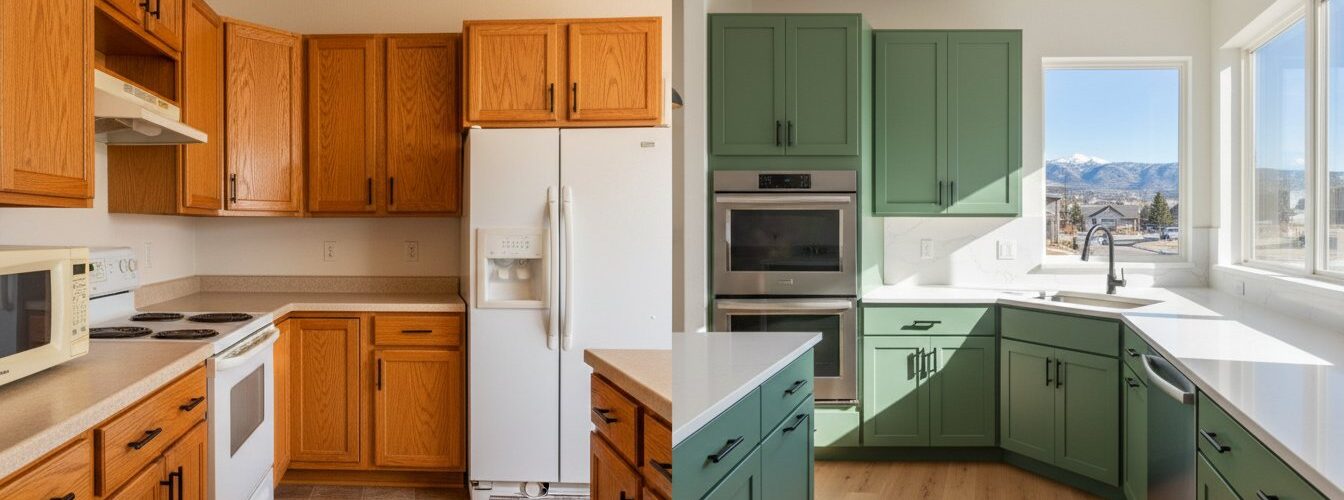
What if that stubborn orange glow in your kitchen wasn’t a permanent design flaw, but a hidden asset waiting for a 2026 upgrade? You likely look at those honey oak doors and see a relic from 1995 that makes your entire home feel dated or even dirty. It’s frustrating when the heavy wood grain makes you worry that a simple coat of paint will just look like a cheap DIY project gone wrong. You’re right to feel hesitant, especially when you want to transform oak cabinets without replacing them but fear the results won’t look professional. According to recent industry surveys, 68 percent of homeowners cite wood grain "bleeding" as their top concern when updating older cabinetry.
Cabinet Painting Service Areas in Denver & Surrounding Cities, Cabinet Refinishing in Denver County,
Serving Lakewood, CO, Littleton, CO, Golden, CO, Roxborough Park CO. Ken Carl Ranch CO, Washington Park Area,
Arvada, CO, Wheat Ridge, CO,
and Castle Pines CO. Englewood CO. Centennial CO.
Cabinet Painting in Arapahoe County, CO
Including Centennial, CO, Greenwood Village, CO,
Cherry Hills Village, CO,
and Aurora, CO.
Cabinet Painting in Adams County & Broomfield, CO
The good news is that you can achieve a professional, glass-smooth finish that rivals a high-end designer showroom. This guide reveals how to turn your current kitchen into a modern masterpiece using specialized grain-filling techniques and industrial-grade coatings. We will walk through the exact process of neutralizing yellow undertones, selecting the right 2026 color palettes, and applying durable finishes that save you up to 70 percent compared to the cost of a full custom remodel.
Key Takeaways
-
Understand why your existing oak cabinets often boast higher structural quality than new big-box store options, making them the perfect candidates for a modern update.
-
Explore the step-by-step professional processes used to transform oak cabinets without replacing them to achieve a high-end, custom look for a fraction of the cost.
-
Learn how to neutralize "orange" honey oak tones instantly using specific Kelvin-rated lighting and contemporary hardware finishes.
-
Discover the critical "grain filling" technique that professionals use to turn cavernous oak textures into a perfectly smooth, factory-grade surface.
-
Gain insights into how Denver’s dry climate impacts paint durability and how to ensure your new finish survives Colorado’s unique environmental factors.
Table of Contents
-
Why Honey Oak Cabinets Feel Dated (And Why You Shouldn’t Replace Them)
-
Option 1: The Cosmetic Facelift (Transforming Oak Without Paint)
-
Professional Cabinet Painting in Denver: The Local Advantage
Why Honey Oak Cabinets Feel Dated (And Why You Shouldn’t Replace Them)
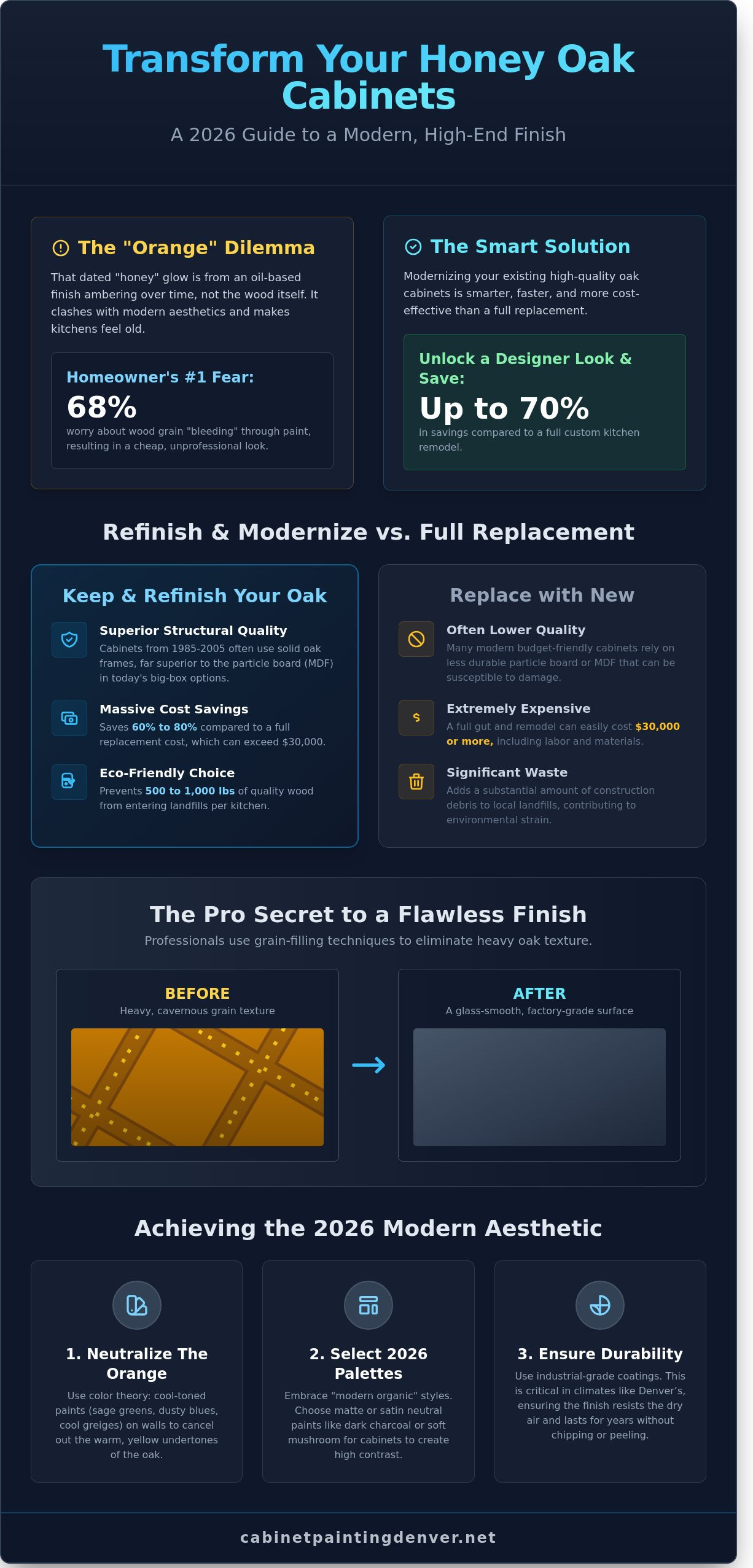
Most homeowners look at their 1990s kitchens and see one thing: orange. This "honey" hue isn’t the wood’s natural color. It’s the result of oil-based polyurethane finishes that amber over 15 to 25 years. This chemical reaction creates a heavy, dated look that clashes with modern palettes. However, choosing to transform oak cabinets without replacing them is the smartest financial move you can make. A full kitchen gut can cost upwards of $30,000, while a professional refinish typically saves homeowners between 60% and 80% of those replacement costs. You’re keeping the high-quality structure while only updating the aesthetic layer.
Beyond the price tag, there’s a significant quality gap to consider. Oak cabinets manufactured between 1985 and 2005 often feature superior structural integrity compared to modern, entry-level "big-box" options. Many older units utilize solid oak frames and doors, whereas modern budget lines frequently rely on particle board or medium-density fiberboard (MDF). By keeping your existing boxes, you prevent approximately 500 to 1,000 pounds of wood waste from entering local landfills. Understanding Kitchen cabinet materials and finishes helps you see why these older builds are worth the effort. Refinishing allows you to keep the durability of the past while embracing the styles of the future.
To see how a simple change can impact these surfaces, watch this helpful video:
Identifying the Quality of Your Oak
Before you commit, check the end panels. If they’re solid wood or high-quality plywood rather than thin laminate, you’ve got a winner. Inspect the drawer glides; if they’re metal and still slide smoothly, the "bones" are solid. You should save oak if the boxes are level and the wood isn’t warped from water damage. If the frames are crumbling or the layout is fundamentally broken, that’s the only time replacement wins. Most oak from the late 20th century is incredibly resilient and takes new finishes beautifully.
The 2026 Modern Aesthetic
The 2026 design forecast favors "modern organic" styles. This means moving away from high-gloss yellows toward matte and satin neutrals. You can transform oak cabinets without replacing them by using ceruse techniques or muted paints that highlight the grain’s texture without the orange glare. High contrast is key. Pair dark charcoal or soft mushroom cabinets with light stone counters to create a 100% modern feel that respects the wood’s natural character. By choosing a satin finish, you hide fingerprints and keep the kitchen looking fresh for years.
Option 1: The Cosmetic Facelift (Transforming Oak Without Paint)
Many homeowners choose to transform oak cabinets without replacing them by focusing on the environmental factors that influence how wood looks. According to the 2024 NKBA Kitchen Trends Report, natural wood finishes are experiencing a 15% increase in popularity as homeowners move away from all-white kitchens. The secret to a modern look isn’t always hiding the grain; it’s about neutralizing the "orange" cast that defined 1990s cabinetry. By updating the surrounding elements, you can make honey oak look like a deliberate, high-end design choice rather than a relic of the past.
Modernizing with Hardware and Accents
Hardware serves as the jewelry of your kitchen. In 2026, design trends have shifted toward "oversized" hardware. Swapping standard 3-inch pulls for 6-inch or 8-inch bars can instantly change the cabinet’s profile. These longer pulls often cover existing drill holes, which eliminates the need for wood filler. Matte black provides a sharp, modern contrast against oak, while champagne bronze offers a sophisticated warmth that lacks the dated yellow of traditional brass. For a more curated look, try mixing metals by using polished nickel on upper cabinets and matte black on the lowers. This creates a layered aesthetic that looks professionally designed.
Surrounding the Cabinets with Color
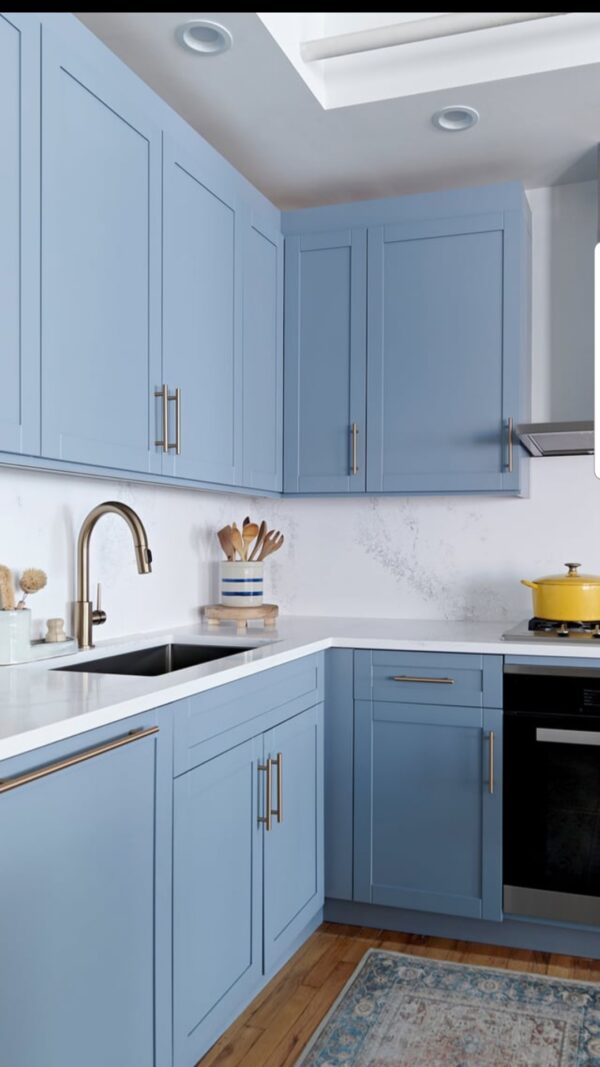
The colors you put on your walls and floors dictate how the oak grain behaves. To kill the orange glow, you must use color theory. Cool-toned paints like soft sage greens, dusty blues, or cool greiges sit opposite orange on the color wheel, effectively neutralizing the wood’s warmth. Many people fall into the "white-on-oak" trap by choosing warm, creamy whites. This is a mistake; warm whites have yellow undertones that actually make oak look more orange. Instead, choose a crisp white with a Light Reflectance Value (LRV) above 80 and a slightly blue or gray base.
Lighting is another critical factor in this transformation. Standard incandescent bulbs (2700K) emit a yellow light that amplifies the honey tones in oak. Upgrading to 3500K or 4000K neutral LED bulbs can reduce the perceived "yellowness" of your cabinets by nearly 25% instantly. If the solid wood feels too heavy for the room, consider professional glass inserts for a few upper cabinet doors. This breaks up the visual density of the grain and allows you to showcase modern dishware. If you are unsure which hardware or lighting combo works best for your specific layout, you can ask a local specialist for a design consultation to ensure your cosmetic updates hit the mark.
Finally, incorporate textiles to soften the wood-heavy environment. A runner rug featuring navy, charcoal, or deep forest green can ground the space. These darker, cooler colors pull the eye downward and provide a visual break from the expansive wood surfaces. By balancing the textures and temperatures of the room, the oak becomes a warm accent rather than an overwhelming presence.
Option 2: Professional Refinishing vs. Painting Oak
Deciding between professional refinishing and painting is the most critical choice you’ll make to transform oak cabinets without replacing them. Both methods provide a significant cost advantage, typically saving homeowners between 50% and 70% compared to the price of purchasing new custom cabinetry. However, the technical requirements and final aesthetics differ greatly. Refinishing focuses on altering the stain or applying a translucent toner to let the natural wood grain show through. Painting uses opaque, high-solids coatings to completely hide the wood’s original color. For 2026, the focus has shifted toward high-performance industrial coatings. While hardware store DIY kits often use standard acrylics that can peel within 12 to 18 months, professional-grade 2K polyurethanes are designed to withstand 15 years of chemical exposure and physical impact.
The timeline for these projects varies based on the level of preparation required. A standard kitchen with 20 to 25 openings generally takes a professional crew 5 to 8 business days to paint. Refinishing can take 7 to 10 days if the existing finish requires full chemical stripping to achieve a lighter tone. Understanding these variables helps you set realistic expectations for your kitchen’s downtime.
When to Choose Refinishing
Refinishing is the ideal path if you appreciate the organic texture of wood but want to eliminate the dated orange or honey tones of the 1990s. Current 2026 design trends show a 22% increase in homeowners requesting "Japandi" or "Scandi" aesthetics, which rely on light-washed oak or muted walnut tones. Toning is a common professional technique where a tinted topcoat is applied to shift the color without removing the existing finish. If you want a significantly lighter look, such as a bleached or "White Oak" appearance, the wood must be stripped to the bare grain. This is a labor-intensive process, but it preserves the architectural integrity of the wood while providing a modern, matte furniture-grade finish.
When to Commit to Painting
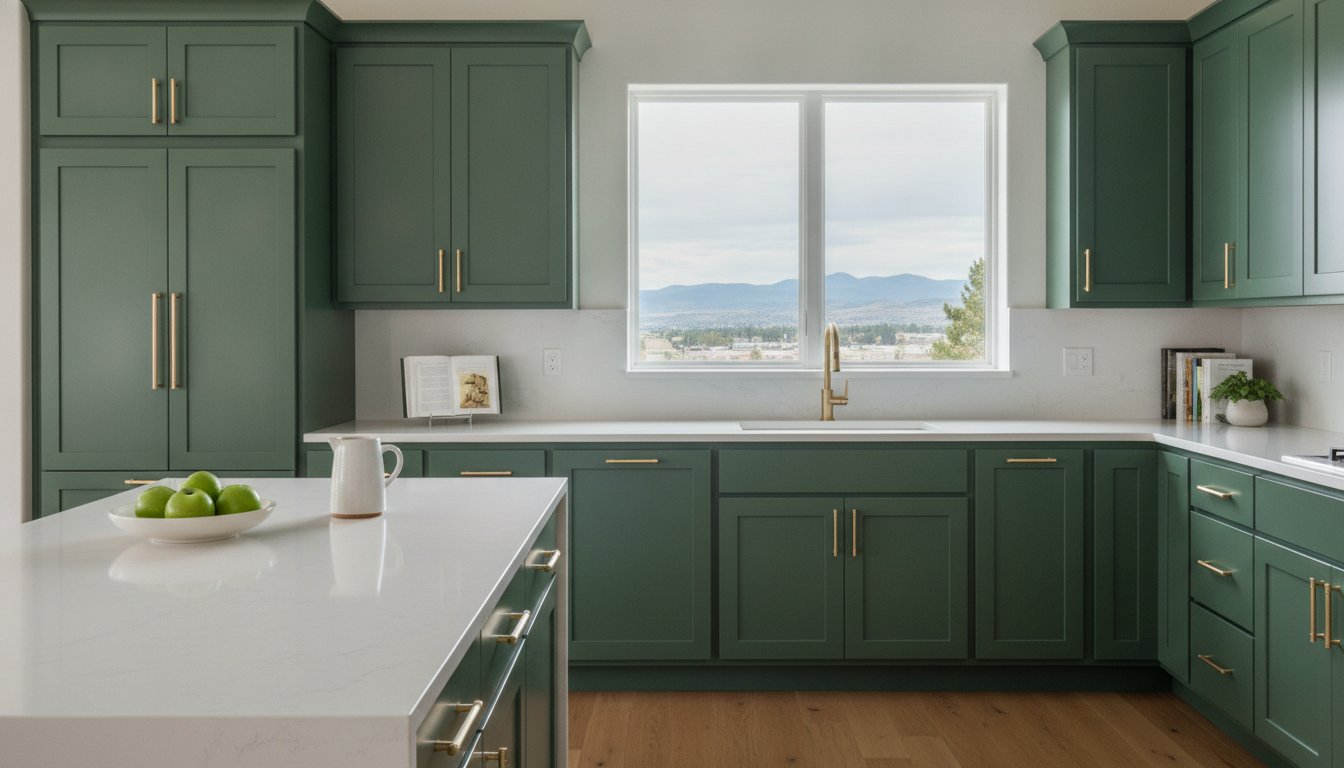
Painting provides the ultimate transformation for homeowners seeking a clean, uniform look. Solid colors like deep Navy, Forest Green, or soft Creams remain the top choices for modernizing heavy oak grains. In the local market, kitchen cabinet painting is currently the #1 ROI project for Denver homes, frequently returning over 100% of the project cost during home appraisals. Because oak is an open-grain wood, it’s susceptible to tannin bleed, which causes yellow or brown spots to appear through the paint. Professionals prevent this by using specialized shellac-based primers or high-solids sealers. These primers create a chemical barrier that ensures the solid color stays vibrant for a decade or longer. This method is the fastest way to make a dark, cramped kitchen feel expansive and high-end.
The Professional Secret: Grain Filling for a Smooth Finish
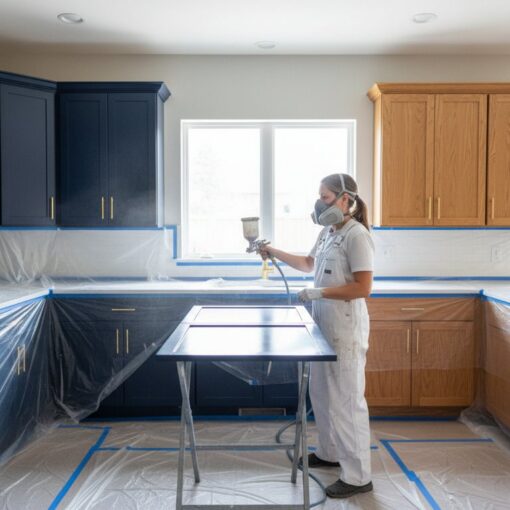
Oak’s heavy, open grain is the biggest obstacle when you want to transform oak cabinets without replacing them. These deep pores act like tiny canyons on the wood surface. If you apply paint directly over them, the texture "telegraphs" through the finish, leaving a pitted, dated look. Grain filling is the essential step for modernizing oak. This process involves pressing a specialized compound into the wood fibers to create a level plane before the first drop of primer touches the surface.
Professional results require a rigorous multi-step protocol. Start by cleaning with a heavy duty degreaser like TSP to remove 100% of kitchen oils. Once dry, sand the surface with 120-grit followed by 150-grit sandpaper. Apply the filler, let it dry for the manufacturer’s recommended 45 to 60 minutes, and sand it back until it only remains inside the pores. You’ll often need two coats of filler to achieve a truly flat surface. Using a high-volume low-pressure (HVLP) sprayer is non-negotiable for a factory finish. While brushes leave 3-mil thick ridges, an HVLP system atomizes the coating into a fine mist, laying down a consistent 4-mil wet film that levels perfectly.
The Steps to a ‘Grainless’ Look
Choose a water-based filler for faster dry times and easier sanding. Solvent-based fillers offer more durability but require 24 hours of off-gassing. Pair your filler with a high-build primer. These primers contain a higher solids content, usually around 50% to 60% by volume, which helps bridge any remaining microscopic gaps. This combination is the only way to successfully transform oak cabinets without replacing the entire door front.
Managing Expectations
Achieving a 100% "plastic-smooth" finish on oak is nearly impossible because wood is a natural material that expands and contracts. Aim for a 95% reduction in texture. You’ll notice the difference between "visible grain," where you can see the wood’s pattern under the paint, and "textured grain," which creates physical shadows. Lower sheen levels, such as a 20-degree Satin, hide imperfections much better than a 70-degree High Gloss finish. Glossy paints reflect light into every remaining pore, making even minor textures stand out.
Ready to upgrade your kitchen? Contact our team for a professional grain-filling consultation to ensure a flawless finish.
Professional Cabinet Painting in Denver: The Local Advantage
Denver’s semi-arid climate presents a unique challenge for wood surfaces. With average humidity levels frequently dipping below 20 percent, oak cabinets are prone to significant contraction and expansion. If you try to transform oak cabinets without replacing them using standard retail paint, you will likely face "bridging" cracks at the door stiles. Local professionals understand that oak is a porous hardwood. It requires specific primers to block tannins and flexible coatings that won’t snap when the wood breathes in Colorado’s thin air.
DIY attempts in the Front Range often result in peeling within the first 12 months. Most consumer-grade paints dry too quickly in our dry atmosphere, preventing the finish from leveling properly. This leaves visible brush strokes and an unsightly orange-peel texture. Hiring professional cabinet painters ensures the heavy oak grain is properly filled and the surface is chemically bonded. This professional approach provides a durable surface that withstands the 300 days of intense high-altitude sunlight we experience annually.
The final steps of a professional transformation involve more than just paint. Expert installers handle the re-installation of doors with precision, ensuring every gap is uniform. This is the ideal time to integrate soft-close hinge upgrades and modern hardware. Moving handles to a new position can completely change the kitchen’s aesthetic, but it requires professional hole-filling that won’t telegraph through the new finish over time.
The Cabinet Painting Denver Process
Our team uses a hybrid approach for maximum durability. Doors and drawers go to a climate-controlled shop for HVLP spraying. This environment maintains a steady 45 percent humidity to ensure a factory-smooth finish. Back at your home, we use HEPA filtration systems that capture 99.97 percent of dust particles during the prep phase. We exclusively use finishes that meet Kitchen Cabinet Manufacturers Association (KCMA) standards, which survive 24-hour exposure tests to household chemicals.
Your Next Steps to Transformation
Getting a clear cabinet painting cost estimate is the first step toward your kitchen’s new look. Before the crew arrives, clear your counters and empty the top drawers to allow for full access. This simple preparation helps the project stay on schedule. Professional re-installation ensures every door hangs level and every drawer glides smoothly. Schedule your free Denver cabinet consultation today!
Bring Your Kitchen Into 2026 Today
You don’t have to endure a full demolition to get the modern aesthetic you want. High-quality oak is a durable asset that simply needs a professional update. By choosing grain filling and advanced coating techniques, you can effectively transform oak cabinets without replacing them while achieving a smooth, factory-grade finish. Our team brings over 10 years of experience to every Denver, CO project. We utilize specialized HVLP spraying equipment to ensure your cabinets look brand new instead of just repainted. This process eliminates the heavy grain patterns that characterized 1990s kitchen designs.
Choosing a 5-star rated team means you get precision and local expertise. We’ve spent a decade perfecting the art of cabinet restoration for Colorado homeowners. Your kitchen’s potential is already there, hidden under that dated honey stain. It’s time to unlock a fresh look that increases your home’s value and matches current 2026 design trends. Take the first step toward your dream kitchen right now. You’ll love the results.
Get a Free Quote for Your Denver Cabinet Transformation
Your beautiful, modernized kitchen is much closer than you think.
Frequently Asked Questions
Can you really make oak cabinets look smooth like MDF?
You can achieve a smooth, MDF-like finish on oak by applying two coats of a high-solids grain filler. This process levels the deep pores characteristic of red oak. After the filler cures for 24 hours, professionals sand the surface with 220-grit sandpaper to create a flat plane. This specific technique adds roughly 30% more labor time to a project but results in a glass-smooth surface that’s indistinguishable from engineered wood.
How much does it cost to transform oak cabinets without replacing them?
According to 2024 data from Angi, the national average cost to refinish or paint cabinets ranges from $900 to $4,000. This is significantly less than the $15,000 to $30,000 typically required for a full kitchen remodel. To transform oak cabinets without replacing them, homeowners usually spend about 25% of the cost of new custom cabinetry. This budget covers professional-grade lacquers and specialized cleaning agents required for long-term durability.
Will the paint on my oak cabinets chip or peel?
Paint won’t chip or peel if the surface is prepared according to KCMA standards. Industry experts at the Painting and Decorating Contractors of America state that 90% of coating failures result from improper cleaning of kitchen grease. Using a bonding primer like INSL-X Stix ensures the topcoat adheres to the wood fibers. When applied correctly, these coatings withstand 200 cycles of scrub testing without losing any adhesion or color.
Is it better to sand oak cabinets or use a liquid deglosser?
Mechanical sanding is the superior choice because it creates a physical profile for the primer to grip. While liquid deglossers chemically dull the finish, they don’t level the wood grain or remove deep-seated contaminants. Professionals use a sequence of 120-grit and 180-grit sandpaper to open the wood pores. This mechanical bond increases coating longevity by 50% compared to chemical deglossing alone, ensuring the new finish remains intact for years.
What is the best color to paint honey oak cabinets in 2026?
Muted sage greens and warm taupes are the leading color choices for 2026 kitchen designs. These tones effectively neutralize the orange undertones of honey oak if any grain remains visible. Designers at the National Kitchen & Bath Association report a 40% increase in requests for organic, nature-inspired palettes. Selecting a satin finish helps hide fingerprint oils while providing a modern, sophisticated look that replaces the dated 1990s yellow glow with contemporary elegance.
How long does a professional oak cabinet transformation take?
A professional crew typically completes an oak cabinet transformation in 5 to 7 business days. This timeline includes one day for site protection, two days for cleaning and sanding, and two days for spraying and curing. If you choose to transform oak cabinets without replacing them, your kitchen remains functional for most of the week. Only the doors are removed to a specialized spray booth to ensure a factory-grade finish without dust.
Can I change my oak cabinet hinges to hidden soft-close hinges?
You can upgrade to hidden soft-close hinges by boring new 35mm holes into the cabinet doors. This process involves filling the old external hinge holes with wood filler before the painting process begins. Statistics from hardware manufacturer Blum show that soft-close hinges are rated for 200,000 opening cycles. This upgrade eliminates the visible butterfly hinges common on 1980s oak cabinets and provides a sleek, contemporary appearance that fits modern design standards.
Do I need to fill the grain if I’m using a dark paint color?
Filling the grain is highly recommended for dark colors because deep shadows make the oak texture 15% more visible under dark pigments. While black or navy paint hides the wood’s color, the physical pits of the grain create a rustic look that conflicts with modern aesthetics. Using a dark-tinted grain filler ensures the final surface is uniform. This step prevents the polka-dot effect where paint pools in deep pores and creates uneven sheen.