A factory-quality cabinet transformation is a technical manufacturing process rather than a standard home decor project. Achieving a smooth, grain-free finish requires industrial coatings and a controlled environment that traditional painting methods cannot provide. If you’re considering a kitchen update, you likely want the appearance of new cabinetry without the high cost of full replacement. It’s natural to feel concerned about the potential for peeling paint, messy fumes, or a kitchen that remains unusable for weeks. Understanding the professional cabinet painting process is the first step toward ensuring your investment yields a durable, resilient result.
We’ve designed this guide to provide total transparency regarding how professional technicians achieve a factory-smooth surface. You’ll discover the specific steps involved in off-site spraying for doors and the detailed on-site masking required to protect your Denver home. We’ll outline everything from hardware removal to the application of industrial coatings. This overview ensures you know exactly what to expect as we transform your space through specialized Kitchen Cabinet Painting or Bathroom Cabinet Painting services.
Key Takeaways
- Learn why industrial-grade coatings and a controlled spray booth are essential for a finish that resists grease and daily wear.
- Understand the technical stages of the professional cabinet painting process, focusing on procedural clarity rather than just surface-level aesthetics.
- Discover the “Triple-Clean” preparation method and meticulous hardware removal techniques that ensure permanent paint adhesion.
- Identify the specific masking and containment protocols used to protect your home’s interior while work is performed on-site.
- See how off-site spraying for doors and drawer fronts creates a factory-smooth, grain-free appearance that outperforms brush and roller methods.
The Professional Cabinet Painting Standard vs. DIY Methods
The professional cabinet painting process is a technical manufacturing sequence. It is not a standard home decor project. This process transforms surfaces through a multi-stage refinishing protocol. While DIY methods often rely on manual application and retail-grade materials, professional standards require industrial coatings and controlled environments. This ensures a factory-quality finish that resists the daily wear of a high-traffic kitchen. By treating the project as a manufacturing task rather than a simple aesthetic update, technicians achieve a level of durability that manual methods cannot replicate.
Industrial Coatings vs. Retail Paint
Retail latex paints are generally insufficient for kitchen environments. They dry via evaporation and often remain soft, making them susceptible to “blocking” where surfaces stick together. Professional technicians utilize industrial coatings such as post-catalyzed lacquers or high-performance urethanes. These materials involve chemical cross-linking to create a resilient, non-porous surface. Understanding paint composition reveals why industrial resins are superior. They are specifically engineered to meet KCMA standards for moisture, grease, and heat resistance.
Industrial enamels contain a higher solids content and specialized resins that bond aggressively to the wood substrate. These coatings are designed to withstand 24-hour exposure to common household chemicals like vinegar, lemon juice, and detergents without softening or staining. This level of protection is a core component of the professional standard. These coatings also cure much faster than retail options. This rapid curing prevents surface impressions and allows for a quicker return to service for the homeowner.
The Role of Specialized Equipment
Specialized equipment is necessary for a smooth, grain-free appearance. Brushes and rollers leave behind “stipple” or visible marks that trap dirt over time. The professional cabinet painting process employs High-Volume Low-Pressure (HVLP) spray systems. These systems atomize the coating into a fine mist for even distribution. HVLP technology provides superior transfer efficiency, meaning more coating lands on the cabinet surface and less is wasted as overspray. This precision allows for a flexible film that accommodates seasonal wood expansion without cracking.
Technicians also use HEPA-filtered dust extraction to maintain a clean workspace. This environmental control is a requirement for every kitchen cabinet painting project. In the Denver area, maintaining a dust-free zone is critical to prevent airborne contaminants from settling into the wet coating. By combining off-site spraying for doors with detailed on-site application for frames, professionals deliver a consistent, high-build finish that looks brand new.
Phase 1: Meticulous Surface Preparation and De-Greasing
The foundation of a successful professional cabinet painting process begins with complete disassembly. Technicians systematically remove every door, drawer front, and piece of hardware. We label each component to ensure precise reinstallation. This stage is critical. Painting cabinets while they are still hanging leads to overspray on hinges and missed spots behind the frames. By clearing the workspace, we can address every square inch of the cabinet box and the individual components separately.
Once disassembled, we initiate a “Triple-Clean” protocol. This isn’t a simple wipe-down with a damp cloth. It involves a sequential application of chemical de-greasers, specialized wood cleaners, and a final neutralizing wipe. This rigorous cleaning removes years of accumulated cooking residues that are invisible to the naked eye. Adhering to professional painting standards ensures that every surface is chemically neutralized before any coating is applied. Without this step, even the highest quality primer will eventually peel.
The Importance of Chemical De-Greasing
Kitchens are harsh environments. Cooking oils, steam, and skin proteins from daily use saturate wood surfaces. These contaminants act as a bond-breaker. Standard retail cleaners often leave a soapy residue that is just as harmful as the grease itself. We utilize professional-grade cleaners used in the cabinet refinishing process to strip these layers away. This chemical neutralization is the only way to guarantee the primer achieves a permanent, industrial-grade bond with the wood substrate.
Sanding and Grain Filling
Mechanical adhesion requires a “profile.” We use a progression of sandpaper grits, typically ranging from 120 to 220, to scuff the existing finish without damaging the wood. This creates microscopic grooves that allow the primer to “bite” into the surface. For open-grain woods like Oak, we apply a specialized grain filler. This fills the deep pores of the wood, preventing the “pitted” look that often plagues DIY projects. To maintain the cleanliness of your home, we use dust-free sanding technology. These systems utilize high-suction vacuums attached directly to the sanders, capturing 99% of airborne particles before they can settle in your Denver kitchen.
After sanding, we repair minor dings, scratches, or cracks with industrial wood fillers. This ensures the final surface is uniform and smooth. If you are planning a project, you can consult with our Denver team to review your specific cabinet wood type and determine if grain filling is necessary for your desired aesthetic.
Phase 2: Professional Priming and Off-Site Spraying
Once the preparation is complete, the professional cabinet painting process moves into the coating phase. This stage requires a level of environmental control that a residential kitchen cannot provide. We transport all doors and drawer fronts to our specialized facility for processing. By separating the removable components from the fixed cabinet boxes, we ensure every surface receives an even, factory-quality application. This off-site approach significantly reduces the equipment footprint and chemical odors within your Denver residence during the project.
The Controlled Spray Booth Advantage
Dust is the primary enemy of a smooth finish. Even a clean residential garage or kitchen contains airborne particles that settle on wet coatings, creating a gritty texture. Our facility utilizes a pressurized, filtered spray booth to eliminate this risk. This controlled environment ensures that the finish remains pristine as it transitions from a liquid to a solid state. We utilize vertical drying racks to maximize airflow around every component. This specialized setup allows for a consistent curing process that is impossible to replicate in a non-industrial setting.
Priming for Adhesion and Blockage
We apply high-build, stain-blocking primers specifically engineered for cabinetry. These primers do more than just provide color; they seal the wood and prevent tannin bleed-through. Tannins are natural chemicals in wood like Oak or Cherry that can seep through standard paint, causing yellow or brown stains. After the primer is applied, our technicians perform a detailed inspection to identify any remaining surface irregularities. For a deeper look at the chemistry behind these coatings, you can review our guide on the best paint for cabinets.
Achieving a glass-smooth surface requires a “sand-back” protocol. Between each application of primer and topcoat, we lightly sand the surfaces with fine-grit abrasives. This removes any raised wood grain or microscopic surface tension. We repeat this process until the foundation is perfectly level. This mechanical smoothing is a requirement for the industrial-grade topcoat to lay flat and bond correctly.
Curing is a critical final step in this phase. While standard paint might feel dry to the touch quickly, industrial coatings require specific temperature and humidity levels to reach their full chemical hardness. Our facility maintains these optimal conditions 24 hours a day. This ensures the finish achieves maximum durability and moisture resistance before the cabinets are ever handled for reinstallation. This controlled curing results in a surface that resists impact and prevents the “sticking” often associated with DIY cabinet projects.
Phase 3: On-Site Execution and Home Protection
While the doors and drawer fronts undergo processing at the off-site facility, the on-site phase begins at the Denver residence. This stage of the professional cabinet painting process focuses on the fixed cabinet frames. To achieve a seamless match between the doors and the boxes, we use the same industrial coatings and spray techniques in your kitchen. Spraying indoors requires extreme measures to protect the surrounding environment. We do not rely on simple drop cloths. Instead, we build a comprehensive containment system that prevents overspray and dust from migrating into other rooms.
Creating a Containment Zone
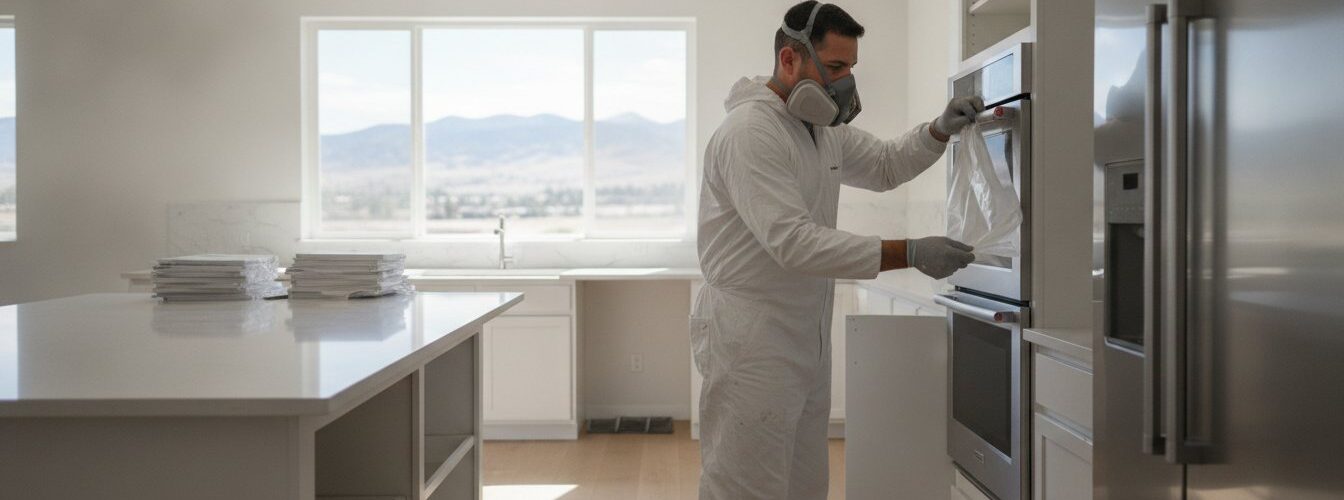
We seal the kitchen using heavy-duty plastic sheeting and telescopic poles. This creates a “plastic tent” that isolates the workspace from the rest of the home. We cover floors with durable protective paper that resists tearing and moisture. Countertops, appliances, and walls are sealed with static-clasp plastic that clings to surfaces for a secure barrier. If the cabinet interiors are not being painted, we mask them off entirely to prevent any mist from entering the storage areas. This level of protection is a requirement for maintaining a clean living environment during the project.
To manage fumes and airborne particles, we utilize high-powered air scrubbers with HEPA filtration. This equipment actively exhausts air to the outside through a window or door. This creates negative air pressure within the containment zone. This ensures that any VOCs or overspray particles are trapped or removed immediately. This technical approach to ventilation is what separates professional execution from standard residential painting. It allows the homeowner to remain in the residence with minimal impact on air quality.
On-Site Spraying Techniques
Spraying fixed frames requires precision to avoid drips and ensure even coverage on vertical surfaces. Technicians apply the same high-build primer and industrial topcoat used in the spray booth. This ensures the color and sheen are identical across all surfaces. We use specialized spray tips to minimize overspray and maximize transfer efficiency. We schedule this work to minimize the time your kitchen remains under containment. This usually involves a concentrated period of intensive application and curing.
Once the final coat is applied, we perform a rigorous inspection of the frames under high-intensity lighting. We check for uniform thickness and surface smoothness. We only remove the masking once the coating is tack-free and meets our quality standards. This careful removal process prevents damage to the fresh finish or the surrounding walls. If you are ready to begin your renovation, request a professional assessment from our team to see how we protect your home during the transformation.
Reassembly, Final Inspection, and Maintenance
The final stage of the professional cabinet painting process involves the careful transport of all finished components back to the residence. Technicians wrap each door and drawer front in protective foam. This prevents surface damage during transit. This transition requires precision. It ensures the factory-quality finish remains intact from the spray booth to the kitchen. Once on-site, the focus shifts from manufacturing to technical assembly. We handle each piece with care to maintain the integrity of the cured industrial coating.
Precision Reinstallation
The labeling system established during the disassembly phase is critical. It ensures that every door and drawer returns to its exact original location. Technicians reinstall all hinges and mount hardware with accuracy. We align and level each door to correct any sagging or uneven gaps. This adjustment phase is essential for a high-end appearance. Homeowners often choose this time to upgrade to soft-close hinges or new handles. This enhances the functional quality of the cabinetry alongside the aesthetic update. Proper alignment ensures that doors don’t rub against frames, which protects the finish from mechanical wear.
Caring for Your Professionally Painted Cabinets
Industrial coatings require a specific duration to reach maximum chemical hardness. This cure time typically lasts between 7 and 14 days. While the cabinets are dry to the touch and ready for light use, the surface remains susceptible to impressions during this window. Don’t place heavy appliances against fresh coatings until the process is complete. Maintaining the finish requires simple but specific care protocols. Use only mild soap and warm water for cleaning. Avoid abrasive sponges or harsh chemical cleaners that can degrade the coating over time.
- Wipe away spills immediately to prevent moisture from sitting on joints.
- Use a soft microfiber cloth for regular dusting.
- Avoid using steam cleaners near the cabinet surfaces.
- Check hinge tightness annually to maintain proper door alignment.
We conclude the project with a comprehensive walk-through. This final quality control check ensures every surface meets our standards for smoothness and color consistency. We verify that all doors operate correctly and that the workspace is returned to its original condition. For more details on local maintenance and care, consult our cabinet painting Denver guide. This systematic approach ensures your cabinets remain durable and visually striking for years to come.
Transforming Your Kitchen with Industrial Precision
A factory-quality finish relies on the intersection of industrial coatings and controlled environments. By moving beyond retail paint and manual application methods, you ensure your cabinetry resists the moisture and heat of a high-traffic kitchen. The professional cabinet painting process is a manufacturing sequence designed for durability. It replaces outdated surfaces with a resilient finish that looks and performs like new cabinetry. From meticulous chemical de-greasing to specialized off-site spraying, every step prioritizes procedural clarity and long-term results. This systematic approach guarantees a smooth, grain-free appearance that standard painting cannot achieve.
We provide specialized refinishing services across the Denver Metro area. Our team delivers a cost-effective kitchen transformation without the disruption of a full remodel. You don’t have to settle for brush marks or peeling paint. We’re committed to transparency and technical excellence in every project we undertake. If you’re ready to upgrade your home with a factory-quality spray finish, we invite you to take the next step. Get Your Free Professional Cabinet Painting Quote in Denver. Our experts are ready to provide the technical expertise your kitchen deserves.
Frequently Asked Questions
How long does the professional cabinet painting process take?
A standard professional cabinet painting process typically takes five to seven business days to complete. This timeframe includes the initial disassembly, the “Triple-Clean” preparation protocol, off-site spraying in our controlled facility, and the final reinstallation. This structured schedule ensures that each industrial coating has sufficient time to cure before the cabinets are handled for assembly.
Will my kitchen be usable during the painting process?
Your kitchen will be partially unusable for two to three days during the on-site execution phase. We build a plastic containment zone with zip-walls to isolate the workspace from the rest of your home. Once the on-site spraying is finished and the masking is removed, you can resume light use of the kitchen while we finish the doors and drawer fronts off-site.
Do professional painters spray or brush the cabinet frames?
We spray the cabinet frames to ensure a consistent, grain-free texture that matches the doors. Brushing or rolling the frames creates a visible “stipple” that looks different from the factory-smooth finish on the doors. Our team uses detailed on-site masking and air scrubbers with HEPA filtration to safely achieve this seamless appearance inside your home.
What is the difference between cabinet painting and cabinet refinishing?
Cabinet painting involves applying an opaque, high-performance industrial coating to change the color of the cabinetry. Refinishing generally refers to restoring or changing the color of the wood stain while keeping the grain visible. Our professional cabinet painting process focuses on transforming outdated wood into a solid, factory-quality finish that looks brand new.
How do you prevent the paint from peeling or chipping over time?
We prevent peeling by achieving a mechanical and chemical bond with the wood substrate. This requires a rigorous de-greasing process to remove kitchen oils and mechanical sanding to create a “profile” for the primer. We use industrial-grade coatings that cure much harder than standard retail paint, making the finish resistant to the daily impacts and moisture found in a kitchen environment.
Do I need to empty my cabinets before the painters arrive?
You must remove all items from your countertops and completely empty all drawers. If we aren’t painting the interiors of your cabinet boxes, you don’t necessarily need to empty the shelves. We mask off the front of the cabinet openings to protect your dishes and belongings from any dust or mist during the spraying phase.
Can you paint over laminate or thermofoil cabinets?
We can paint over laminate or thermofoil as long as the surface isn’t peeling or delaminating. If the thermofoil is already lifting, it must be removed to expose the underlying substrate before we begin. We utilize specialized high-adhesion bonding primers specifically engineered to stick to these non-porous synthetic surfaces.
What kind of paint do professionals use for a factory finish?
Professionals use industrial-grade coatings like post-catalyzed lacquers or high-performance urethanes rather than standard house paint. These materials meet KCMA standards for durability and chemical resistance. They cure much faster and harder than retail latex options, which prevents the “sticking” or “blocking” often seen in DIY projects.