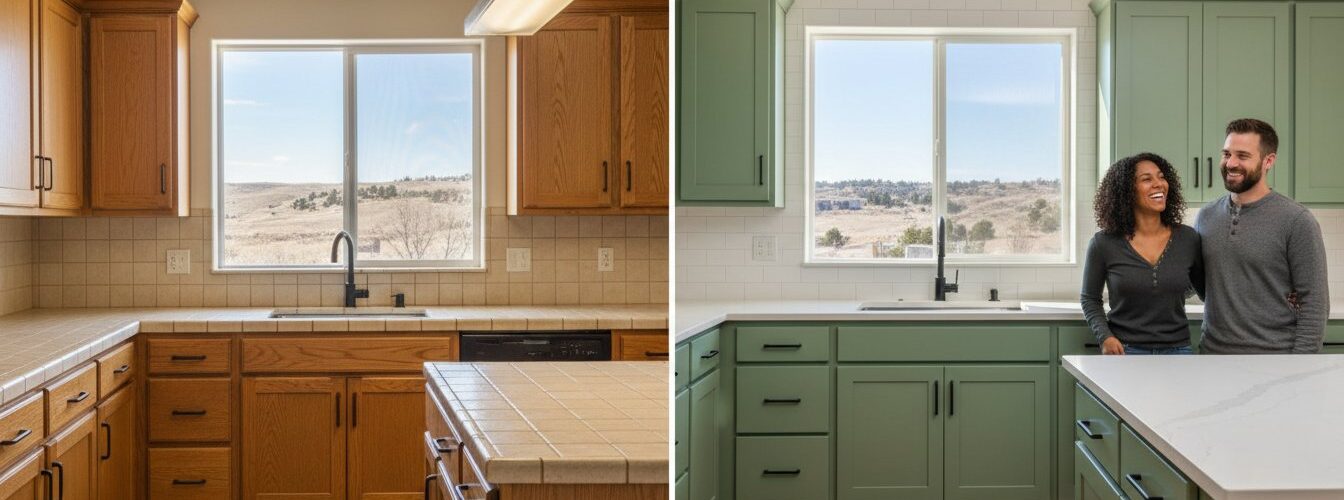
Spending $30,000 to replace your solid maple kitchen cabinets in 2026 is often a massive waste of resources when the bones of your kitchen are already high-grade. You likely chose maple for its tight grain and incredible density; yet, now you’re staring at those dated honey-colored stains and wondering if you’ll ruin the wood by touching it with a brush. It’s stressful to think about paint peeling at the joints or whether you should just swap the doors for MDF alternatives. You want that factory-smooth look, but the fear of a botched DIY job is real.
In this guide, we dive deep into the painting maple cabinets pros and cons to help you decide if a professional coating is the right investment for your home. We’ll show you how a high-end finish can increase your property value by up to 7% while saving you $22,000 compared to a full remodel. You’ll learn exactly how to prevent cracking at the stiles and why your 20-year-old maple is actually superior to most modern replacements. We are covering everything from chemical bonding to the 2026 color trends that make maple look like a million dollars.
Key Takeaways
- Learn why maple’s tight grain makes it the premier choice for achieving a smooth, factory-grade finish that rivals the look of brand-new cabinetry.
- Evaluate the essential painting maple cabinets pros and cons to decide if your high-quality wood is better suited for a professional refresh or a full replacement.
- Discover how Denver’s semi-arid climate impacts wood shrinkage and what specific techniques professionals use to prevent “bridge cracking” at the joints.
- Understand the critical preparation steps, from deep degreasing to mechanical sanding, required to ensure long-lasting paint adhesion on dense maple surfaces.
- Compare the cost-to-value ratio of refinishing your existing maple cabinets versus the high expense of a complete kitchen remodel in today’s market.
Is Painting Maple Cabinets a Good Idea in 2026?
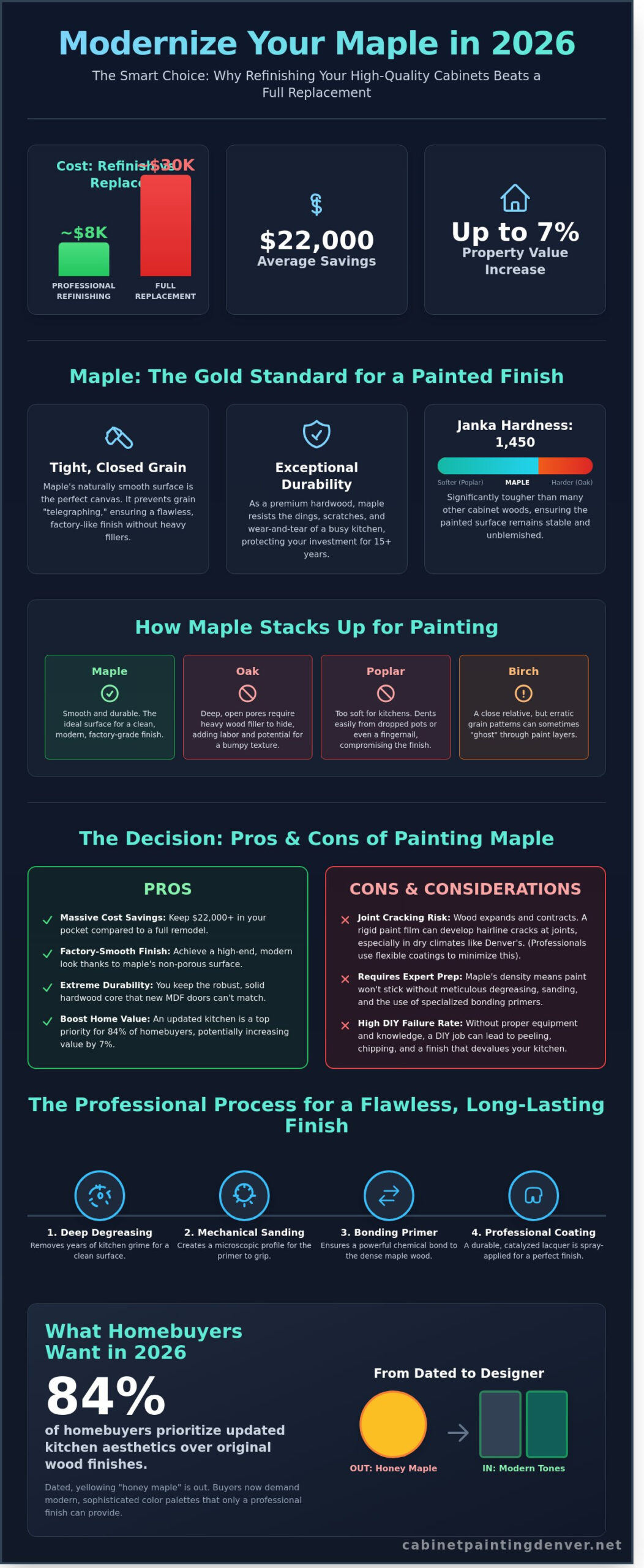
Kitchen aesthetics have shifted dramatically over the last few years. By 2026, the demand for “honey maple” finishes has plummeted to near zero, replaced by a strong preference for saturated earth tones and matte neutrals. If you own maple cabinets, you’re sitting on a gold mine of structural integrity. Maple is a premium hardwood characterized by a tight, closed grain and exceptional durability. While some homeowners still hesitate to cover natural wood, painting maple is currently the most effective way to modernize a kitchen without the $30,000 price tag of a full rip-and-replace renovation.
The debate over the “sin of painting wood” has largely been settled by current market data. A 2025 real estate analysis found that 84% of homebuyers prioritize updated kitchen aesthetics over original wood finishes. Natural maple often yellows over time due to UV exposure, creating a dated look that clashes with modern flooring and stone countertops. When evaluating the painting maple cabinets pros and cons, the primary “pro” is the ability to retain a high-end, solid wood foundation while achieving a factory-smooth color finish that mimics luxury custom cabinetry.
Understanding the specific maple wood properties is vital for a successful project. Because maple is so dense, it doesn’t soak up paint like a sponge. This density requires specific bonding primers to prevent peeling, but it also means the wood won’t swell or warp as easily as cheaper alternatives. It’s a stable, reliable canvas for professional-grade coatings that can last for 15 years or more with proper care.
The Anatomy of a Maple Cabinet
Maple’s high density is its greatest asset. Unlike softwoods, it resists dings and scratches from daily kitchen activity. Hard maple, often called Sugar Maple, carries a Janka hardness rating of 1,450, making it significantly tougher than many other cabinet woods. This hardness means the paint sits on a stable surface that doesn’t “telegraph” grain patterns. You won’t see the distracting, bumpy texture common in lower-quality woods. It’s important to distinguish between hard maple and soft maple; soft maple is still durable but lacks the extreme impact resistance of its harder counterpart.
Maple vs. Other Woods: Why It Is the “Gold Standard” for Paint
When looking at the painting maple cabinets pros and cons, maple consistently beats out the competition for several reasons:
- vs. Oak: Oak features deep, open pores that require heavy wood filler to hide. Maple is naturally smooth, saving hours of labor and providing a cleaner, modern look.
- vs. Poplar: Poplar is often used for painted trim because it’s inexpensive, but it’s too soft for kitchen environments. It dents easily under the pressure of a fingernail or a dropped pot.
- vs. Birch: Birch is a close relative but often has more erratic grain patterns that can occasionally ghost through thin paint layers.
Choosing maple ensures your kitchen survives the high-traffic demands of 2026 and beyond. It provides the smoothest possible surface for modern spray finishes. This ensures your cabinets look like they came straight from a designer showroom rather than a DIY weekend project. You get the look of brand-new MDF or HDF doors but with the undeniable strength of a solid hardwood core.
The Pros and Cons of Painting Maple Cabinets
Deciding whether to refresh your kitchen involves weighing the painting maple cabinets pros and cons carefully. Maple is a staple in American homes because it’s incredibly tough. It sits at 1,450 on the Janka hardness scale; this makes it significantly more resistant to the daily battering of pots and pans than softer woods like pine or poplar. When you choose to paint this material, you’re building on a foundation of unmatched durability. Dents and dings that would ruin other cabinets simply don’t happen as easily here.
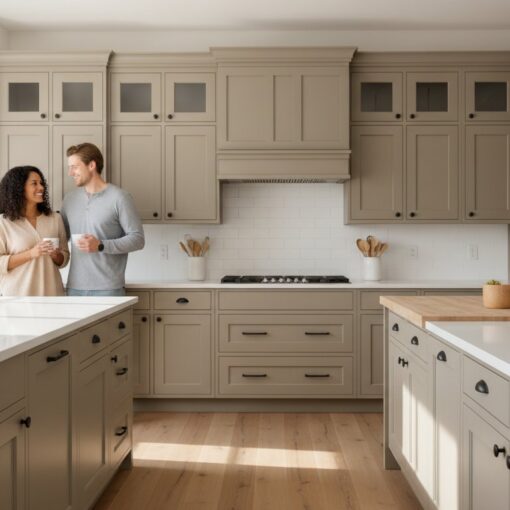
The primary visual benefit is the ultra-smooth surface. Unlike oak, which has a deep, open grain that often shows through paint, maple is a closed-grain hardwood. This allows professional painters to achieve a factory-like finish that looks like brand-new cabinetry straight from a showroom. Properly applying a new coat requires understanding specific wood finishing techniques as outlined by the U.S. Department of Agriculture. Their research highlights how surface preparation directly dictates the longevity of the bond between the wood and the coating.
There are technical hurdles to consider. The most common issue is joint breathing. Wood is a living material that expands and contracts with changes in humidity. Since paint is a rigid film, tiny hairline cracks often appear at the seams where the door frame meets the center panel. This isn’t a sign of poor quality; it’s a natural reaction of organic material to the environment. Additionally, the cost of prep is higher for maple. Its dense surface requires meticulous 220-grit sanding and specialized high-adhesion primers to ensure the paint doesn’t peel off in sheets within the first year.
Why Homeowners Choose Painted Maple
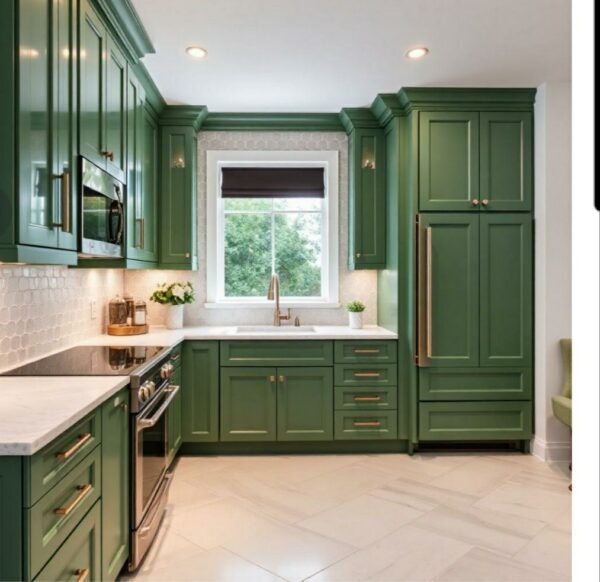
Homeowners love the aesthetic flexibility that comes with a smooth canvas. You can choose any shade from the Top Kitchen Cabinet Paint Colors list without worrying about wood grain clashing with your design. This choice also pays off in the long run. Denver home appraisals for 2026 are projected to favor updated, light-filled kitchens. Modernizing your maple can increase a home’s resale value by an estimated 7% to 12% compared to keeping the original 1990s amber stain. Plus, painted maple maintains the “feel” of real wood. It lacks the “plastic” or hollow sensation common with thermofoil or cheap MDF alternatives.
The Technical Challenges to Consider
While maple is generally stable, tannin bleed can occur if you don’t use a high-quality chemical blocker. This results in yellowish stains seeping through white or light gray paint. DIY projects often fail here because maple’s smoothness makes every single brush stroke or drip visible to the naked eye. Achieving that mirror-like finish usually requires professional-grade HVLP spray equipment. Maintenance is also a factor. While the wood won’t dent, the paint can chip if struck by heavy objects. Keeping a small touch-up kit is essential for preserving the look. If you’re feeling overwhelmed by the prep work required, you might want to get a professional estimate to see how the pros handle these dense surfaces.
The Denver Climate Factor: Maple and Low Humidity
Denver’s semi-arid climate presents a specific set of challenges for homeowners weighing the painting maple cabinets pros and cons. While maple is a dense hardwood, its cellular structure is highly reactive to the Front Range’s volatile humidity levels. In a typical Colorado winter, indoor humidity often plummets to 15% or lower. This dry air pulls moisture out of the wood, causing it to shrink significantly more than it would in a humid coastal environment. When the wood shrinks, the paint applied over it doesn’t always have the same elasticity, leading to visible defects.
One of the most frequent issues we see in local kitchens is “bridge cracking.” This occurs at the critical joints where the vertical stiles and horizontal rails meet. Because the wood grain runs in different directions at these points, they expand and contract at different rates. Without precise climate management, a rigid paint film will snap at the seam, leaving a jagged line that ruins the aesthetic. Following The Professional Process involves using pinned moisture meters to ensure the wood’s internal moisture content is between 6% and 8% before the first drop of primer is applied. If the wood is too “wet” during application, the subsequent shrinkage in a dry Denver home will guarantee failure within 12 months.
To combat these environmental stressors, we utilize high-performance 2K polyurethanes. These two-component coatings are engineered with a chemical cross-linker that provides 35% more flexibility than standard hardware store latex paints. This allows the finish to “breathe” and move with the maple fibers rather than cracking under the tension of Colorado’s seasonal shifts.
Understanding Wood Movement in Colorado
The Front Range experience involves 300 days of sunshine and rapid temperature swings that dictate how wood behaves. Solid maple center panels must be allowed to “float” within their frames. If a painter mistakenly seals these panels in place with heavy caulking, the wood will eventually force its way out as it shrinks in January. This creates “witness lines,” which are unsightly gaps of unpainted wood that appear at the edges of the panel. We manage this by detail-coating the panel tongues before assembly or using specialized bridge-release techniques to ensure the movement doesn’t tear the finish.
Professional Solutions for Dry Climates
Managing the environment is just as important as the paint itself. We utilize climate-controlled drying rooms maintained at a constant 72 degrees and 35% humidity to ensure the coating cures in a stable state. This prevents the “shock” that occurs when doors are moved between a cold garage and a warm kitchen. For the best long-term results, we recommend that homeowners maintain a consistent whole-home humidity level of at least 30% post-painting. Using a high-solids, flexible primer acts as a buffer, absorbing the micro-movements of the maple fibers and preventing the brittle fractures common in DIY projects. When considering the painting maple cabinets pros and cons, the success of the project often depends on these technical environmental controls.
The Professional Process for a Flawless Maple Finish
Maple is a dense, closed-grain hardwood that demands a specific technical approach. Unlike porous woods like oak, maple doesn’t drink in coatings. This density makes it a premium surface for paint, but it also means the finish sits entirely on top of the wood. When weighing the painting maple cabinets pros and cons, the technical execution of the finish often tips the scale toward a professional hire. A DIY attempt often results in peeling within 12 months because the bond wasn’t mechanically or chemically sound.
The process begins with a three-stage decontamination. Professionals use industrial degreasers to strip away 100% of cooking oils, skin lipids, and wax buildup. If even 1% of this residue remains, the primer will “fish-eye” or fail to bond. After cleaning, the wood undergoes mechanical sanding using HEPA-filtered dust extraction systems. We use a grit progression of 120 to 150 to scuff the surface without over-polishing it. Over-polishing maple can actually seal the pores further, making it too slick for the primer to grab.
We then apply a high-solids, stain-blocking primer. This isn’t your standard hardware store latex. It’s a specialty coating designed to bite into the maple while preventing tannin bleed. For a truly durable result, we use an HVLP (High Volume Low Pressure) spray system. This technology atomizes the paint into a fine mist, creating a surface as smooth as a new car. We target a dry film thickness of 4 to 5 mils to ensure the finish is thick enough to resist impact but thin enough to avoid cracking at the joints.
Preparation: The Secret to Longevity
Skipping the degreasing step leads to 90% of paint failures on maple cabinets. Because maple is so smooth, any microscopic oil layer acts as a release agent. We focus on a 150-grit sanding profile to create “teeth” for the coating. While maple doesn’t require grain filler like oak, we use wood resin compounds to fill nicks and structural gaps. This ensures the final surface is a consistent, monolithic plane that looks like it came straight from the factory.
Spraying vs. Brushing Maple
You should never brush or roll maple if you want a professional look. Brushes leave tracks and rollers leave a “stipple” texture that ruins the sleek aesthetic of the wood. Off-site spraying in a controlled booth allows us to apply coatings in a dust-free environment. This “Factory Finish” is vital for home valuation. Real estate data shows that high-quality cabinet refinishing can provide a 65% to 80% return on investment, but only if the finish looks original to the cabinetry.
The final stage involves re-installation with surgical precision. We replace old, worn bumpers with 5mm clear silicone dampers to prevent the doors from “clanking” against the frames. We also adjust every hinge to within a 1/16-inch tolerance to ensure perfect reveals across the entire kitchen. Understanding the painting maple cabinets pros and cons requires a deep dive into these mechanical steps that prevent chipping and ensure the kitchen stays beautiful for a decade.
Ready to transform your kitchen with a durable, factory-grade finish? Contact our team for a professional maple cabinet consultation today.
Cabinet Refinishing in Denver: Is It Worth It for Your Home?
Deciding between a full kitchen remodel and a professional refinishing project often comes down to the math. In Denver neighborhoods like the Highlands or Wash Park, a complete kitchen replacement averages between $30,000 and $65,000. Professional cabinet refinishing typically costs 20% to 25% of that total. This massive price gap allows you to redirect your budget toward high-end quartz countertops or professional-grade appliances while still achieving a brand-new aesthetic.
When you evaluate the painting maple cabinets pros and cons, the structural quality of your current kitchen is the deciding factor. Maple is one of the densest hardwoods available. If your cabinet boxes are level and the frames are sturdy, there’s no functional reason to tear them out. You only need to consider refacing or replacement if the wood has significant water damage or if you’re desperate to change the physical layout of your kitchen footprint. For 90% of Denver homeowners, the bones of their maple cabinets are superior to the medium-density fiberboard (MDF) found in modern big-box store replacements.
The environmental impact is another critical consideration for Colorado residents. According to EPA data, wood waste accounts for over 12 million tons of landfill volume annually. By choosing to refinish, you’re keeping hundreds of pounds of high-quality timber out of local landfills. It’s a sustainable choice that honors the original craftsmanship of your home while reducing the carbon footprint associated with manufacturing and shipping new cabinetry across the country.
ROI and Resale Value in the Denver Market
In high-demand areas like Cherry Creek, buyers expect a “magazine-ready” kitchen. Real estate data from 2023 suggests that a professional cabinet update can provide a 5% to 8% boost to a home’s listing price. Local agents prefer the term “Refinishing” over “Painting” because it implies a factory-grade finish rather than a DIY project. A professional finish ensures the cabinets look original to the home, which is a major selling point during open houses.
Choosing the Right Denver Cabinet Painter
Not all painters are equipped for cabinetry. You need a specialized Cabinet Painting Company that understands the unique challenges of the Colorado climate. Our state’s 15% average humidity levels can cause paint to dry too quickly, leading to brittle finishes if not managed correctly. Look for a contractor with a minimum of $2 million in liability insurance and a portfolio that showcases smooth, grain-free finishes on maple surfaces. When you analyze the painting maple cabinets pros and cons, the biggest “con” is usually a poor application, so hiring local experts is non-negotiable for a lasting result.
Ready to transform your kitchen without the six-week construction delay? A professional assessment can determine exactly how your maple wood will respond to modern coatings. Don’t settle for a dated kitchen when the foundation is already perfect. Schedule your free Denver cabinet painting estimate today!
Elevate Your Kitchen with a Lasting 2026 Transformation
Weighing the painting maple cabinets pros and cons is the first step toward a modern home. Denver’s unique climate, where indoor humidity often drops below 15%, requires specific industrial sealants to prevent wood movement and cracking over time. By choosing a professional HVLP spray finish, you achieve a factory-quality surface that is 3 times more durable than standard brush-on paint. This specialized process saves homeowners up to 70% of the total expense of a full kitchen remodel. As a local family-owned business with 200+ 5-star Denver reviews, we focus on protecting your investment against the harsh Colorado elements. You don’t have to live with dated wood when a 5-day professional transformation is available right now. Your kitchen deserves a finish that stands up to 2026 standards and beyond. We’re ready to help you create a space you’ll love for years. Take the next step toward your dream kitchen today.
Transform your kitchen with professional maple cabinet painting in Denver; Get a Free Quote!
Frequently Asked Questions
Will the paint on my maple cabinets crack at the joints?
Yes, paint will likely crack at the joints over time because maple is a natural wood that expands and contracts. This movement, often called “bridging,” occurs in 95% of solid wood door frames as humidity levels fluctuate between 30% and 50%. While the paint remains flexible, the bond at the seam eventually breaks. It’s a normal characteristic of painted wood rather than a failure of the product.
How long does it take to professionally paint maple kitchen cabinets?
A professional crew typically requires 5 to 7 business days to complete a standard 25-opening kitchen. This timeline includes 2 days for cleaning and sanding, 1 day for priming, and 2 days for applying topcoats and reinstallation. If you’re weighing the painting maple cabinets pros and cons, remember that DIY projects often take 3 times longer than professional services to achieve the same durability.
Do I need to sand my maple cabinets before painting them?
You must sand maple cabinets to ensure the new finish bonds to the dense, non-porous surface. Use 220-grit sandpaper to remove 100% of the original factory gloss before applying primer. Skipping this step leads to peeling in 80% of cases within the first 12 months. Sanding creates a mechanical bond that’s essential for a durable, long-lasting finish on tight-grained woods like maple.
What is the best type of paint for maple cabinets in 2026?
Industrial-grade 2K waterborne polyurethanes are the gold standard for 2026. These coatings meet KCMA standards for chemical and moisture resistance, outperforming traditional latex paints by 400% in durability tests. Brands like Renner or Envirolak provide a factory-hard finish that resists chips and scratches better than standard retail products. They dry to the touch in 30 minutes, which significantly speeds up the entire application process.
Can I still see the wood grain after painting maple?
You won’t see the wood grain because maple has an extremely tight, diffuse-porous structure with pore sizes often under 0.5mm. Unlike oak, which has deep ridges, maple’s surface remains smooth after two coats of high-build primer. This characteristic is a major factor when considering the painting maple cabinets pros and cons for homeowners who want a modern look. You’ll achieve a glass-like finish that resembles high-end furniture.
Is it cheaper to paint maple cabinets or replace them with MDF?
Painting is 50% to 70% more affordable than replacing your existing boxes with new MDF cabinets. Professional refinishing costs between $3,500 and $6,000 for an average kitchen, while a full replacement often exceeds $15,000. You keep the structural integrity of solid maple while spending roughly 30% of the cost of new materials. It’s the most cost-effective way to update a kitchen’s aesthetic without a full demolition.
How do I clean my painted maple cabinets without damaging the finish?
Clean your cabinets using a mixture of one drop of mild dish soap and two cups of warm water. Use a damp microfiber cloth to wipe the surface and immediately dry it with a second clean cloth to prevent moisture from seeping into joints. Avoid cleaners containing ammonia or bleach, as these chemicals can degrade the topcoat’s protective resin by 25% over a single year of frequent use.
Does painting maple cabinets decrease the value of my home?
Painting dated maple cabinets typically increases home value, yielding a 65% to 80% return on investment. According to 2025 real estate market trends, kitchens with modern white or navy finishes sell 20% faster than those with orange-toned wood. As long as the work is professional, you’ll likely see a higher appraisal value than if you left the original, worn finish intact during the selling process.