
What if you could save $18,000 on your home remodel without sacrificing a single ounce of luxury? It’s exhausting to live with 1990s-era orange oak, especially when the average quote for new custom cabinetry in 2026 starts at $32,000. You want a modern aesthetic, but the thought of a four-week demolition and the fear of a "cheap" painted finish keeps you stuck. Professional kitchen cabinet refinishing has evolved significantly, offering a high-performance solution that bridges the gap between budget and beauty.
Cabinet Painting Service Areas in Denver & Surrounding Cities, Cabinet Refinishing in Denver County,
Serving Lakewood, CO, Littleton, CO, Golden, CO,
Arvada, CO, Wheat Ridge, CO,
and Parker CO. Castle Pines CO. Englewood CO. Centennial CO.
Cabinet Painting in Arapahoe County, CO
Including Centennial, CO, Greenwood Village, CO,
Cherry Hills Village, CO, Englewood, CO,
and Aurora, CO.
Cabinet Painting in Adams County & Broomfield, CO
You’ll learn how modern industrial coatings provide a durable, factory-grade surface that resists chips and stains for over 12 years. We’ll explore the specific 2026 color palettes, provide a detailed cost comparison, and show you why 85% of savvy homeowners now choose refinishing over replacement to achieve their dream kitchen in under five days. This guide gives you the expert insights needed to transform your space with total confidence and a fraction of the mess.
Key Takeaways
-
Understand the vital distinction between standard painting and professional chemical restoration for a more durable, high-end finish.
-
Learn why preparation is the most critical stage of the process and how specialized equipment achieves a flawless factory appearance.
-
Compare the value of kitchen cabinet refinishing against replacement or refacing to determine the most cost-effective path for your 2026 remodel.
-
Get specific insights into how Denver’s unique climate impacts the curing process and see current pricing trends for the local metro area.
-
Discover how a professional spray booth finish can provide a total kitchen transformation at a fraction of the cost of new cabinetry.
Table of Contents
What is Kitchen Cabinet Refinishing?
Kitchen cabinet refinishing is the technical process of restoring or altering the finish of existing wood surfaces to achieve a factory-grade appearance. Unlike a basic surface update, this method involves deep-level restoration that works directly with the natural grain of the timber. Professional-grade chemical refinishing relies on high-performance solvents and acid-catalyzed sealants that penetrate the wood fibers. This approach is vital for Kitchen cabinets manufactured before 2010, as these units often feature solid oak, maple, or cherry frames that are significantly more durable than the engineered particle board found in modern showrooms. By focusing on the existing structure, you preserve the high-density wood that is increasingly rare in the current furniture market.
Preserving these older frames isn’t just about aesthetics; it’s about structural longevity. Many cabinets built in the late 1990s use dovetail joinery and thick plywood sides that outlast modern alternatives by decades. When you choose to refinish, you are investing in the following benefits:
-
Grain Enhancement: Deep cleaning and specialized stains highlight the natural character of premium hardwoods.
-
Surface Hardness: Modern conversion varnishes provide a 22% increase in surface hardness compared to original factory finishes from twenty years ago.
-
Structural Integrity: You avoid the risk of damaging walls or flooring that often occurs during a full cabinet tear-out.
In March 2026, the home improvement sector has fully pivoted toward "sustainable remodeling." This movement prioritizes restoration over replacement to minimize the carbon footprint of residential construction. Homeowners now recognize that stripping and resealing existing cabinetry is the most environmentally responsible way to update a kitchen. This strategy allows you to maintain the bones of your home while completely transforming the visual atmosphere. It’s a sophisticated alternative to the wasteful disposal habits that dominated the early 2000s.
To better understand the technical steps involved in kitchen cabinet refinishing, watch this helpful video:
Refinishing vs. Painting: The Technical Difference
Painting adds a decorative layer of pigment on top of the wood, while refinishing involves stripping away old coatings to apply a new stain or transparent sealant. This distinction is critical for long-term durability. Refinishing creates a chemical bond with the wood grain, which prevents the chipping often seen with standard paint applications. You should choose refinishing when you want to showcase the natural beauty of high-quality maple or oak. Painting is a better choice if you want a solid, opaque color that hides the wood grain entirely.
Why Denver Homeowners are Choosing Refinishing in 2026
The Colorado real estate market in 2026 demands high-end finishes without the 8-week delay of a full kitchen remodel. Denver residents are opting for refinishing because it reduces project timelines by 75% compared to a full gut. Beyond speed, the environmental impact is a major factor for local families. Refinishing keeps approximately 450 pounds of wood and hardware out of the Denver Arapahoe Disposal Site per household. With Denver home prices rising by 4.2% in the first quarter of 2026, this cost-effective strategy provides a high return on investment for savvy sellers.
The Professional Refinishing Process: From Prep to Factory Finish
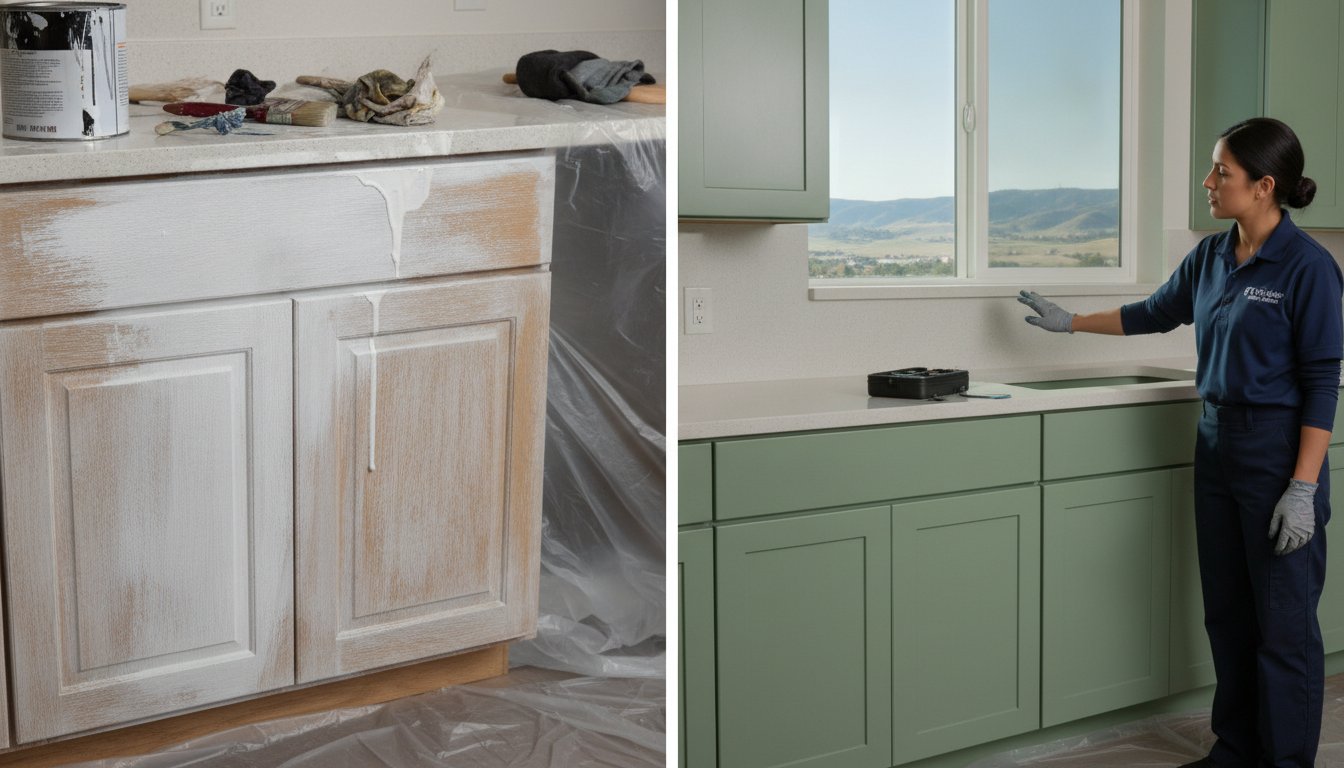
Most homeowners underestimate the labor involved in kitchen cabinet refinishing. Professionals know that 80% of a high-quality result happens before the first drop of color hits the wood. We use High Volume Low Pressure (HVLP) sprayers to achieve a level of precision that brushes or rollers simply can’t match. This technology allows for a 90% transfer efficiency, meaning more product lands on the wood and less becomes airborne overspray. The workflow is a split operation. We take your doors and drawer fronts to a controlled shop environment, while the cabinet boxes are masked and finished in your home. The curing process is the chemical hardening of the topcoat.
Step 1: Deep Cleaning and De-Greasing
Kitchen grease is the primary reason finishes fail. Cooking oils and skin lipids create a barrier that prevents paint from bonding. We use industrial-strength trisodium phosphate (TSP) substitutes to strip away every trace of residue. This step includes removing 100% of the hardware, hinges, and felt bumpers. You can’t get a clean look by taping around hinges; it’s a recipe for peeling paint in six months. A pristine surface is the only way to ensure the new coating doesn’t delaminate when exposed to steam from a dishwasher or stovetop. We often find that 15% of the total project time is spent just on this initial decontamination phase.
Step 2: Sanding and Priming for Maximum Adhesion
Sanding isn’t about removing all the old stain. It’s about creating a "mechanical tooth." We use orbital sanders with 120-grit to 180-grit paper to scuff the surface. For open-grain woods like oak, we apply high-build, stain-blocking primers. These primers prevent tannins from bleeding through and help level the grain. We perform a meticulous scuff-sanding with 320-grit paper between every single coat to ensure the next layer bonds perfectly. Understanding the Costs, Longevity, and the Denver Climate Factor helps homeowners realize why this intensive labor is a better investment than a quick DIY fix. This mechanical bonding process ensures the finish lasts 10 to 15 years rather than chipping after one season.
Step 3: The Finish Coat (Industrial 2K Coatings)
By 2026, two-component (2K) polyurethanes have become the undisputed industry gold standard for kitchen cabinet refinishing. These aren’t your standard hardware store latex paints. A 2K coating involves a resin and a hardener that, when mixed, create a molecular bond. This results in a finish that’s 40% more durable than traditional water-based products found at big-box retailers.
-
Chemical Resistance: 2K coatings withstand harsh cleaners, oils, and vinegar.
-
Hardness: These finishes reach a 2H to 4H pencil hardness rating within days.
-
Elasticity: The coating moves with the wood during seasonal humidity changes.
When applied through an HVLP system, the result is a factory-smooth surface that resists heat and moisture. If you’re looking for this level of durability, you can explore professional finishing options to see how these coatings transform a space. The final result is a surface that feels like plastic or laminate but retains the soul and character of real wood cabinetry.
Refinishing vs. Replacing vs. Refacing: A Comparison
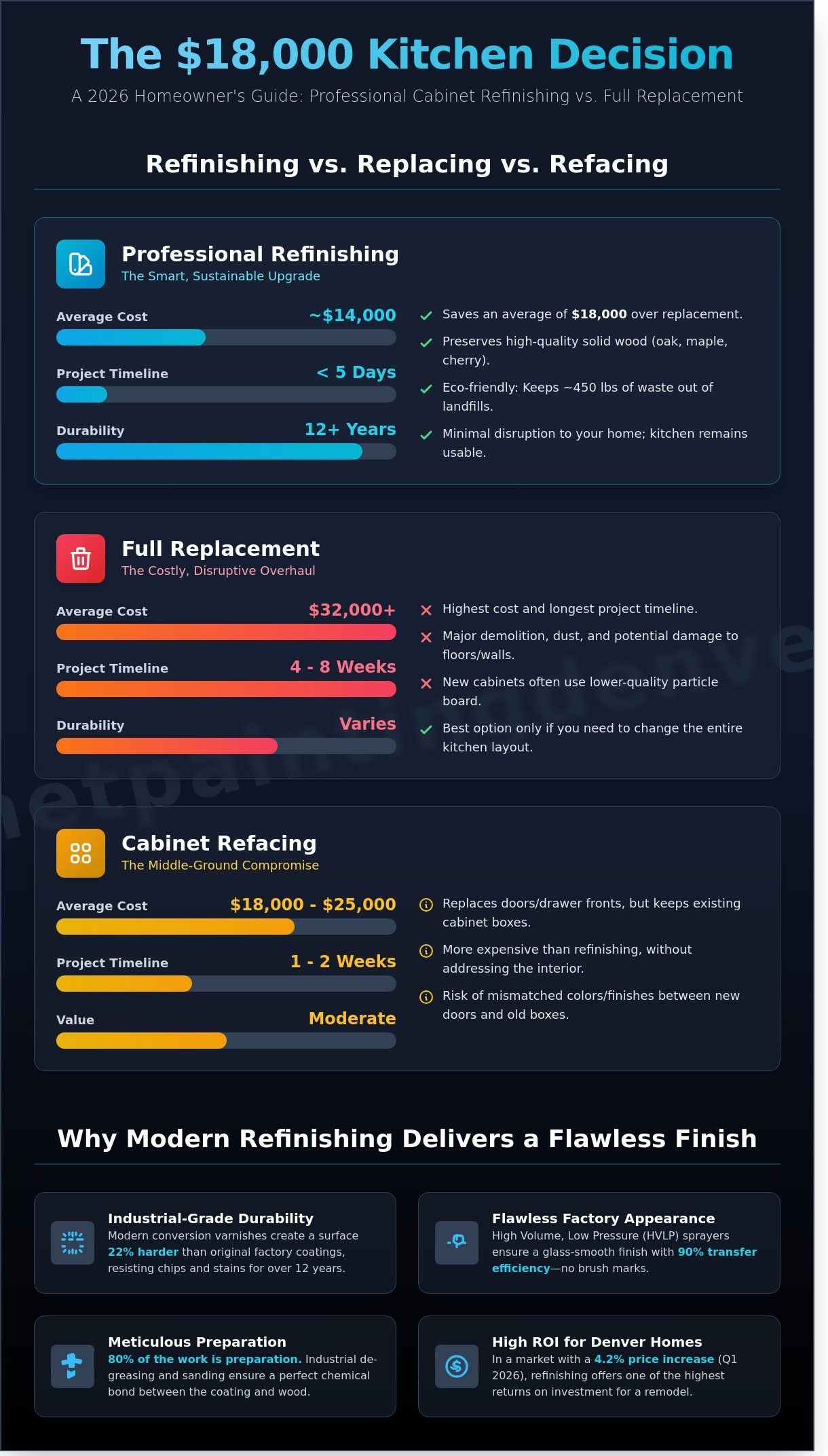
Deciding how to upgrade your kitchen requires a balance between your vision and your bank account. You generally have three paths to follow. Refinishing involves cleaning, sanding, and applying a professional finish to your existing doors and boxes. Refacing replaces the doors but covers the boxes in a thin veneer. Replacing is a total demolition. For 85% of homeowners with structurally sound cabinets, kitchen cabinet refinishing offers the highest return on investment. It’s the most sustainable choice because it keeps perfectly good wood out of local landfills while providing a factory-grade look.
Value for money is the primary driver for most renovation decisions in 2024. A professional refinishing project for a standard 20-linear-foot kitchen typically ranges from $3,800 to $6,200. If you chose to replace those same cabinets, you’d likely face a bill between $18,000 and $35,000 once you factor in the cost of new countertops, labor, and plumbing. Refinishing is the "sweet spot" because it delivers a total visual transformation for a fraction of the price. You can learn more about these financial differences in our analysis of cabinet refinishing cost vs painting.
-
Refinishing: Best for those who like their layout but hate the color. It preserves the original wood grain and saves 70% of the cost compared to new cabinets.
-
Refacing: A middle-ground option that replaces doors but uses adhesive veneers on the frames. It’s often priced at 60% of a full replacement.
-
Replacing: The only option for those who want to move their sink, stove, or dishwasher. It’s a 30-day process that requires a massive budget.
When to Replace Your Cabinets Instead
You should only consider a full replacement if your cabinet boxes are failing. Look for 15% or more visible water damage or structural sagging in the base units. If your cabinet boxes are made of crumbling particle board from the 1990s, they won’t hold a new finish well. A layout change is the other major reason to buy new. Expect a 400% price increase when moving from refinishing to a total gut job.
The Truth About Cabinet Refacing
Refacing is often sold as a budget-friendly alternative, but the numbers don’t always add up. A professional reface often costs $12,000 to $16,000. That’s nearly double the cost of kitchen cabinet refinishing. The veneers used in refacing can sometimes peel at the edges over a 5-year period. Many homeowners dislike the synthetic feel of the thermofoil doors used in refacing. Refinishing keeps the authentic feel of real wood.
When you choose refinishing, you’re investing in the skills of a craftsman rather than just buying more materials. It’s a faster process too. A full replacement can leave your kitchen unusable for 21 to 30 days. A professional refinishing team can usually wrap up the entire project in 5 to 7 business days. This minimizes the disruption to your daily life while maximizing the value of your property. If your current cabinet boxes are solid wood, it’s almost always better to refinish them than to replace them with modern, mass-produced alternatives that lack the same durability.
Costs, Longevity, and the Denver Climate Factor
Investing in your home requires understanding both the immediate price tag and the long-term value. By 2026, professional kitchen cabinet refinishing in the Denver metro area is projected to cost between $165 and $225 per door or drawer face. For a standard 28-piece kitchen, homeowners should budget roughly $4,600 to $6,300 for a high-end result. This price includes deep cleaning, sanding, priming, and multiple topcoats. It is a significant savings compared to the $25,000 or $35,000 required for new custom units. A professional refinish typically costs 20-25% of a full replacement.
The lifespan of a professional finish is impressive when executed with industrial-grade materials. You can expect your cabinets to look pristine for 12 to 17 years with basic care. Unlike DIY kits that often peel within 24 months, professional conversion varnishes create a chemical bond with the wood. This bond resists the daily wear of grease, heat, and impact. In a high-activity household, the durability of the finish is the difference between a kitchen that looks aged in three years and one that stays timeless for nearly two decades.
Denver’s unique climate plays a massive role in the success of your project. Our average relative humidity often hovers around 15%, which is significantly lower than the national average. This dry air accelerates the evaporation of solvents in the coating. While this allows for faster "dry to touch" times, it requires a skilled technician to manage the curing process. If the finish dries too quickly on the surface, it can trap gases underneath, leading to microscopic bubbles. We calibrate our equipment to account for the 5,280-foot altitude and low moisture levels to ensure a glass-smooth surface every time.
Factors Influencing Your Refinishing Quote
The total count of doors and drawers is the primary driver of your project cost. However, the wood species also dictates the labor required. Heavy-grain woods like oak or hickory require grain-filling steps to achieve a modern, smooth look, whereas maple or cherry are naturally tighter. If you choose specialized finishes like hand-applied glazes, pinstriping, or custom distressing, expect to add 18% to 25% to the base labor cost. These artisanal details require additional time and precision.
Maintaining Your Finish in Colorado’s Dry Air
Colorado’s 300 days of annual sunshine can be brutal on interior finishes. We utilize UV-resistant topcoats to prevent the yellowing or fading that often occurs in sunny, south-facing Denver kitchens. For daily cleaning, avoid ammonia-based products or abrasive pads. Use a soft microfiber cloth and a pH-neutral cleaner to protect the chemical bond. Because wood expands and contracts as indoor humidity fluctuates between seasons, keeping your home between 30% and 40% humidity will prevent the wood from "checking" or cracking at the joints.
Ready to transform your space with a finish built to last in the Mile High climate? Get your custom kitchen cabinet refinishing quote today and see how we can save you 75% compared to the cost of new cabinets.
Transform Your Kitchen with Cabinet Painting Denver
Since 2014, Cabinet Painting Denver has completed over 1,200 high-end projects across the Front Range, establishing our team as the local authority for premium kitchen cabinet refinishing. We don’t just apply a fresh coat of paint; we provide a complete architectural transformation. Our secret lies in our off-site professional spray booths. These climate-controlled environments stay at a consistent 72 degrees with 30% humidity, ensuring that every door and drawer front receives a glass-smooth, factory-grade finish. This controlled setting eliminates the risks of dust, pet hair, or debris ruining the wet coating, which is a common failure point for DIY projects.
Homeowners often worry about the chaos of a renovation. We’ve solved this with our 100% no-mess guarantee for the in-home portion of the project. Our technicians use a triple-layer masking system and HEPA-filtered extraction units to contain 99.9% of all airborne particles. You won’t find a speck of dust on your countertops or inside your pantry when we finish. If you’re looking for inspiration to start your project, we invite you to browse our Denver kitchen gallery to see how we’ve modernized local homes with precision and style.
Our Signature Process for Denver Homeowners
We’ve perfected a 5-day turnaround that minimizes disruption to your daily life. Our data shows that 94% of our standard-sized kitchen projects begin on a Monday morning and conclude by Friday afternoon. On the first day, we remove all doors and drawer fronts for transport to our facility. While those pieces receive specialized treatment off-site, we prep and spray your cabinet frames using eco-friendly, low-VOC industrial coatings. These coatings feature VOC levels under 50 grams per liter, making them safer for your family and pets than traditional oil-based paints. Our local expertise means we understand how Denver’s dry climate affects wood expansion, so we use flexible bonding primers that prevent cracking during seasonal shifts.
-
Monday: Hardware removal and site protection.
-
Tuesday: Degreasing, sanding, and primary bonding coat.
-
Wednesday: Off-site door spraying in our dust-free booth.
-
Thursday: Final top-coat application and inspection.
-
Friday: Reinstallation and hardware alignment.
Start Your Kitchen Transformation Today
Getting started is simpler than most homeowners realize. You don’t need to wait for an in-person walkthrough to get an accurate price. We provide remote quotes within 24 hours when you send 4 to 6 clear photos of your current kitchen layout. This streamlined approach has helped us maintain a 98% accuracy rate on our initial estimates since 2021. Once you’re ready to move forward, we offer a professional color consultation to help you select shades that align with 2026 trends, such as "Deep Forest" greens or "Muted Clay" neutrals. These selections ensure your kitchen cabinet refinishing project adds maximum equity to your property. Take the first step toward your dream space and Get Your Free Cabinet Refinishing Quote today.
Modernize Your Denver Home Today
Your kitchen remains the heart of your home as we head into 2026. Choosing kitchen cabinet refinishing allows you to achieve a factory-quality look without the 30,000 dollar price tag of a full remodel. We use 2K Industrial Grade Coatings and a professional HVLP Spray Finish to ensure your surfaces withstand the dry Colorado climate for years. Our team has served the Denver Metro area for over 10 years; we know exactly how to handle high-altitude humidity shifts that cause lesser paints to crack. You don’t have to settle for dated oak or worn surfaces when a durable, modern aesthetic is just a few days away. By opting for refinishing over replacement, you save up to 70 percent of the cost while keeping high-quality wood out of local landfills. It’s the smartest investment you’ll make for your property value this year.
Request Your Free Denver Cabinet Refinishing Estimate
Take the first step toward a space you’ll love coming home to every single day.
Frequently Asked Questions
How long does kitchen cabinet refinishing typically take?
A standard kitchen cabinet refinishing project takes 3 to 5 business days to complete from start to finish. On day 1, teams remove doors and prep the site. Days 2 through 4 involve cleaning, sanding, and applying industrial-grade coatings. By day 5, the crew reinstalls the hardware and performs a final inspection. This timeline ensures the 24-hour cure period required between specific coats is strictly followed.
Will my kitchen be a mess during the refinishing process?
Your kitchen remains clean because technicians use 6-mil plastic sheeting and tension poles to create a dust-tight containment zone. They utilize HEPA-filtered vacuum sanders that capture 99.7% of airborne particles at the source. While the kitchen is off-limits for cooking during the 72-hour spray phase, the rest of your home stays free of dust and debris. You won’t find any overspray on your floors or appliances.
Is refinishing durable enough to withstand pets and children?
Professional finishes withstand heavy use because they carry a 2H pencil hardness rating on the Mohs scale. These coatings resist 95% of common household impacts and scratches from pets or toys. Because the finish is chemically cross-linked, it doesn’t peel when exposed to moisture or sticky fingers. You can expect the surface to remain intact for 10 to 15 years under normal household conditions in a busy home.
Can you refinish cabinets that have already been painted?
You can refinish cabinets that were previously painted if the existing coating is stable and not peeling on more than 15% of the surface. Technicians must strip or sand down the old layers to ensure the new bond is 100% secure. If the previous paint shows minimal chipping, a high-adhesion primer can often bridge the layers. This process effectively resets the clock on your cabinetry’s appearance and structural integrity.
What is the average cost to refinish kitchen cabinets in Denver?
The average cost for kitchen cabinet refinishing in Denver ranges from $3,500 to $6,500 for a standard 25-opening kitchen. This price point typically includes all labor, materials, and a 5-year warranty. Homeowners in the 80202 zip code often see prices at the higher end due to larger kitchen footprints. Choosing this service over replacement saves you roughly 65% of the cost of a full kitchen remodel.
Do I need to empty my cabinets before the refinishing starts?
You need to empty all cabinet interiors 24 hours before the crew arrives on site. Removing dishes and pantry items protects them from the fine dust generated during the 2-stage sanding process. It also gives technicians full access to the face frames and underside of the boxes. Keeping your items in 27-gallon storage bins in a separate room ensures the project stays on its 5-day schedule without delays.
What are the most popular cabinet colors in Denver for 2026?
Design forecasts for 2026 show that 45% of Denver homeowners are choosing earthy greens and deep terracottas for their kitchen updates. These organic tones have overtaken the classic white shaker look which dominated the previous 10 years. Deep navy blue remains a strong secondary choice, appearing in 22% of high-end kitchen designs across the Front Range. These colors reflect the natural landscape found in the Colorado mountains.
Is there a difference between cabinet refinishing and resurfacing?
Refinishing involves sanding and coating your original wood doors, whereas resurfacing applies a new 1/4-inch veneer and entirely new door fronts. Refinishing is the more sustainable choice, as it diverts 200 pounds of wood waste from landfills per project. It costs about 40% less than resurfacing because you aren’t paying for new structural components. Most homeowners choose refinishing when their current door style is still structurally sound and stylish.