The longevity of painted cabinets is determined in the first 48 hours of preparation, not the years that follow. Many homeowners ask how long do painted cabinets last before they commit to a renovation, fearing that a fresh coat of paint will quickly peel or chip under the daily stress of kitchen grease and heat. It’s a valid concern. When cabinets are treated like a standard wall painting project, the finish often fails in under 24 months. You deserve an investment that stands up to high-traffic use and remains easy to clean.
This guide explains why professional refinishing with industrial-grade coatings provides a durable, factory-quality finish that lasts 10 to 15 years or more. We’ll break down the technical differences between DIY methods and professional HVLP spraying. You will learn about the science of chemical bonding and receive a straightforward maintenance plan to protect your kitchen’s aesthetic for over a decade. By understanding the procedural requirements of a professional finish, you can ensure your cabinets remain a functional and beautiful centerpiece of your home for years to come.
Key Takeaways
- Learn how long do painted cabinets last when using professional industrial-grade coatings, which provide a reliable lifespan of 8 to 15 years.
- Professional HVLP spraying produces a factory-quality finish that resists the chipping and peeling common in DIY applications.
- Long-term durability depends on thorough degreasing and off-site spraying to ensure a permanent chemical bond.
- Proper maintenance and gentle handling during the initial curing period are required to maximize the lifespan of the finish.
- Professional refinishing provides a decade of durability, whereas hardware-store paints often fail within 24 months.
The Realistic Lifespan of Professionally Painted Cabinets
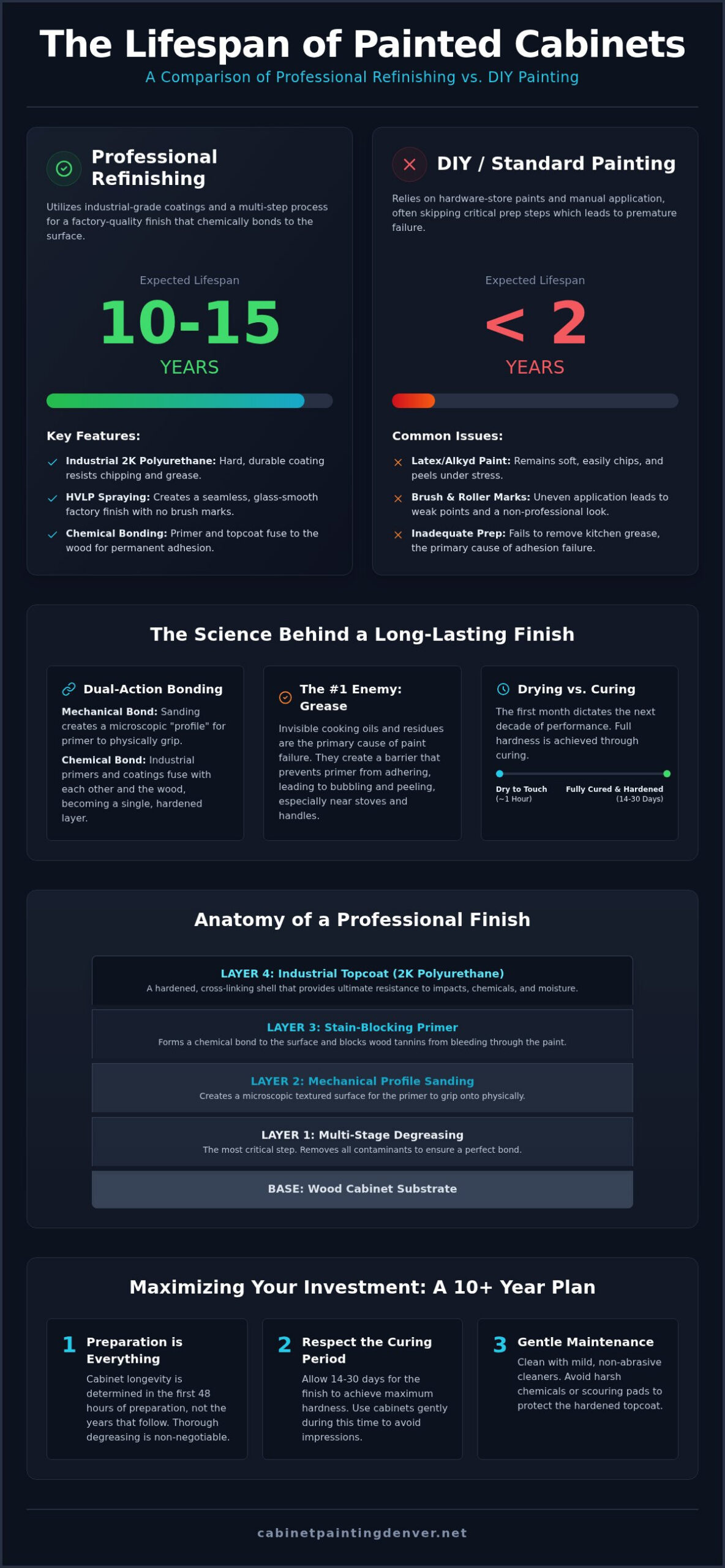
Professionally painted cabinets are designed to endure for 8 to 15 years. While a standard wall painting project might last five years before needing a refresh, cabinetry requires a higher standard of durability. A professional finish is not just a layer of color; it’s a hardened shell that chemically bonds to the wood surface. Understanding how long do painted cabinets last requires looking at the technical quality of the application rather than just the brand of paint. A high-quality job often rivals the longevity of original factory-finished cabinetry, which typically lasts 15 to 20 years before showing structural wear.
The 10-Year Benchmark: What to Expect
A ten-year lifespan is the standard benchmark for professional work. In this context, “failure” doesn’t mean the color has faded. It refers to a loss of adhesion where the coating chips or peels away from the substrate. Professional HVLP spraying creates a seamless “envelope” around every door and drawer front. This barrier prevents moisture from reaching the wood, which is the primary cause of warping and finish failure. High-traffic areas, such as trash pull-outs and sink bases, naturally experience more friction. These specific zones might require a minor touch-up after a decade, but the overall system should remain intact.
Paint vs. Refinishing: Clarifying the Terminology
The terms “painting” and “refinishing” represent different levels of protection. Refinishing implies a multi-step industrial process that includes deep cleaning, degreasing, and the application of high-performance coatings like 2K polyurethanes. You can find more details in our Cabinet Refinishing: The Ultimate Guide to Revitalizing Your Kitchen. The science of paint formulation explains how binders and resins determine the final film hardness. While consumer latex paint remains soft and flexible, professional-grade lacquers cure into a rigid, glass-like surface. This hardness prevents kitchen grease from softening the finish over time.
Signs of a job built for longevity include a perfectly smooth texture and a finish that feels cold to the touch. This temperature difference indicates a high-density coating. Longevity is a measure of adhesion and film hardness, not just color retention. If the surface feels sticky or shows brush marks, it likely won’t survive the five-year mark. Professional Kitchen Cabinet Painting focuses on these technical details to ensure the finish remains durable through years of heavy use.
The Science of Durability: Why Some Finishes Fail
The primary factor in how long do painted cabinets last is the quality of the bond between the coating and the wood. Mechanical bonding relies on sanding to create a “profile,” providing microscopic teeth for the primer to grip. Chemical bonding occurs when the molecules of the primer and topcoat fuse together during the drying process. Professional refinishing utilizes both methods to ensure the finish doesn’t just sit on the surface but becomes part of the substrate. Without this dual-action bonding, even the most expensive paint will eventually delaminate.
Kitchen oils are the primary enemy of paint longevity. Even invisible residues from cooking grease prevent primer from adhering to the wood. This is why professional Bathroom Cabinet Painting and kitchen projects require a multi-stage degreasing process. If this step is rushed, the finish will eventually bubble or peel, particularly in high-heat areas like the space above a stove. To maintain the surface after a professional application, you should learn how to properly care for painted cabinets using non-abrasive cleaners.
There’s a critical difference between drying and curing. A cabinet might feel dry to the touch in an hour, but it hasn’t reached its maximum hardness. Curing is a chemical process that can take 14 to 30 days depending on local humidity. During this window, the finish is susceptible to impressions and chemicals. Understanding how long do painted cabinets last requires recognizing that the first month of use dictates the next decade of performance. If you’re considering a project, you can consult with our team to understand the timeline required for your specific layout.
The Anatomy of a Long-Lasting Finish
Stain-blocking primers are essential for preventing “tannin bleed,” where natural oils in woods like oak seep through the paint years later. Industrial-grade topcoats are formulated for impact resistance, meaning they won’t crack when struck by kitchenware. Cross-linking is the chemical process that creates a lattice-like molecular structure, turning the liquid coating into a rock-hard, durable shield. This molecular density is what separates professional industrial coatings from standard hardware-store enamels.
Common Failure Points in Low-Quality Jobs
Failure usually begins at the edges or near handles where hand oils accumulate. Inadequate cleaning is the most common culprit for premature peeling. Skipping the primer is another fatal error; topcoats are designed for color and protection, not for bonding to old, slick varnish. Environmental contamination also plays a role. If a project isn’t done in a controlled environment, dust and hair become trapped in the wet film. These contaminants create microscopic weak points where moisture can enter and begin the delamination process.
External Factors That Impact Cabinet Longevity
Environmental stressors dictate how long do painted cabinets last once the initial curing process is complete. While industrial coatings provide a hardened shell, the kitchen remains a high-traffic environment with fluctuating temperatures and humidity levels. Steam from dishwashers or kettles can soften finishes over time if the area isn’t properly ventilated. Similarly, direct UV sunlight from windows can cause certain pigments to shift or resins to become brittle. Consistent exposure to temperatures exceeding 140 degrees Fahrenheit near ovens can also compromise the chemical bond of the coating if heat shields aren’t utilized.
Chemical degradation from cleaning agents is another significant factor in finish failure. Harsh household cleaners containing ammonia, bleach, or abrasive scouring pads strip the protective topcoat. This exposure leaves the underlying paint vulnerable to moisture and stains. For those maintaining Bookshelves cabinet painting or kitchen units, using pH-neutral soaps is required to preserve the film’s integrity. When the topcoat is compromised, the lifespan of the project drops from a decade to just a few years.
Daily Wear and Tear in the Modern Kitchen
Mechanical friction is a constant threat to cabinetry longevity. Finger oils are naturally acidic and can slowly break down the resins in a finish if they accumulate around handles. Acidic food spills, such as lemon juice or vinegar, can etch the surface if you don’t wipe them away immediately. The choice of hardware also plays a role; larger handles prevent fingernails from scratching the cabinet face during daily use. Installing soft-close hinges is a functional requirement for long-term durability because it eliminates the high-impact vibrations that cause hairline cracks in the finish over time.
The Role of Substrate and Wood Grain
The material beneath the paint significantly influences the final lifespan of the finish. Oak is a porous wood with a prominent grain that expands and contracts with seasonal humidity changes. This movement can lead to “bridge cracking” at the joints of the cabinet doors. In contrast, Maple and MDF provide a more stable, non-porous surface that maintains a factory-quality look for a longer duration. For a deeper look at material selection, see our Kitchen Cabinet Painting: The Ultimate Guide for Homeowners. Selecting a stable substrate ensures the coating remains intact regardless of local climate shifts.
Professional Spraying vs. DIY: A Lifespan Comparison
The technical gap between a homeowner project and a professional refinishing service becomes visible around the 24-month mark. This period is often referred to as the “DIY Wall,” where standard consumer paints begin to delaminate. When homeowners ask how long do painted cabinets last, they are often comparing a weekend project to a professional result. Data indicates that over 70% of DIY cabinet projects show significant chipping or staining within two years. In contrast, professional HVLP (High Volume Low Pressure) spraying creates a factory-quality bond that resists impact and friction for a decade or more.
Professional tooling is the primary differentiator for longevity. A $3,000 HVLP system atomizes the coating into fine droplets, allowing for a thinner, harder film than a brush or roller can achieve. Brushing often leaves thick layers of paint that remain soft on the inside, making them prone to dents and deep scratches. Additionally, professional off-site spraying for doors and drawers ensures a sterile environment. This prevents dust and hair from being trapped in the wet finish, which creates microscopic weak points. If you want to ensure your kitchen receives this level of technical precision, you can schedule a consultation with our specialists.
Why DIY Finishes Often Chip Early
DIY finishes frequently suffer from “film build” issues. When paint is applied too thick with a brush, it fails to cure properly. This results in a finish that feels “gummy” or “tacky” even weeks after application. Environmental control is also impossible in a residential kitchen. Airborne particles settle on the surface during the drying phase, compromising the topcoat’s integrity. Understanding how long do painted cabinets last requires looking at the equipment used; without industrial-grade sprayers and controlled booths, achieving a permanent bond is statistically unlikely.
The Denver Market: Local Factors in 2026
Denver’s high-altitude climate offers a unique advantage for cabinet longevity. The region’s low humidity levels prevent the “tackiness” often found in humid-climate paint jobs, allowing for a more efficient curing process. This dry air helps the chemical cross-linking process occur uniformly across the surface, resulting in a harder final film. When reviewing a professional Denver cabinet painting quote, verify that the provider uses industrial coatings suited for Colorado’s specific atmospheric conditions. For a comprehensive overview of local standards, read our Cabinet Painting Denver: Your Ultimate Guide to a Flawless Finish. Proper regional expertise ensures the coating withstands both the dry climate and daily kitchen use.
Maximizing Your Investment: Maintenance and ROI
Professional refinishing is a significant home improvement, but owner habits ultimately dictate the final timeline. While the technical application provides the durability, daily interaction determines how long do painted cabinets last in a functional environment. A professional finish that receives proper care can easily exceed the 10-year mark without requiring a full repaint. In the Denver real estate market, a high-quality cabinet finish is a requirement for maintaining property value. Buyers in 2026 prioritize updated, move-in ready kitchens over those requiring a full tear-out and replacement.
Knowing when to request a touch-up rather than a full service is key to maximizing your ROI. Small chips near the dishwasher or high-use handles should be addressed immediately. If the underlying wood is exposed to moisture, it can cause the surrounding film to lift and delaminate. A targeted professional touch-up preserves the integrity of the original coating envelope. This proactive approach prevents the need for a more expensive intervention and keeps the aesthetic consistent across the entire kitchen.
The Homeowner’s Maintenance Checklist
Proper maintenance requires the right tools and cleaning agents to avoid degrading the topcoat. Modern industrial coatings are chemical-resistant, but they aren’t invincible. Use the following guidelines to preserve your finish:
- Approved Cleaning Agents: Use mild dish soap and warm water for daily wipes. Avoid “orange” or citrus-based cleaners, as the acidity can eventually soften the finish.
- Microfiber Cloths: Use microfiber instead of paper towels. Paper towels are surprisingly abrasive and can create micro-scratches that dull the sheen over several years.
- Dry Immediately: Don’t allow water to sit on the edges of doors or in the grooves of shaker-style cabinets. Moisture is the primary cause of finish failure at the joints.
Final Verdict: Is It Worth the Cost?
When evaluating how long do painted cabinets last, the financial comparison to replacement is stark. A full kitchen cabinet replacement for a standard home often exceeds $30,000. Professional painting provides a similar aesthetic result for a fraction of that investment. If the finish lasts 10 to 15 years, the annual cost of the upgrade is negligible compared to the immediate equity boost. You can view more details on budgeting in our Cabinet Painting Cost: A Full 2026 Price Breakdown.
There’s also a significant environmental advantage to refinishing. By utilizing your existing high-quality wood boxes and only updating the surface, you prevent thousands of pounds of cabinetry from entering local landfills. This sustainable approach to renovation is increasingly valued by modern homeowners who want a luxury look without the waste of a total demolition.
Securing a Decade of Durability for Your Kitchen
Choosing a professional finish transforms your kitchen from a temporary aesthetic update into a long-term investment. While DIY methods often fail within two years, understanding how long do painted cabinets last reveals that industrial coatings applied via HVLP spraying provide a functional lifespan of 10 to 15 years. This longevity is achieved through a comprehensive 5-step preparation process that ensures maximum adhesion and a factory-quality surface.
By prioritizing industrial-grade materials and controlled off-site spraying, you eliminate the risks of peeling and chipping common with standard paints. Our team has been serving the Denver Metro area since 2026, delivering a professional factory-grade sprayed finish that stands up to daily use and local climate conditions. We prioritize procedural clarity and technical precision in every project to ensure your results meet industrial standards.
If you’re ready to revitalize your space with a finish built to last, Get Your Free Cabinet Painting Quote in Denver. We look forward to providing the expertise required to protect and enhance your home for years to come.
Frequently Asked Questions
How long do professionally painted cabinets last compared to DIY?
Professionally refinished cabinets typically last between 8 and 15 years, while DIY projects using hardware-store paints often show failure within 12 to 24 months. The difference lies in the industrial-grade coatings and the HVLP spraying process used by experts. Professional Kitchen Cabinet Painting involves off-site spraying in controlled environments, ensuring a factory-quality bond that resists chipping. DIY methods usually lack the high-performance resins required to withstand the heat and grease of a modern kitchen environment.
Will my painted cabinets chip easily if I have kids or pets?
Industrial-grade 2K polyurethane coatings are specifically formulated to resist high-impact friction from children and pets. These professional finishes are significantly harder than standard household paints and resist scratches from fingernails or toys. While no finish is indestructible, the chemical cross-linking in professional coatings creates a rigid shield. This durability ensures that your investment remains intact even in high-traffic households where daily contact with cabinet surfaces is frequent.
How long does it take for the paint to fully cure and harden?
A professional finish requires 2 to 4 weeks to reach its maximum hardness and chemical resistance. While the cabinets are dry to the touch within hours, the internal chemical curing process takes longer. During this first month, you should handle the doors gently and avoid using any cleaning chemicals. Denver’s low humidity levels aid this process by allowing solvents to evaporate more efficiently, resulting in a more uniform and durable final film.
Can you paint cabinets that have already been painted once?
Yes, cabinets that have been previously painted can be refinished if the existing coating is structurally sound. The process involves removing any failing or peeling paint and using specialized bonding primers to ensure the new layer adheres correctly. If the previous job was a low-quality DIY attempt, a more intensive sanding or stripping process may be required to create a stable substrate. This ensures the new finish provides the expected 10-year lifespan.
What is the best way to clean painted cabinets to make them last?
The most effective cleaning method is using a soft microfiber cloth with a solution of mild dish soap and warm water. Avoid using abrasive scouring pads or cleaners containing ammonia, bleach, or citrus oils, as these chemicals can degrade the protective topcoat over time. Drying the surfaces immediately after cleaning prevents moisture from seeping into the joints. Consistent, gentle maintenance is the primary factor in determining how long do painted cabinets last in your home.
Does the type of wood affect how long the paint stays on?
Substrate choice significantly impacts the longevity and final appearance of the finish. Maple and MDF are the preferred materials because they are non-porous and remain stable during seasonal humidity shifts. Oak is also a candidate for painting, but its prominent grain requires filler for a smooth look. Because oak expands and contracts more than other woods, it can occasionally develop hairline cracks at the door joints, though the overall adhesion remains strong.
Is there a warranty for professional cabinet painting?
Warranty terms vary significantly between service providers in the Denver area. Most reputable professionals offer a limited warranty covering issues related to adhesion or application defects, such as peeling or bubbling. It’s important to review the specific terms of your contract before the project begins. These warranties typically don’t cover standard wear and tear or damage caused by improper cleaning, highlighting the importance of following the recommended maintenance plan for your new finish.
How do I know if my cabinets are too old to be painted?
Age is less important than structural integrity when deciding if cabinets are candidates for refinishing. If the cabinet boxes are made of solid wood or high-quality plywood and are still square and sturdy, they can be painted regardless of their age. However, if the wood is rotting, severely water-damaged, or the particle board is crumbling, replacement is a better option. Most cabinets from the 1980s and 1990s are excellent candidates for a professional update.